- Publication year : 2026
1~3 item / All 3 items
Displayed results
Added to bookmarks
Bookmarks listBookmark has been removed
Bookmarks listYou can't add any more bookmarks
By registering as a member, you can increase the number of bookmarks you can save and organize them with labels.
Free membership registration
Contact this company
Inquiry Form1~3 item / All 3 items

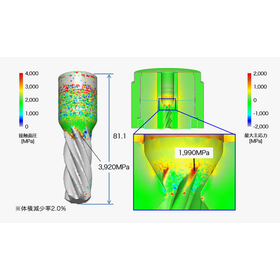
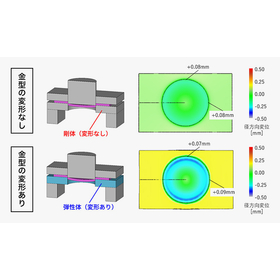
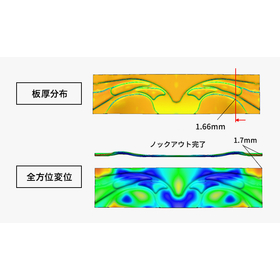
Are you struggling with additional costs and delays due to mold cracking, chipping, or excessive tool wear during press forming? Simply simulating the formability of product shapes does not adequately assess the risks on the mold side. Therefore, an effective approach is to combine this with mold load analysis using the analysis software "DEFORM." - Damage Prevention: Visualization of maximum principal stress to identify risk areas for mold cracking and chipping - Improved Lifespan: Predicting the progression of tool wear to support optimal maintenance cycles and material selection - Quality Stability: Precisely simulating variations in thickness and bending accuracy For more details, please refer to the related link.
Added to bookmarks
Bookmarks listBookmark has been removed
Bookmarks listYou can't add any more bookmarks
By registering as a member, you can increase the number of bookmarks you can save and organize them with labels.
Free membership registration
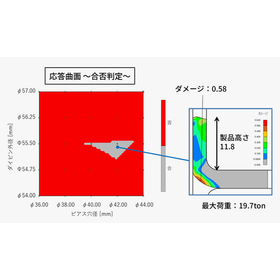
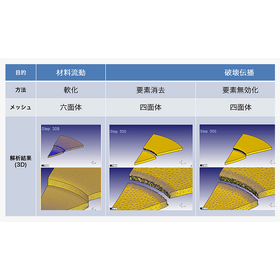
Are you facing walls that cannot be solved by the "experience and intuition" of the person in charge in process design involving breakage? - Unable to identify the starting point of cracks, leading to reactive measures - Unable to predict changes in "flanging" due to slight differences in clearance - Repeated prototyping and modifications because "you won't know until you try" Especially in precise shearing and complex plastic processing, predicting the progression of breakage and the final shape is difficult, and the uncertainty in design becomes a significant obstacle. In this article, we will reveal a practical approach to "decipher" breakage phenomena in advance using plastic processing CAE "DEFORM." By utilizing "three breakage analysis methods" that are directly linked to on-site decision-making, we will visualize the progression from the starting point of cracks to the flanging shape. We will provide detailed explanations of the recommended utilization points by Yamanaka Gokin that balance reducing prototyping and improving design accuracy. For more details, please refer to the related link.
Added to bookmarks
Bookmarks listBookmark has been removed
Bookmarks listYou can't add any more bookmarks
By registering as a member, you can increase the number of bookmarks you can save and organize them with labels.
Free membership registration
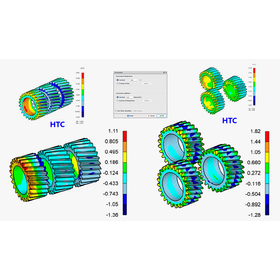
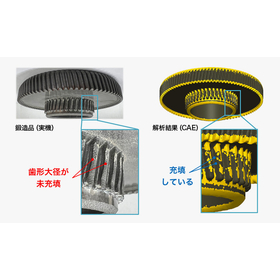
Are you facing such walls when trying to examine complex shape forging processes with CAE? - The computation time is enormous, making it difficult to cycle through PDCA. - Spending several days just to set conditions. - Ultimately, the results do not match the actual machine behavior and cannot be fully utilized. Especially for difficult shapes like two-stage helical gears, the "computation cost barrier" from 360° full model analysis becomes a significant obstacle. In this article, we will reveal the efficient analysis process utilizing "sparse gear segmented model (90°) × DEFORM" practiced by Yamanaka Gokin. First, we will use a fast segmented model to get a preliminary assessment, and then conduct full model verification in the final stage. We will provide a detailed explanation of a method that truly helps in practice, achieving a balance between computation cost and accuracy. For more details, please refer to the related links.
Added to bookmarks
Bookmarks listBookmark has been removed
Bookmarks listYou can't add any more bookmarks
By registering as a member, you can increase the number of bookmarks you can save and organize them with labels.
Free membership registration