Reducing energy and CO₂ emissions from industrial furnaces by up to 25%: How to optimize 'control waste' in heating processes and support carbon-neutral management by simply implementing advanced control that is difficult with PID.
Proxima Technology
Industrial furnaces are a major source of CO₂ emissions, accounting for about 15% of domestic emissions. Energy conservation and decarbonization have become unavoidable challenges for the manufacturing industry in terms of both cost reduction and environmental management.
**Issues**
Controlling industrial furnaces is complex. It requires precise adjustments of multiple heat sources during the heating, holding, and cooling processes, where even slight delays or deviations can lead to overheating and temperature inconsistencies. Traditional PID control struggles to flexibly respond to these complex thermodynamic changes and disturbances, resulting in accumulated structural energy losses due to "overreaction" and "delayed response."
**Solution**
In this seminar, we will introduce "Smart MPC," a model predictive control that combines machine learning and optimization technology. By utilizing past operational data, it achieves high-precision predictive control without the need for specialized tuning. The embedded controller "E-Smart MPC" allows for easy implementation with direct mounting to control panels and GUI operation.
**Implementation Results**
CO₂ and fuel reduction (up to 25%), improved control accuracy (up to 80%), and reduced setup time (up to 60%).
**Target Audience**
Production engineers, equipment managers, and site managers who want to promote energy conservation and decarbonization in thermal control equipment such as industrial furnaces and dryers.
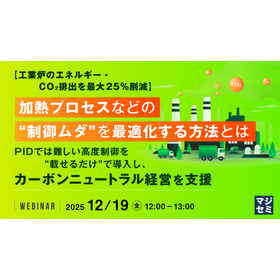
| Date and time | Friday, Dec 19, 2025 12:00 PM ~ 01:00 PM |
|---|---|
| Entry fee | Free |
Inquiry about this news
Contact Us OnlineMore Details & Registration
Details & Registration
Related catalog(1)

Distributors