[Data Published] Heating efficiency changes significantly with medium-wave infrared - A technical explanation of the essential differences between near-infrared and far-infrared.
 ライスター・テクノロジーズ
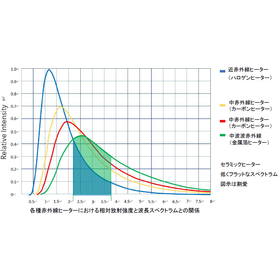
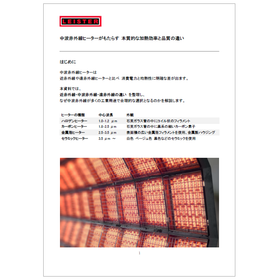
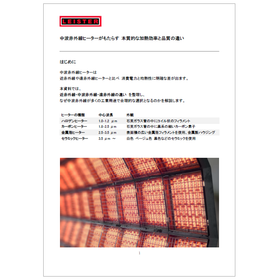
Leister offers not only plastic welding machines and hot air generators but also "mid-infrared heaters" as part of its product lineup. When selecting infrared heaters based solely on "output," it can lead to unexpected power loss and quality issues. The key factor is the compatibility of materials and wavelengths. Many industrial materials such as resins, paper, wood, and water have been confirmed to have high absorption efficiency in the mid-wave infrared range. On the other hand, near-infrared has a fast response time but is peakier, while far-infrared has a broad range but a slow response time, making it prone to energy loss due to continuous power supply. In actual comparative tests, it has been reported that the power consumption can differ by about twice to achieve the same heating results. This affects not only electricity costs but also heating time, equipment capacity, and finished quality. This document organizes the differences between near-infrared, mid-wave, and far-infrared, and technically explains why the 2.6μm mid-wave infrared heater is a rational choice for many industrial applications. If you want to reconsider your heater selection, please refer to the technical materials and the product pages for infrared heaters.
Inquiry about this news
Contact Us OnlineMore Details & Registration
Details & Registration
Related Documents
Related Links
We have listed various infrared heater product lineups.
We are introducing the drying process, embossing process, and others.
Related product


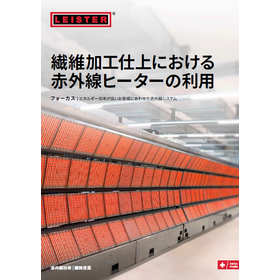


Related catalog(4)


![Heat molding using infrared heaters - Is a 50% reduction in power consumption possible? [Energy Saving]](https://image.mono.ipros.com/public/catalog/image/01/a36/807976/IPROS10615500655088204824.jpeg?w=120&h=170)
Distributors