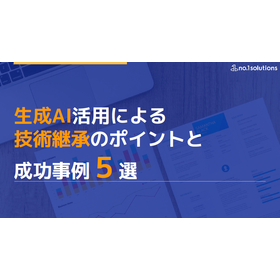
What are the solutions to the "crisis of skill inheritance in the manufacturing industry" using local LLMs?
Visualization of Tacit Knowledge with Local LLMs and How to Create a "Non-Stopping Factory"

"Why do traditional manuals fail?" A document summarizing the three barriers that hinder tacit knowledge and successful examples of utilizing local LLMs for manufacturing sites will be provided.
The retirement of veterans and the shortage of human resources are no longer just issues of on-site training. The Ministry of Economy, Trade and Industry warns that the "2025 cliff" could lead to an annual economic loss of up to 12 trillion yen in Japan due to delays in digital transformation (DX). Particularly in the manufacturing sector, failures in technology transfer directly connect to BCP risks that threaten the survival of companies in the form of "increased quality costs," "operational stoppages," and "opportunity losses." This white paper explains how to utilize a "site-specific local LLM" to digitize the wisdom of skilled workers while protecting on-site confidential information. It summarizes specific measures to transform technology transfer from a "cost" to an "investment" in order to secure competitiveness. [White Paper Table of Contents] 01 The Crisis of Skill Transfer and the Nature of Economic Loss 02 Solutions: Site-Specific "Local LLM" 03 Economic Rationality: Cost Structure That Does Not Hinder Utilization 04 Practice: Specific Use Cases That Change the Field 05 Implementation Steps and Checklist *For more details, please download the PDF document or feel free to contact us.
Inquire About This Product
basic information
**Purpose of this White Paper** ■ Transplanting "Judgment" What is lost with the retirement of veterans is not "knowledge," but the "judgment" on the ground. We will explain methods to transplant tacit knowledge into AI and transform it into organizational assets. ■ Breaking the "Dual Walls" "Technology leakage" and "increased costs." We will present how local LLMs can solve the dual challenges of security and cost. ■ Practical Acceleration of DX The field will "fully utilize" AI. We will provide a concrete roadmap towards a "self-regulating factory" where skills are continuously inherited autonomously. *For more details, please download the PDF or feel free to contact us.*
Price range
Delivery Time
Applications/Examples of results
**Case 1: "High-Speed Navigator" for Trouble Recovery** Challenge: When a problem occurred, it was difficult to identify the cause without consulting a specific veteran employee, leading to longer recovery times (MTTR). Solution: An AI learned from a vast amount of past response records. Young employees can simply input error codes in a chat, and the AI provides suitable solutions instantly. ▼ Example Interaction Young Employee: "Error E-203 has occurred. What should I do?" AI: "In a similar case two years ago, the cause was 'sensor dirt.' Please try cleaning the area at location XX first." Results: Reduced recovery time (MTTR) by an average of 60%. **Case 2: Digitizing the "Tips" of Skilled Workers** Challenge: Sensory techniques such as "force adjustment" and "changes in sound" used by skilled workers could not be verbalized, making it difficult to pass on knowledge to younger employees. Solution: AI analyzed videos of veteran workers and automatically extracted and explained key points. - Knowledge of Movement: The AI identified scenes in the footage that highlight "the key points" and converted them into easily viewable videos with chapters. - On-Demand Instruction: Even in the absence of instructors, young employees can check "examples" and "professional explanations" anytime with just a tablet. Results: Reduced the time for young employees to become independent by 33%.
catalog(1)
Download All Catalogs
Company information

Our company is an IT firm established in 2002, located in Meguro, Tokyo. Currently, we are engaged in AI solutions, system development, and education businesses.