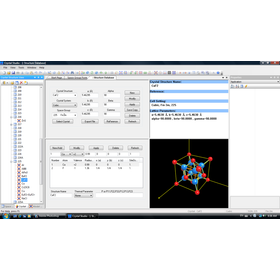
Modeling and analysis of crystal structures.
Crystal Studio is a Windows-based crystallographic analysis software that supports research and education in the fields of materials science, solid-state physics, mineralogy, geology, X-ray crystallography, and electron microscopy. It is a powerful tool equipped with highly user-friendly model creation tools, 3D graphical design, display, and manipulation features, as well as a simulation engine for diffraction patterns. Ideal for research and education in crystallography It is extremely powerful and fast, yet very simple to operate. With just a few clicks of the mouse, you can create highly attractive colors and 3D realism for crystallographic structures. Available according to the level of crystallography knowledge With even a little knowledge of crystallography, you can quickly become an expert. You can study atomic arrangements and material structures, as well as discover relationships that characterize their properties. For advanced researchers in crystallography, various means are provided to customize crystal structures. Advanced users can also modify space group specifications and create new ones, allowing for experiments that change the symmetry of the unit cell.
Inquire About This Product
basic information
Photorealistic high-resolution 3D graphics can be created with captivating colors and 3D realism. You can finely adjust lighting effects, unlimited color specifications, and material attributes. The created 3D graphics can be saved in Windows bitmap format or JPEG files, as well as in various applications such as Adobe PhotoShop as JPEG, PNG, BMP, PSD, and TIFF files. Database Functionality Crystal Studio is integrated with a crystallographic database. It includes information on the specifications of all 530 types of space groups contained in each version of the International Tables for (X-Ray) Crystallography, as well as information on atomic valence and radius for all elements of the periodic table, the latest data for atomic scattering amplitudes, and information on the Debye-Waller factor used in diffraction calculations.
Price information
Please feel free to contact us.
Delivery Time
Applications/Examples of results
- Simple mouse operations - Nanotubes and nanocones You can create carbon (boron nitride or other element) nanotubes and nanocones, and also distort the nanotubes. - Creation of various crystal defects - Transformation of unit cells - 3D atomic arrangement view and reciprocal lattice Laue zones - Combo view (composite display) function - Modeling through condition selection - Display function for 3D symmetry elements - Polyhedra with coordination and cavities (voids) - Various crystal structure creation functions Construct superlattice unit cells by deleting, modifying, or exchanging some atoms from a group of atoms Apply cell styles from numerous styles including basic, simple, custom, multilayered composite polyhedra, and stick models Visualize polyhedra in different planes or crystal structures in a translucent style Create atomic views for different planes or layers Plot polyhedra indicating void sites or coordination in translucent or opaque styles Freely change the viewpoint of the crystal, rotate it with mouse drag, and animate the crystal rotating at any speed Interactively plot powder diffraction patterns, zone axis electron diffraction patterns, and stereographic projections
Company information

Even in a rapidly changing world, the philosophy of HuLinks has not changed since its founding. The greatness of humanity lies in our ability to think, create, and carve out a new tomorrow. We aim to contribute to society by providing carefully selected solutions that support this remarkable human ability—intellectual creation—while also offering a more comfortable environment and enhancing productivity.