

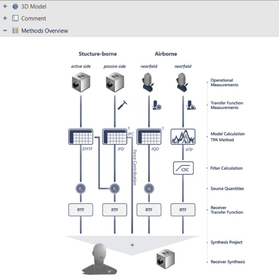
It enables the calculation of the IQD matrix and the air propagation sound attenuation model (p2p) for the measured air propagation sound components.
TPA – Airborne Sound Analysis is an extension option of the TPA project that enables the identification of actual operating volume velocity by applying the IQD method (Indirect Q Source Identification) to invert the acoustic impedance transfer function matrix. Additionally, the p2p method (sound pressure to sound pressure) can be used to identify the noise contributions caused by airborne sound. Furthermore, TPA – Airborne Sound Analysis allows for sound pressure and volume velocity measurements to conduct validation measurements aimed at evaluating the quality of the TPA model and optimizing the mapping accuracy of the synthesis.
Inquire About This Product
basic information
Expansion of the TPA project for the creation and validation of the air propagation sound component model (APR 600 is required.) Methods corresponding to model calculations: › Identification of indirect volume velocity (indirect Q-source measurement, IQD) › Identification of air propagation sound attenuation (sound pressure to sound pressure, p2p) Model validation › Execution of sound pressure and volume velocity measurements for model validation
Price range
Delivery Time
Applications/Examples of results
› Accurate and arbitrary path-specific characteristic evaluation and analysis of air propagation sound sources in the entire system › Reconstruction of sound source intensity (inverse matrix) › Investigation of the air propagation path from the sound source to the receiving point › Identification of dominant sound components › Quantification of frequency-dependent contributions › High-reliability evaluation of TPA model quality
catalog(1)
Download All Catalogs
Company information

HEAD acoustics Japan Co., Ltd. has been active as a leading company in the fields of dummy head-related recording and playback systems, acoustic analysis based on human auditory characteristics, and communication measurement technology for over 25 years. HEAD acoustics has consistently been a pioneer in developing innovative technologies such as dummy head-related binaural technology, acoustic analysis related to human hearing, interactive sound simulation systems, and transmission path analysis. HEAD acoustics will continue to focus on research and development through collaboration with universities and other research institutions and participation in international research projects.

![[Analysis Case] Three-Dimensional Structural Analysis of 3D Printed Objects](https://image.mono.ipros.com/public/product/image/387108/IPROS6079074888200176205.png?w=280&h=280)


