

Line Impedance Stabilization Network (LISN) 0.7µH TBL00705-2
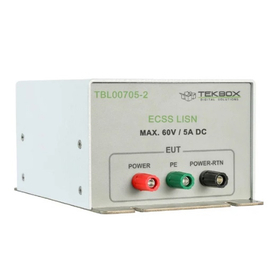
TBL00705-2 LISN is a 2-path 50 Ω // 0.7µH LISN characterized from 10Hz to 200 MHz. It is based on the ECSS-E-ST-20-07C Rev 1 standard. This standard provides a general circuit diagram for the LISN and allows for some flexibility in the component values. The implementation of TBL00705-2 is intended for use in EMC measurements of satellites and spacecraft. The LISN does not have an output for conducted emission measurements and simply functions as a network for line impedance stabilization. According to this standard, RF current monitoring probes are used for measuring conducted emissions. The 0.7 µH inductor mimics the typical inductance of power wire harnesses in spacecraft and satellites. The LISN is inserted into the power line and power return line of the EUT.
Inquire About This Product
basic information
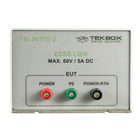
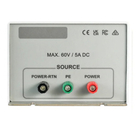
- LISN type: V-AMN, 50Ω // 0.7µH - Characteristic frequency range: 10Hz to 200MHz - DC resistance: 400mΩ (per path) - Maximum current: 5A (continuous) - Operating voltage range: 0 to 60V DC - EUT/SOURCE terminal: 4mm banana socket - Dimensions: Width 120mm x Length 175mm x Height 85mm - Weight: 0.9kg
Price range
Delivery Time
Applications/Examples of results
- Automotive EMC (CISPR 25 / ISO 7637 2 / ISO 11452 4) - Aircraft EMC (DO 160) - Military EMC (MIL STD 461G) - General EMC (CISPR 16 1 2) - Noise measurement of high current power lines (up to 100A) - Separation measurement of common mode/differential mode noise - EMC precon noise source analysis
Detailed information
-
Line Impedance Stabilization Network (LISN) 0.7µH TBL00705-2
-
Line Impedance Stabilization Network (LISN) 0.7µH TBL00705-2
-
Line Impedance Stabilization Network (LISN) Lineup
catalog(1)
Download All Catalogs
Company information

As a company that provides unique and innovative solutions in EMC testing and general measurement, Wavecrest Corporation is active in this field. The increasingly sophisticated electronic and communication environment not only affects the performance of its products but also serves as a social infrastructure that impacts the overall safety of society, requiring high levels of safety and reliability. We aim to provide new products and solutions that the market needs, without being constrained by traditional testing methods and equipment.

