
List of Environmental Equipment products
- classification:Environmental Equipment
91~105 item / All 10671 items


It won't break even after 1 million repetitions! A mat switch with reliable operation, high durability, and low price. Suitable for options in machine tools as well. Please consult us about delivery t...
- Sensors


We can accommodate high resistance over 10,000 ohms, with diameters ranging from approximately 30 mm to 8 inches, and we also offer thinning and chip processing arrangements!
- Other semiconductors
- Processing Contract
- Wafer
![[Material] Chiranou How-to Book Vol...](https://image.mono.ipros.com/public/product/image/fd4/2000608139/IPROS16760040756522612449.png?w=280&h=280)

Solutions for issues such as 'The temperature of the circulating water isn't rising! It's not dropping!' and 'The circulating water isn't flowing properly!' are provided!
- Chiller

【Data "Chiller Know-How Book Vol. 1" Now Available】Clearly explains solutions to chiller problems such as unstable circulation water temperature and leaks in circulation water!
[We have published the "Chiller Know-How Book Vol. 1"] Are there any users of chillers who are experiencing issues such as "the temperature of the circulating water is unstable," "the circulating water is not flowing properly," or "algae or rust has developed in the circulation path"? This document introduces chillers that can solve such problems and their features. If you are interested, please download the PDF from the related catalog below or feel free to contact us. [Contents] ■CASE01: The temperature of the circulating water won't rise! It won't drop! ■CASE02: The temperature of the circulating water is unstable! ■CASE03: The circulating water is not flowing properly! ■CASE04: Vibration occurs inside the equipment! ■CASE05: Circulating water leaked from the chiller! ■CASE06: Algae or rust has developed in the circulation path!
![[Material] Chirano Know-How Book Vo...](https://image.mono.ipros.com/public/product/image/3b4/2000608141/IPROS85238884828181361668.png?w=280&h=280)
Solutions for issues such as 'I don't know the flow rate of the circulating water!' and 'I can't log the status of the chiller!' are posted!
- Chiller

[Data "Chiller Know-How Book Vol. 2" Now Available] Clearly explains how to solve chiller problems such as inability to confirm circulation water flow and reduction of circulation water!
[Information: "Chiller Know-How Book Vol.2" has been published] Are there any users of chillers who are facing issues such as "not knowing the flow rate of the circulating water," "the circulating water not returning," or "being unable to log the status of the chiller"? This document introduces solutions to such concerns. If you are interested, please download the PDF from the related catalog below or feel free to contact us. [Contents] ■CASE01: I don't know the flow rate of the circulating water! ■CASE02: The temperature accuracy of the circulating water is not sufficient! ■CASE03: The circulating water has run out! ■CASE04: The circulating water is not returning! ■CASE05: Water has gotten into the electrical circuit! ■CASE06: I can't log the status of the chiller!

The Apiste chillers are available in three series: non-Freon, high durability, and ultra-wide range! You can choose the optimal chiller according to your needs.
- Chiller

The Apiste chillers are available in three series: non-Freon, high durability, and ultra-wide range! You can choose the optimal chiller according to your needs.
- Chiller

The Apiste chillers are available in three series: non-Freon, high durability, and ultra-wide range! You can choose the optimal chiller according to your application.
- Chiller

The Apiste chillers are available in three series: non-Freon, high durability, and ultra-wide range! You can choose the optimal chiller according to your application.
- Chiller

The Apiste chillers are available in three series: non-Freon, high durability, and ultra-wide range! You can choose the optimal chiller according to your needs.
- Chiller

The Apiste chillers are available in three series: non-Freon, high durability, and ultra-wide range! You can choose the optimal chiller according to your application.
- Chiller

The Apiste chillers are available in three series: non-Freon, high durability, and ultra-wide range! You can choose the optimal chiller according to your application.
- Chiller

The Apiste chillers are available in three series: non-Freon, high durability, and ultra-wide range! You can choose the optimal chiller according to your application.
- Chiller

Standard equipped with ultra-fine filter green pulse system! No need for filter replacement for a long time.


- Dust collector
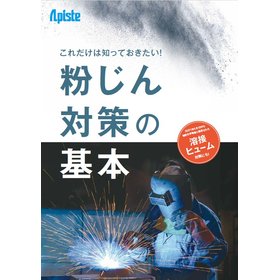
◆◆Free Progressing◆◆ Latest technical document "Basic Dust Control Measures" *Also ideal for welding fume control!
"The Basics of Dust Control" explains the fundamental knowledge related to dust for those engaged in work environments where dust is generated. It covers appropriate dust control measures to maintain health and comfort at work, including knowledge about dust, regulations, methods for suppressing and removing dust, and other essential information related to dust. It also includes details about the revision of specific regulations in April 2021. This book summarizes dust control measures to prevent health disorders, so if you are interested, please download the PDF from the related catalog below or feel free to contact us. [Contents (Excerpt)] ■ Health disorders caused by dust ■ Dust control measures ■ Management of dust-related work ■ Regulations concerning dust ■ About the revision of specific regulations in April 2021 (welding fumes)
![[Data] Chiller Technology vol.1 How...](https://image.mono.ipros.com/public/product/image/133/2000608145/IPROS28215937871841329721.png?w=280&h=280)
We have published the selection procedure for chillers, as well as key points for selecting chillers!
- Chiller

[Data "Chiller Technology vol.1" Now Available] A clear explanation of the chiller selection process and key points, illustrated for easy understanding!
We have released a document titled "Chiller Technology vol.1," which explains the selection procedure and key points for choosing a chiller, accompanied by illustrations. This document summarizes the selection procedure and key points for chiller selection. It also introduces how to calculate cooling capacity and head using formulas and graphs, along with examples. If you are considering the introduction of a chiller, you can use this as a reference material. If you are interested, please download the PDF from the related catalog below or feel free to contact us. [Contents] ■ Chiller selection procedure ■ Chiller selection points ■ Determining the temperature of circulating water ■ Deciding on the cooling method [air-cooled or water-cooled] ■ Determining cooling capacity ■ Calculating head
![[Data] Chira Technology vol.2 What ...](https://image.mono.ipros.com/public/product/image/fe5/2000608147/IPROS10248559155573411127.png?w=280&h=280)
We have published information such as 'Types of Water Based on Composition' and 'How Pure Water Cleans Dirt'!
- Chiller

【Data "Chira Technology vol.2" Now Available】A clear explanation of the differences between soft water and hard water, as well as pure water and ultra-pure water!
We have published a document titled "Chira Technology vol.2," which explains the types of water from the perspective of its components, accompanied by illustrations. Water is colorless and transparent, but in reality, various components are dissolved in it. This document summarizes the types of water classified by components, as well as the differences between pure water and ultra-pure water. We also provide an easy-to-understand explanation of how pure water removes dirt, so if you are interested, please feel free to download the PDF from the related catalog below or contact us. [Contents] ■ Introduction ■ Secrets of Water ■ Types of Water by Components ■ Pure Water and Ultra-Pure Water ■ How Pure Water Removes Dirt ■ Water Troubles
![[Information] Welding fumes designa...](https://image.mono.ipros.com/public/product/image/5cc/2000610588/IPROS49141197136625959413.png?w=280&h=280)
Apiste proposes the high-performance dust collector "GDE Series," suitable for the collection of welding fumes.
- Dust collector
◆◆Free Progressing◆◆ Latest technical document "Basic Dust Control Measures" *Also ideal for welding fume control!
"The Basics of Dust Control" explains the fundamental knowledge related to dust for those engaged in work environments where dust is generated. It covers appropriate dust control measures to maintain health and comfort at work, including knowledge about dust, regulations, methods for suppressing and removing dust, and other essential information related to dust. It also includes details about the revision of specific regulations in April 2021. This book summarizes dust control measures to prevent health disorders, so if you are interested, please download the PDF from the related catalog below or feel free to contact us. [Contents (Excerpt)] ■ Health disorders caused by dust ■ Dust control measures ■ Management of dust-related work ■ Regulations concerning dust ■ About the revision of specific regulations in April 2021 (welding fumes)

The Apiste chillers are available in three series: non-Freon, high durability, and ultra-wide range! You can choose the optimal chiller according to your application.
- Chiller