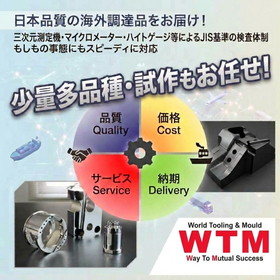
We are offering a document that outlines "4 Selection Points for Aluminum Processing Companies"!
As a specialist in precision aluminum machining, I will share four key selection points for choosing an aluminum processing company!
Did you have any of these concerns when requesting aluminum processing? ■ After aluminum processing, I had to request surface treatment from a different company, which also involved additional work like reinforcing screw holes... ■ Since only large machines were available, machining small workpieces resulted in significant waste... ■ When I requested a variety of small lots, I was turned down... To solve such concerns, we have published a document on the "Four Selection Points for Aluminum Processing Companies" that we understand as specialists in precision aluminum machining! Please download it from the PDF below.
- Company:奥野精密工業
- Price:Other

![[Processing Example] Machining Cutting](https://image.mono.ipros.com/public/product/image/6a1/2001142239/IPROS31340100934307331904.jpeg?w=280&h=280)
![[Processing Example] Acrylic Transparent <Machining Cutting Process>](https://image.mono.ipros.com/public/product/image/415/2001218073/IPROS75601083875553905344.jpeg?w=280&h=280)
![[Processing Example] Acrylic Transparent Plate <Machining Center Processing>](https://image.mono.ipros.com/public/product/image/8d3/2001431709/IPROS00824102395254206350.jpeg?w=280&h=280)
![[Processing Example] Acrylic Transparent Plate <Acrylic Block Helicoil Processing>](https://image.mono.ipros.com/public/product/image/f7f/2001432326/IPROS22550835768969950007.png?w=280&h=280)
![[Processing Example] Research Equipment Parts](https://image.mono.ipros.com/public/product/image/131/2001444122/IPROS91460071023128659032.png?w=280&h=280)






![[Proposed Solution Case] Difficulty in procuring cast molds due to the bankruptcy of the mold manufacturer.](https://image.mono.ipros.com/public/product/image/2049786/IPROS10137235280931451451.png?w=280&h=280)