We have compiled a list of manufacturers, distributors, product information, reference prices, and rankings for Simulation Software.
ipros is IPROS GMS IPROS One of the largest technical database sites in Japan that collects information on.

Simulation Software(Test) - List of Manufacturers, Suppliers, Companies and Products | IPROS GMS

Last Updated: Aggregation Period:Jan 21, 2026~Feb 17, 2026
This ranking is based on the number of page views on our site.

Simulation Software Product List

31~60 item / All 89 items

Displayed results

[Example] Tensile test of resin and copper interface in MaterialsStudio

Introduction of tensile test case for resin and copper interface in Materials Studio.

Case Study Utilizing "Materials Studio" ◇ It is possible to observe the movement of molecules during tensile testing. It is possible to determine the force required to lift epoxy resin with a crosslink density. Additionally, it is possible to determine the crosslinked structure in an amorphous state. 【Product Features】 ■ Ideal for "Materials Informatics" ■ Simulation software that streamlines material development Available for use by those engaged in research, development, design, and manufacturing across various industries. ■ Helps in the development of new materials more efficiently and easily. ■ Supports various types of materials. ■ All tasks, including crystal structure creation, calculation condition settings, and calculation result display, can be performed on a single GUI screen. *For more details, please feel free to contact us. Wavefront Co., Ltd. Sales Department MAIL: sales@wavefront.co.jp

  • others
  • plastic
  • Other metal materials
  • Simulation Software

Added to bookmarks

Bookmarks list

Bookmark has been removed

Bookmarks list

You can't add any more bookmarks

By registering as a member, you can increase the number of bookmarks you can save and organize them with labels.

Free membership registration

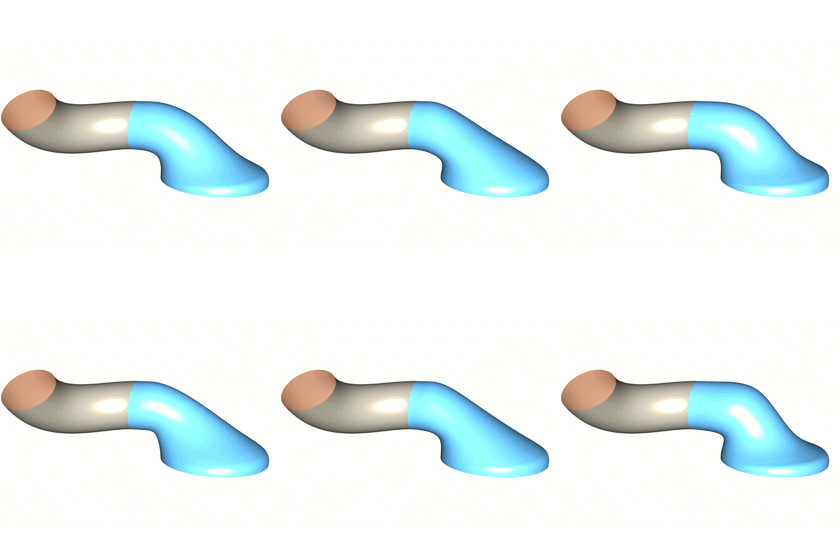
Optimization of catalytic converter performance using CAESES.

Optimization of the duct of the catalytic converter using CAESES!

Designing engine components for automobiles often involves considering many constraints, making it a challenging task within development design work. One example is the duct located just before the catalytic converter. Due to space constraints, this component is often designed to be bent quite sharply, which makes it difficult to ensure that the flow distribution is sufficiently uniform. In other words, if the flow characteristics of the catalytic converter are poor, there is a possibility that performance will decrease and emissions will increase. In this case, optimization of the duct for the catalytic converter will be performed using CAESES. *For more details, please refer to the related links. For further information, feel free to download the PDF or contact us.*

  • 6385803935833329694682380.gif
  • 9-2.png
  • 6385803976342704737924415.gif
  • 9.png
  • Other analysis software
  • Simulation Software

Added to bookmarks

Bookmarks list

Bookmark has been removed

Bookmarks list

You can't add any more bookmarks

By registering as a member, you can increase the number of bookmarks you can save and organize them with labels.

Free membership registration

Collaboration between CAESES and OpenFOAM in Blade Shape Optimization

Introduction to parameter control of script files and optimization execution during OpenFOAM integration!

This article focuses on the software connection in the shape optimization process using OpenFOAM and CAESES. The application targeted is a propeller blade, and the connection between external software and CAESES can be established quickly, allowing for the rapid initiation of automatic optimization and design considerations for the blade. The collaboration between CAESES and OpenFOAM has been utilized in various cases, and tutorials and sample files are available within CAESES. This collaborative system using open-source software is highly efficient and can greatly benefit from optimization calculations. *For more detailed information, please refer to the related links. For further details, you can download the PDF or feel free to contact us.*

  • ブレード形状最適化におけるCAESESとOpenFOAMの連携2.png
  • ブレード形状最適化におけるCAESESとOpenFOAMの連携3.png
  • ブレード形状最適化におけるCAESESとOpenFOAMの連携4.png
  • ブレード形状最適化におけるCAESESとOpenFOAMの連携5.png
  • ブレード形状最適化におけるCAESESとOpenFOAMの連携7.png
  • Other analyses
  • Image analysis software
  • Simulation Software

Added to bookmarks

Bookmarks list

Bookmark has been removed

Bookmarks list

You can't add any more bookmarks

By registering as a member, you can increase the number of bookmarks you can save and organize them with labels.

Free membership registration

[Example] Polymer/Metal Surface Interactions in MaterialsStudio

Introduction of interaction examples between "polymer/metal surfaces" in Materials Studio.

Case Study Utilizing "Materials Studio" ◇ The interaction at interfaces in polymers is important in a wide range of product fields. For example, adhesives, coatings, composite materials, films, lubricants, paints, and printing inks. The properties at interfaces are of interest to researchers in these fields. Utilizing one of the modules, "Forcite Plus," helps to understand the structure of interfaces. In this case study, we simulated the interaction between alumina (Al2O3) and polyparanitrostyrene. 【Features】 ■ Also optimal for "Materials Informatics" ■ Simulation software that streamlines material development It can be used by those engaged in research, development, design, and manufacturing across various industries. ■ Helps in the development of new materials more efficiently and easily. ■ Supports various types of materials. ■ All tasks, including crystal structure creation, calculation condition setting, and calculation result display, can be performed on a single GUI screen. *For more details, please feel free to contact us. Wavefront Co., Ltd. Sales Department MAIL: sales@wavefront.co.jp

  • others
  • plastic
  • Other metal materials
  • Simulation Software

Added to bookmarks

Bookmarks list

Bookmark has been removed

Bookmarks list

You can't add any more bookmarks

By registering as a member, you can increase the number of bookmarks you can save and organize them with labels.

Free membership registration

Dimensional reduction of hull shape using principal component analysis in CAESES.

Introducing the dimensional reduction function based on the drag optimization of KCS ships!

To optimize the hydrodynamic performance of the hull using the parametric modeling and optimization software CAESES, we first extract design variables related to the deformation of the hull's variable geometry. By increasing the number of design variables in this process, we can obtain a wider variety of deformation shapes, which in turn increases the likelihood of achieving better hull design proposals. However, the number of computational cases required for simulations (such as CFD analysis) increases exponentially (recommended number of cases S = 2^N, where N is the number of design variables), leading to significantly larger computational and time costs. To address this issue, CAESES5 offers a dimensionality reduction feature based on Principal Component Analysis (PCA) methods. *For more detailed information, please refer to the related links. For further details, feel free to download the PDF or contact us.*

  • 主成分分析による船体形状の次元圧縮2.png
  • 主成分分析による船体形状の次元圧縮3.png
  • 主成分分析による船体形状の次元圧縮4.png
  • 主成分分析による船体形状の次元圧縮5.png
  • 主成分分析による船体形状の次元圧縮6.png
  • 主成分分析による船体形状の次元圧縮7.png
  • 主成分分析による船体形状の次元圧縮8.png
  • Other analyses
  • Simulation Software

Added to bookmarks

Bookmarks list

Bookmark has been removed

Bookmarks list

You can't add any more bookmarks

By registering as a member, you can increase the number of bookmarks you can save and organize them with labels.

Free membership registration

Optimization design of assistive artificial hearts

Introducing the parametric model of the pump model and the evaluation of H-Q (Head-Flow) and T-Q (Torque-Flow)!

This article introduces the research and development of a ventricular assist device conducted by researchers at the Penn State College of Medicine using CAESES and CONVERGE. The goal of this research is to reduce the risk of adverse events such as hemolysis, degradation of von Willebrand factor, and thrombosis while minimizing the size of the pumps used in artificial hearts. To efficiently create a wide range of pump designs, CAESES has parameterized the flow path shape of the pump. *For more detailed information, you can view the related links. For further details, please download the PDF or feel free to contact us.*

  • 補助人工心臓の最適化設計2.png
  • 補助人工心臓の最適化設計3.png
  • 補助人工心臓の最適化設計4.png
  • Structural Analysis
  • Other analysis software
  • Other Pumps
  • Simulation Software

Added to bookmarks

Bookmarks list

Bookmark has been removed

Bookmarks list

You can't add any more bookmarks

By registering as a member, you can increase the number of bookmarks you can save and organize them with labels.

Free membership registration

Optimization of vessels

The total hull resistance obtained after parametric modeling, CFD analysis, and optimization processing was reduced by 2 to 3%.

CAESES's hull parametric modeling, when combined with CFD software, facilitates the study of hull shapes (reducing resistance) and enables the design to optimize hull performance. The hull shape, particularly the forward shape, has a significant impact on hull resistance, making shape optimization crucial. With CAESES, hulls can be easily parameterized, allowing for straightforward adjustments to the hull shape. By generating multiple shape patterns and combining them with analysis tools, designs can be optimized according to various optimization objectives. *For more detailed information, please refer to the related links. For further details, you can download the PDF or feel free to contact us.*

  • 6370199815693877095633449.gif
  • 6370199819867683684716010.jpg
  • Software (middle, driver, security, etc.)
  • Other analyses
  • Simulation Software

Added to bookmarks

Bookmarks list

Bookmark has been removed

Bookmarks list

You can't add any more bookmarks

By registering as a member, you can increase the number of bookmarks you can save and organize them with labels.

Free membership registration

[Case] Electrode Expansion in Charging and Discharging of MaterialsStudio

"Materials Studio" can perform battery characteristic calculations. [Case Introduction] We will present examples of electrode expansion during charging/discharging.

◇Introduction of Electrode Expansion Cases in Charging/Discharging - Here, we are calculating and plotting the volume of the electrode to observe changes in the active material. - It is believed that the anode experiences an increase in volume due to the weakening of the intercalation bonds in the graphite layers caused by Li intercalation. - In the cathode, the volume increases with the decrease of Li ions. 【Product Features】 ■ Also optimal for "Materials Informatics" ■ Simulation software that streamlines material development Available for use by those engaged in research, development, design, and manufacturing across various industries. ■ Helps in the development of new materials more efficiently and easily. ■ Compatible with various types of materials. ■ All tasks, including crystal structure creation, calculation condition setting, and calculation result display, can be performed on a single GUI screen. *For more details, please feel free to contact us. Wavefront Corporation Sales Department MAIL: sales@wavefront.co.jp

  • others
  • plastic
  • Other metal materials
  • Simulation Software

Added to bookmarks

Bookmarks list

Bookmark has been removed

Bookmarks list

You can't add any more bookmarks

By registering as a member, you can increase the number of bookmarks you can save and organize them with labels.

Free membership registration

[Example] MaterialsStudio semiconductor band gap calculation

"Materials Studio" is also useful for semiconductor material development. [Example] We will guide you through the band gap calculation of semiconductor GaAs.

◇Introduction of Band Gap Calculation Example for Semiconductor GaAs - GaAs, a semiconductor, is used in transistors and has the characteristic of high electron mobility. - The energy level between the valence band and the conduction band is called the band gap. - By investigating the band gap, characteristics such as electrical conductivity and conversion efficiency can be understood. - Using quantum mechanical calculations, it is also possible to investigate semiconductors that are attracting attention as materials. 【Product Features】 ■ Also optimal for "Materials Informatics" ■ Simulation software that streamlines material development Available for use by those engaged in research, development, design, and manufacturing across various industries. ■ Helps in the development of new materials more efficiently and easily. ■ Supports various types of materials ■ All tasks, including crystal structure creation, calculation condition setting, and calculation result display, can be performed on a single GUI screen. *For more details, please feel free to contact us. Wavefront Corporation Sales Department MAIL: sales@wavefront.co.jp

  • others
  • plastic
  • Other metal materials
  • Simulation Software

Added to bookmarks

Bookmarks list

Bookmark has been removed

Bookmarks list

You can't add any more bookmarks

By registering as a member, you can increase the number of bookmarks you can save and organize them with labels.

Free membership registration

[Example] Optical property calculation of coumarin using MaterialsStudio

Introduction of a simulation case for calculating the optical properties of coumarin using Materials Studio.

Case Study Utilizing "Materials Studio" ◇ Coumarin molecules are a type of aromatic compound derived from plants, represented by cherry leaves. Additionally, it is known that coumarin molecules are optically active. By utilizing one of the modules, "DMOL3," we can gain insights into optical properties in such cases. In this case study, we simulated the optical properties of coumarin molecules in both vacuum and aqueous solvent. Furthermore, the consideration of the solvent was conducted using the COSMO solvent model. 【Features】 ■ Also optimal for "Materials Informatics" ■ Simulation software that streamlines material development Available for use by those engaged in research, development, design, and manufacturing across various industries ■ Helps in the development of new materials more efficiently and easily. ■ Supports various types of materials ■ Allows for the creation of crystal structures, setting of calculation conditions, and display of calculation results all on a single GUI screen. *For more details, please feel free to contact us. Wavefront Corporation Sales Department MAIL: sales@wavefront.co.jp

  • others
  • plastic
  • Other metal materials
  • Simulation Software

Added to bookmarks

Bookmarks list

Bookmark has been removed

Bookmarks list

You can't add any more bookmarks

By registering as a member, you can increase the number of bookmarks you can save and organize them with labels.

Free membership registration

Optimization of the shape of the volute and diffuser of a centrifugal compressor.

For shape creation, we use CAESES, and for mesh model creation and CFD analysis, we use products from NUMECA!

At the Technical University of Darmstadt in Germany (Institute of Gas Turbines and Aerospace Propulsion), research was conducted on the automatic optimization of the volute of centrifugal compressors and vane diffusers. This project was carried out in collaboration with NUMECA, a German company, and Kompressorenbau Bannewitz GmbH (KBB), a turbo machinery manufacturer. CAESES was used for shape creation, while NUMECA's products were utilized for mesh model creation and CFD analysis. In CAESES, a parametric model was created that allowed for variations in the cross-sectional shape and area distribution of the volute. For the diffuser, a non-axisymmetric design was implemented, enabling quick shape transformations by varying the misalignment angle, blade twist, chord length, pitch, and rotation through a parametric model. *For more detailed information, please refer to the related links. You can download the PDF for more details or feel free to contact us.*

  • 遠心圧縮機のボリュートとディフューザーの形状最適化2.png
  • Structural Analysis
  • Other analysis software
  • Simulation Software

Added to bookmarks

Bookmarks list

Bookmark has been removed

Bookmarks list

You can't add any more bookmarks

By registering as a member, you can increase the number of bookmarks you can save and organize them with labels.

Free membership registration

Maritime and Offshore design

Processing in multiple fields within a single environment! Easy handling of large-scale and complex models.

BETA CAE Systems' software package provides simulation solutions that cover the advanced needs of the maritime industry. The advanced pre-processing and post-processing capabilities of our products significantly contribute to cost reduction in research and design processes. The rich tools and methods elevate simulation analysis in maritime testing to a new level, helping to understand the behavior of models. 【Features】 ■ Process automation ■ Geometry cleanup ■ Shell and volume meshing ■ Boundary layer mesh ■ Interoperable deck *For more details, please refer to the PDF materials or feel free to contact us.

  • Other analyses
  • Simulation Software

Added to bookmarks

Bookmarks list

Bookmark has been removed

Bookmarks list

You can't add any more bookmarks

By registering as a member, you can increase the number of bookmarks you can save and organize them with labels.

Free membership registration

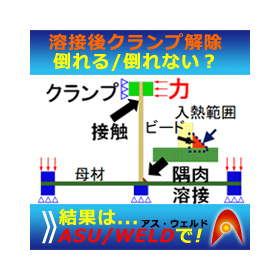
Welding deformation and residual stress simulation software 'ASU/WELD'

A series of welding distortion and residual stress simulation software that can be utilized to improve the efficiency of jig design. We will introduce examples of welding distortion based on clamping conditions.

The "ASU/WELD" series visualizes the effects of welding thermal distortion in advance and guides the welding process, enabling reductions in prototype costs and shortening of delivery times. ■ Product Introduction - "ASU/WELD-Express," a software for analyzing inherent distortion in a short time. - "ASU/WELD-Master," a thermal elastic-plastic analysis software capable of detailed evaluation of welding deformation and residual stress. ■ Challenges and Issues Faced by Welding Engineers - Shortening delivery times and reducing man-hours in the welding process. - Product dimension defects due to welding distortion. - Decreased structural strength due to residual stress. This is recommended for those facing the above challenges. For detailed product information, please download the catalog or contact us.

  • weld_s.png
  • weld.png
  • Other analyses
  • Analysis Services
  • Image analysis software
  • Simulation Software

Added to bookmarks

Bookmarks list

Bookmark has been removed

Bookmarks list

You can't add any more bookmarks

By registering as a member, you can increase the number of bookmarks you can save and organize them with labels.

Free membership registration

Welding deformation and residual stress simulation software 'ASU/WELD'

A series of welding deformation and residual stress simulation software that allows for actual machine evaluation. We will introduce case studies that improve the challenges faced by welding engineers!

The "ASU/WELD" series visualizes the effects of welding thermal distortion in advance and guides the welding process, enabling reductions in prototype costs and shortened delivery times. ■ Product Introduction - "ASU/WELD-Express," a software for analyzing inherent distortion in a short time. - "ASU/WELD-Master," a thermal elastic-plastic analysis software capable of detailed evaluation of welding deformation and residual stress, among others. ■ Challenges and Issues Faced by Welding Engineers - Shortening delivery times and reducing man-hours in the welding process. - Product dimension defects due to welding deformation. - Decreased structural strength due to residual stress. This is recommended for those facing the above challenges. For detailed product information and examples of improvements to these issues, please download the catalog or contact us.

  • Other analyses
  • Analysis Services
  • Image analysis software
  • Simulation Software

Added to bookmarks

Bookmarks list

Bookmark has been removed

Bookmarks list

You can't add any more bookmarks

By registering as a member, you can increase the number of bookmarks you can save and organize them with labels.

Free membership registration

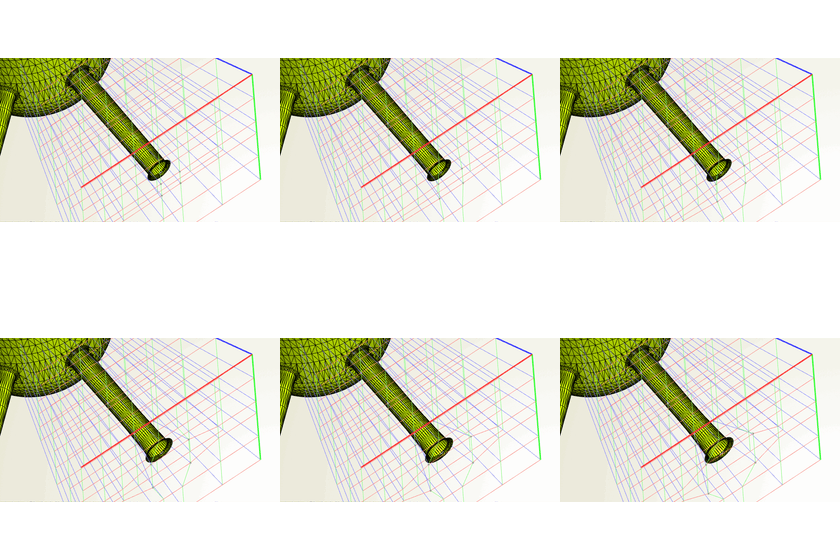
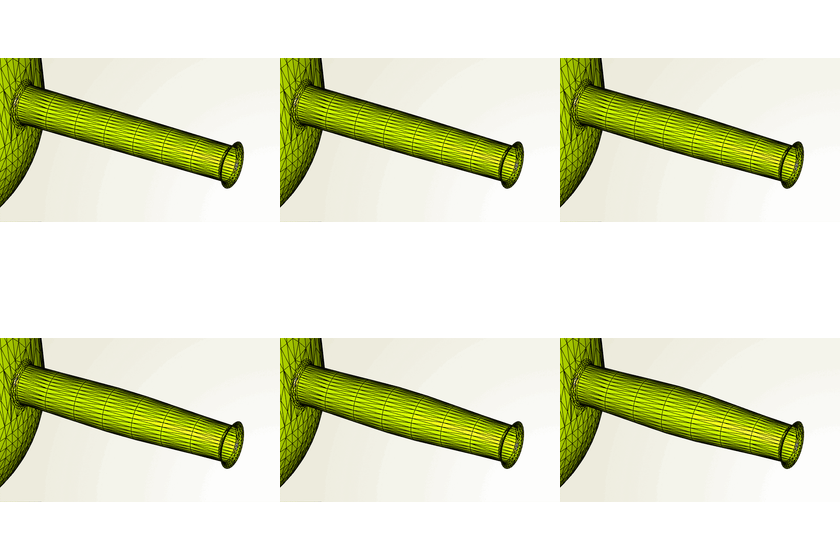
Morphing of the injector nozzle

Implement shape deformation on the injector nozzle using the morphing function!

One of the components targeted for optimization in diesel engines is the injector. This component is designed with careful consideration of its orientation and dimensions to ensure that fuel is injected appropriately into the combustion chamber, making it highly refined. In this case, we will introduce a method for rapidly deforming the existing nozzle shape of the fuel injection system. Based on the shape data imported into CAESES in STL format, we will use the morphing function to implement shape deformation on the injector nozzle. *For more detailed information, you can view the related links. For further details, please download the PDF or feel free to contact us.*

  • 7-2.png
  • 7-3.gif
  • 7-4.gif
  • 7-5.gif
  • 7-6.gif
  • Other analysis software
  • Simulation Software

Added to bookmarks

Bookmarks list

Bookmark has been removed

Bookmarks list

You can't add any more bookmarks

By registering as a member, you can increase the number of bookmarks you can save and organize them with labels.

Free membership registration

Lithography simulation software

Eliminate waste of cost and time, and achieve high-performance, low-cost product development in a short period.

At Intersoft, we handle "Lithography Simulation Software." We offer a variety of products, including "FullChip," which supports a computing environment consisting of a layout server and multiple clients, as well as the very user-friendly, flexible, and powerful "HyperLith" and "EM-Suite." We eliminate costs and wasted time, enabling high-performance, low-cost product development in a short period. 【Product Lineup (Partial)】 ■FullChip ■HyperLith ■EM-Suite ■TEMPESTpr2 ■TRIG, etc. *For more details, please refer to the PDF materials or feel free to contact us.

  • Software (middle, driver, security, etc.)
  • Simulation Software

Added to bookmarks

Bookmarks list

Bookmark has been removed

Bookmarks list

You can't add any more bookmarks

By registering as a member, you can increase the number of bookmarks you can save and organize them with labels.

Free membership registration

Shape optimization of SWATH support vessels.

In conducting shape optimization, CAESES was used for the creation of the parametric model and optimization calculations.

In the industry of operation, maintenance, and service for offshore wind power generation in Europe, which is expected to see significant growth in the future, fierce product competition is unfolding among companies. Related companies are pursuing "cost reduction of vessels," "high efficiency," and "high profitability" as much as possible to survive in the industry, advancing their design and development. The project introduced here involves the shape optimization of a SWATH vessel support ship with an innovative structure. *For detailed information, please refer to the related link. For more details, you can download the PDF or feel free to contact us.*

  • 6377991615469876016857917.png
  • 6377991633894897438080663.png
  • 6377889885001534016043736.gif
  • 6377991747754245955127008.png
  • 6377991811369977035143448.png
  • Other measurement, recording and measuring instruments
  • Other analyses
  • Simulation Software

Added to bookmarks

Bookmarks list

Bookmark has been removed

Bookmarks list

You can't add any more bookmarks

By registering as a member, you can increase the number of bookmarks you can save and organize them with labels.

Free membership registration

Torque converter shape optimization

CAESES provides beneficial results across various fields, regardless of the products in question!

A torque converter for automobiles is a type of fluid coupling used in vehicles equipped with automatic transmissions to transmit rotational force from the engine to the drive shaft. Designers of torque converters work to minimize cavitation within the device and ensure good flow behavior of the transmission oil, aiming to maximize efficiency and torque ratio at high speeds. CAESES enables the modeling of such complex shapes and can build an optimization system that incorporates shape data into analysis software. By connecting CFD analysis software and proprietary CFD codes to CAESES, it analyzes flow behavior for each designed shape during optimization calculations and provides users with the optimal shape based on constraints. *For more detailed information, please refer to the related links. For further details, feel free to download the PDF or contact us.*

  • 13-2.png
  • Other analysis software
  • Simulation Software

Added to bookmarks

Bookmarks list

Bookmark has been removed

Bookmarks list

You can't add any more bookmarks

By registering as a member, you can increase the number of bookmarks you can save and organize them with labels.

Free membership registration

[Case Study] Reduction of Electrolyte and Formation of SEI Film in MaterialsStudio

"Materials Studio" can perform battery property calculations [Case Study Introduction].

◇Introduction of examples of electrolyte reduction and SEI film formation - The SEI film refers to the film formed by the decomposition products of the electrolyte on the electrode surface. - Its role includes preventing excessive decomposition of the electrode liquid and regulating the ions absorbed by the electrode; however, an increase in the SEI film can lead to increased electrical resistance and a decline in battery performance. ◆Details of the case - A Li / Li2CO3 / EC model was created. - The energy barrier of the SEI film, which plays a role in preventing excessive ion supply to the electrode, can be observed. - The charge transfer coefficient α, calculated from the Butler-Volmer equation, is approximately 0.22, which matches the experimental value. - This report has enabled a bottom-up modeling approach for battery design. 【Product Features】 ■ Also optimal for "Materials Informatics" ■ Simulation software that streamlines material development It can be used by those engaged in research, development, design, and manufacturing across various industry sectors. ■ Helps in the development of new materials more efficiently and easily. *For more details, please feel free to contact us. Wavefront Inc. Sales Department MAIL: sales@wavefront.co.jp

  • others
  • plastic
  • Other metal materials
  • Simulation Software

Added to bookmarks

Bookmarks list

Bookmark has been removed

Bookmarks list

You can't add any more bookmarks

By registering as a member, you can increase the number of bookmarks you can save and organize them with labels.

Free membership registration

ProSim Plus

General-purpose steady-state process simulation and optimization software

ProSim Plus is a product of the French company Fives ProSim and is a general-purpose steady-state process simulator that includes optimization features. In addition to a rigorous thermodynamic model (also sold as a separate product called Simulis Thermodynamics), it is equipped with precise models of chemical engineering unit operations such as heat exchangers, reactors, distillation columns, absorption columns, and extraction columns, allowing for the modeling and simulation of large manufacturing processes, including complex recycling. Designed with the concept of Open Software, it enables users to add custom unit models and modify or extend standard models using Visual Basic. It complies with Cape-Open standards and allows for the integration of models from compatible external software for simulation.

  • simulator
  • Simulation Software

Added to bookmarks

Bookmarks list

Bookmark has been removed

Bookmarks list

You can't add any more bookmarks

By registering as a member, you can increase the number of bookmarks you can save and organize them with labels.

Free membership registration

Design and optimization of valves

The procedure explored using CAESES achieved a reduction in working time from several months to several days!

The optimization of valve design is one of many optimization targets, and by appropriately automating the design change process using CAESES and analyzing the number of implementation cases generated by the CFD solver, it is possible to significantly shorten the time to commercialization while exploring truly suitable designs under constraints. A valve is a device that opens, closes, or partially obstructs various passages to control, direct, or adjust the flow of fluid. In an open valve, fluid flows from high pressure to low pressure. Typically, the main objective of valve optimization is to adjust the flow rate passing through the valve at a specified pressure loss. This is often expressed as a flow coefficient, which serves as a relative measure of flow efficiency. *For more detailed information, please refer to the related links. For more details, you can download the PDF or feel free to contact us.*

  • バルブの設計と最適化2.jpg
  • バルブの設計と最適化3.gif
  • バルブの設計と最適化4.gif
  • バルブの設計と最適化5.gif
  • バルブの設計と最適化7.gif
  • バルブの設計と最適化8.gif
  • バルブの設計と最適化9.gif
  • バルブの設計と最適化10.gif
  • バルブの設計と最適化11.gif
  • valve
  • Simulation Software

Added to bookmarks

Bookmarks list

Bookmark has been removed

Bookmarks list

You can't add any more bookmarks

By registering as a member, you can increase the number of bookmarks you can save and organize them with labels.

Free membership registration

Optimization of turbine blade shape

Enabling optimization calculations of parametric models through automated processes!

In this case, we will introduce the shape optimization of gas turbine fixed blades, including end wall contouring, which is a joint project with SIEMENS. An efficient workflow using CAESES can provide significant support for design development. The gas turbine, which is the application in this instance, is a type of internal combustion engine used for driving generators, among other purposes. *For more detailed information, you can view it through the related links. For more details, please download the PDF or feel free to contact us.

  • タービンブレードの形状最適化2.gif
  • Turbine
  • Simulation Software

Added to bookmarks

Bookmarks list

Bookmark has been removed

Bookmarks list

You can't add any more bookmarks

By registering as a member, you can increase the number of bookmarks you can save and organize them with labels.

Free membership registration

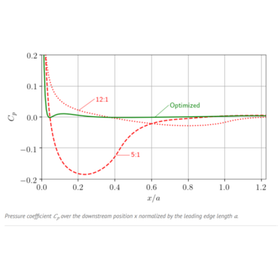
Optimization of the Leading Edge for Boundary Layer Experiments on a Flat Plate

When the minimum curvature radius is approximately 2.5mm, it is possible to prevent plastic deformation of the steel belt!

Predicting transitional boundary layers under arbitrary conditions in fluid mechanics is a very challenging task. A research group at Karlsruhe Institute of Technology conducted tests for predicting transitional boundary layers considering the effects of pressure gradients, mainstream turbulence, and surface roughness, using CAESES and the open-source OpenFOAM for suitable leading-edge shape optimization. *For more details, you can view the related links. For further information, please download the PDF or feel free to contact us.*

  • 平板境界層実験のためのリーディングエッジの最適化2.png
  • 平板境界層実験のためのリーディングエッジの最適化3.png
  • 平板境界層実験のためのリーディングエッジの最適化4.png
  • 平板境界層実験のためのリーディングエッジの最適化5.png
  • 平板境界層実験のためのリーディングエッジの最適化6.png
  • 平板境界層実験のためのリーディングエッジの最適化7.png
  • 平板境界層実験のためのリーディングエッジの最適化8.png
  • others
  • Simulation Software

Added to bookmarks

Bookmarks list

Bookmark has been removed

Bookmarks list

You can't add any more bookmarks

By registering as a member, you can increase the number of bookmarks you can save and organize them with labels.

Free membership registration

[Case Study] Li Ion Diffusion Energy on Graphite Anode

"Materials Studio" can perform battery property calculations [Case Study] Here we introduce a paper case.

By profiling the diffusion energy of ions within the holy graphite, we are conducting discussions on the effects of the holy structure using Materials Studio. ◇ The effects associated with the improvement treatment of graphite anodes can be confirmed. 【Product Features】 ■ Also optimal for "Materials Informatics (MI)" ■ Simulation software that streamlines material development ■ Helps in the development of new materials more efficiently and easily. *For more details, please feel free to contact us.

  • plastic
  • Other metal materials
  • Contract Analysis
  • Simulation Software

Added to bookmarks

Bookmarks list

Bookmark has been removed

Bookmarks list

You can't add any more bookmarks

By registering as a member, you can increase the number of bookmarks you can save and organize them with labels.

Free membership registration

[Case Study] Water Adsorption on the Surface of V2O5 Electrodes Used in Water Batteries

"Materials Studio" can perform battery property calculations [Case Study] Here we introduce a paper case.

In this paper, we analyze the behavior of water molecules adsorbed on surfaces such as V2O5(1 0 0) using Materials Studio. ◇ It is possible to analyze the relationship between functional groups on the surface of 2D layers, density of states, and adsorption properties. 【Product Features】 ■ Also optimal for "Materials Informatics (MI)" ■ Simulation software that streamlines material development ■ Helps in the development of new materials more efficiently and easily *For more details, please feel free to contact us.

  • plastic
  • Other metal materials
  • Contract Analysis
  • Simulation Software

Added to bookmarks

Bookmarks list

Bookmark has been removed

Bookmarks list

You can't add any more bookmarks

By registering as a member, you can increase the number of bookmarks you can save and organize them with labels.

Free membership registration

Simulation software 'gPROMS Process'

For process development, optimal plant design, and operational optimization studies! Simulators for the oil, gas, and chemical industries.

In plant design, equipment sizing, process consideration, and operational optimization, PSE believes that existing process simulators still have room for improvement in terms of convergence for obtaining numerical solutions, constraints of processes they can handle, and customization of process models (model extensibility). The process simulation software developed to meet the needs for more advanced and value-added process plant design and optimization is 'gPROMS Process'. 【Features】 * Libraries for specific applications * Creation of flow sheets using Drag & Drop * High-precision custom model creation and editing functions using gPROMS language * Changes in settings within the same environment from steady-state simulation models to dynamic simulation models * Powerful optimization solution search and analysis functions * Global System Analysis (GSA) * High-Performance Computing (HPC) ★ You can view two "case study materials" available for download. These include examples of achieving high-value product offerings and cost reduction through batch process optimization, as well as successful cases of cost reduction through the optimization of entire plants.

Added to bookmarks

Bookmarks list

Bookmark has been removed

Bookmarks list

You can't add any more bookmarks

By registering as a member, you can increase the number of bookmarks you can save and organize them with labels.

Free membership registration

AUTODESK MOLDFLOW

To create high-quality plastic products.

Autodesk Moldflow, one of Autodesk's digital prototype solutions, is an application for plastic injection molding simulation that allows for the verification and optimization of the design of plastic parts and injection molds, enabling detailed validation of the plastic injection molding process. Used by many companies around the world, Autodesk® Moldflow® Adviser and Autodesk® Moldflow® Insight help reduce the number of costly prototypes, minimize potential manufacturing defects, and contribute to bringing innovative products to market faster.

  • Other analyses
  • Simulation Software

Added to bookmarks

Bookmarks list

Bookmark has been removed

Bookmarks list

You can't add any more bookmarks

By registering as a member, you can increase the number of bookmarks you can save and organize them with labels.

Free membership registration

Optimization of the poppet valve

This article explains the design system based on the collaboration between the CFD solver SimericsMP and CAESES, based on actual research conducted!

The Italian company OMIQ SRL, which sells software, conducted research on an automatic design system using the poppet valve of high-pressure pumps developed by the Danish machinery manufacturer Danfoss. In this case, we will introduce the design system that integrates the CFD solver SimericsMP with CAESES based on the research that was actually conducted. The issue in this case is that the poppet valve exhibits unacceptable unstable behavior during operation. It was found that when the poppet valve attempts to open to its maximum displacement (27.5 mm), the instability of the flow increases, resulting in a decrease in pressure on the poppet valve, ultimately preventing the valve from fully opening (closing to about 6 mm remaining). This unstable phenomenon was verified through unsteady analysis using SimericsMP. *For more detailed information, please refer to the related link. For further details, you can download the PDF or feel free to contact us.*

  • ポペットバルブの最適化2.png
  • ポペットバルブの最適化3.gif
  • ポペットバルブの最適化4.gif
  • ポペットバルブの最適化5.gif
  • ポペットバルブの最適化6.gif
  • ポペットバルブの最適化7.png
  • ポペットバルブの最適化8.png
  • ポペットバルブの最適化9.png
  • ポペットバルブの最適化10.png
  • valve
  • Simulation Software

Added to bookmarks

Bookmarks list

Bookmark has been removed

Bookmarks list

You can't add any more bookmarks

By registering as a member, you can increase the number of bookmarks you can save and organize them with labels.

Free membership registration

CFD optimization through integration with AnsysCFD.

An appropriate CAD tool is needed to ensure the generation of various model variations to be analyzed in the automation process!

Ansys CFD tools such as Fluent and CFX receive strong support from engineers for evaluating fluid dynamic behavior in design, along with various options and tools used for mesh creation. These tools provide valuable information and insights regarding the performance to be evaluated. Moreover, they enable automated optimization and design exploration workflows that include CFD. In addition to improving design and shortening development time and design cycles, these tools significantly enhance the development process by increasing information about the impact of various design variables on performance (product behavior) during the initial design phase, where there is a high degree of freedom in decision-making. *For more details, you can view the related links. For more information, please download the PDF or feel free to contact us.*

  • 【CAESES】AnsysCFDとの連携によるCFD最適化2.png
  • 【CAESES】AnsysCFDとの連携によるCFD最適化3.png
  • 【CAESES】AnsysCFDとの連携によるCFD最適化4.png
  • 【CAESES】AnsysCFDとの連携によるCFD最適化5.png
  • 【CAESES】AnsysCFDとの連携によるCFD最適化6.png
  • 【CAESES】AnsysCFDとの連携によるCFD最適化7.png
  • 【CAESES】AnsysCFDとの連携によるCFD最適化8.png
  • 【CAESES】AnsysCFDとの連携によるCFD最適化9.png
  • Structural Analysis
  • Other CAD
  • Simulation Software

Added to bookmarks

Bookmarks list

Bookmark has been removed

Bookmarks list

You can't add any more bookmarks

By registering as a member, you can increase the number of bookmarks you can save and organize them with labels.

Free membership registration

Propeller optimization using machine learning

The main objective of the contest was to design a propeller that could achieve maximum efficiency at a wide range of operating speeds.

In propeller design, achieving optimal efficiency and performance is extremely important. Recently, by effectively combining AI and CFD, we were able to win an online propeller design contest hosted by a popular YouTube creator. In this contest, we were able to create two high-performance propellers that demonstrated excellent efficiency using "CAESES" and "AirShaper." *For more details, you can view the related links. For more information, please download the PDF or feel free to contact us.*

  • 機械学習によるプロペラ最適化2.gif
  • 機械学習によるプロペラ最適化3.gif
  • 機械学習によるプロペラ最適化4.gif
  • 機械学習によるプロペラ最適化5.gif
  • 機械学習によるプロペラ最適化6.gif
  • 機械学習によるプロペラ最適化7.png
  • 機械学習によるプロペラ最適化8.png
  • 機械学習によるプロペラ最適化9.png
  • 機械学習によるプロペラ最適化10.png
  • Image analysis software
  • Structural Analysis
  • Simulation Software

Added to bookmarks

Bookmarks list

Bookmark has been removed

Bookmarks list

You can't add any more bookmarks

By registering as a member, you can increase the number of bookmarks you can save and organize them with labels.

Free membership registration