- Publication year : 2026
1~2 item / All 2 items
Displayed results

Added to bookmarks
Bookmarks listBookmark has been removed
Bookmarks listYou can't add any more bookmarks
By registering as a member, you can increase the number of bookmarks you can save and organize them with labels.
Free membership registration
Contact this company
Inquiry Form1~2 item / All 2 items

Envalior's Material Advisor is a simulation tool that can predict the behavior of resin materials under a wide range of conditions. Based on the fundamental temperature-dependent S-S curve (stress-strain curve), it is possible to estimate material properties under various conditions that closely resemble actual usage environments, including fatigue, creep, and thermal aging. The feature of this tool lies in its foundation on experimental data accumulated by Envalior over many years. Based on this data, a specialized research team constructs estimation models, achieving highly reliable predictions at a practical level. In customer design environments, while basic physical property data is readily available, application data such as fatigue characteristics and long-term reliability may not be immediately obtainable, making design decisions challenging. By utilizing the Material Advisor, such data gaps can be quickly filled, allowing for more accurate considerations from the early stages of design. This contributes to improved development speed, reduced prototyping cycles, and optimal material selection. For more details, please refer to the link below. If you have any questions or need individual consultations, please feel free to contact us.
Added to bookmarks
Bookmarks listBookmark has been removed
Bookmarks listYou can't add any more bookmarks
By registering as a member, you can increase the number of bookmarks you can save and organize them with labels.
Free membership registration
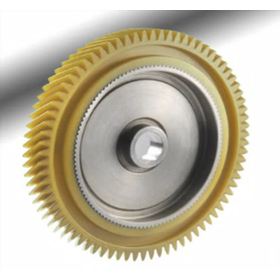
As PFAS regulations advance, a key theme in the design of sliding components is "how to achieve friction and wear without using PTFE." Simple material substitution often reveals new challenges such as wear life and seizure. In PFAS-free design, the focus is on stabilizing the contact state through the inherent rigidity, heat resistance, and dimensional stability of the material, rather than relying on additives for low friction. Stanyl (PA46) excels in maintaining elastic modulus at high temperatures due to its high crystallinity and has properties that make it easier to suppress surface pressure concentration and localized heating. As a result, it can achieve practically important sliding performance, such as stability of friction and gradual wear progression, without depending on PFAS. It is one of the strong options to consider for PFAS-free sliding design.
Added to bookmarks
Bookmarks listBookmark has been removed
Bookmarks listYou can't add any more bookmarks
By registering as a member, you can increase the number of bookmarks you can save and organize them with labels.
Free membership registration