- Publication year : 2026
1~3 item / All 3 items
Displayed results
Added to bookmarks
Bookmarks listBookmark has been removed
Bookmarks listYou can't add any more bookmarks
By registering as a member, you can increase the number of bookmarks you can save and organize them with labels.
Free membership registration
Contact this company
Contact Us Online1~3 item / All 3 items

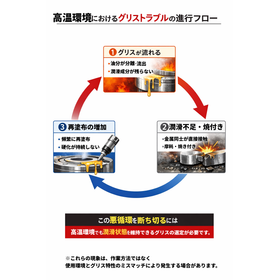
Q. What happens to grease in high-temperature environments? Does it stick, deteriorate, or seize? A. In high-temperature conditions, these phenomena often occur "gradually." In a high-temperature environment, the oil components in the grease become more prone to separation and movement, making it difficult for the lubricating components to remain in the moving parts. At this stage, stiffness in movement and insufficient lubrication begin to appear. If the condition where the lubricating film cannot be maintained continues, direct contact between metals increases, leading to friction and wear. As a result, issues such as seizing and sticking occur. In other words, the progression often follows this flow: deterioration → insufficient lubrication → seizing and sticking. Even if a problem seems to occur suddenly, there is always a change in lubrication condition in the preceding stages. In high-temperature environments, not only the heat resistance temperature values but also the ability to maintain lubrication under high temperatures become crucial points for grease selection. The changes in grease that occur at high temperatures and the mechanism of trouble occurrence are organized technically in the attached document.
Added to bookmarks
Bookmarks listBookmark has been removed
Bookmarks listYou can't add any more bookmarks
By registering as a member, you can increase the number of bookmarks you can save and organize them with labels.
Free membership registration
In die-cast molds and movable parts used in high-temperature environments, issues such as "despite applying grease, movement becomes sluggish" and "eventually seizing occurs" can be observed. This phenomenon is not merely due to wear or insufficient lubrication; the main cause is the inability to maintain a lubricating film at high temperatures. As the temperature rises, the separation and volatilization of oil components progress, making it easier for metal parts to come into direct contact with each other, leading to increased friction and rising sliding resistance. Seizing does not occur suddenly; it is a phenomenon that surfaces as a result of the gradual deterioration of lubrication conditions. In high-temperature environments, it is not only the "heat resistance temperature value" that matters, but also whether lubrication conditions can be maintained at high temperatures, which becomes an important point in grease selection. The mechanisms behind seizing and sluggish movement, as well as considerations during selection, are organized technically in the attached materials.
Added to bookmarks
Bookmarks listBookmark has been removed
Bookmarks listYou can't add any more bookmarks
By registering as a member, you can increase the number of bookmarks you can save and organize them with labels.
Free membership registration
In high-temperature environments such as die-casting molds, there are many cases where, despite using high-temperature grease, "the grease flows away during operation." This phenomenon occurs not simply because the grease melts, but because the oil components separate under high temperatures, making it difficult for the lubricating components to remain in the moving parts. As a result, this leads to issues such as: - Oil splattering to the surroundings - Insufficient lubrication - Increased frequency of reapplication In high-temperature environments, it is not only the heat resistance temperature that matters, but also whether the lubrication state can be maintained under high temperatures, which becomes an important point in grease selection. Detailed causes and considerations for selection are organized technically in the attached document.
Added to bookmarks
Bookmarks listBookmark has been removed
Bookmarks listYou can't add any more bookmarks
By registering as a member, you can increase the number of bookmarks you can save and organize them with labels.
Free membership registration