iPROS Manufacturing
  • Search for products by classification category

    • Electronic Components and Modules
      Electronic Components and Modules
      59960items
    • Machinery Parts
      Machinery Parts
      74968items
    • Manufacturing and processing machinery
      Manufacturing and processing machinery
      100617items
    • Scientific and Physics Equipment
      Scientific and Physics Equipment
      35601items
    • Materials
      Materials
      37286items
    • Measurement and Analysis
      Measurement and Analysis
      55190items
    • Image Processing
      Image Processing
      15232items
    • Control and Electrical Equipment
      Control and Electrical Equipment
      53567items
    • Tools, consumables, and supplies
      Tools, consumables, and supplies
      64647items
    • Design and production support
      Design and production support
      12452items
    • IT/Network
      IT/Network
      44207items
    • Office
      Office
      13858items
    • Business support services
      Business support services
      24538items
    • Seminars and Skill Development
      Seminars and Skill Development
      6434items
    • Pharmaceutical and food related
      Pharmaceutical and food related
      31484items
    • others
      74197items
  • Search for companies by industry

    • Manufacturing and processing contract
      7336
    • others
      5005
    • Industrial Machinery
      4410
    • Machine elements and parts
      3284
    • Other manufacturing
      2879
    • IT/Telecommunications
      2555
    • Trading company/Wholesale
      2473
    • Industrial Electrical Equipment
      2301
    • Building materials, supplies and fixtures
      1815
    • software
      1631
    • Electronic Components and Semiconductors
      1562
    • Resin/Plastic
      1493
    • Service Industry
      1452
    • Testing, Analysis and Measurement
      1126
    • Ferrous/Non-ferrous metals
      982
    • environment
      697
    • Chemical
      630
    • Automobiles and Transportation Equipment
      561
    • Printing Industry
      509
    • Information and Communications
      456
    • Consumer Electronics
      416
    • Energy
      329
    • Rubber products
      312
    • Food Machinery
      306
    • Optical Instruments
      276
    • robot
      272
    • fiber
      249
    • Paper and pulp
      229
    • Pharmaceuticals and Biotechnology
      167
    • Electricity, Gas and Water Industry
      167
    • Warehousing and transport related industries
      147
    • Glass and clay products
      140
    • Food and Beverage
      128
    • CAD/CAM
      123
    • retail
      109
    • Medical Devices
      103
    • Educational and Research Institutions
      102
    • Ceramics
      98
    • wood
      88
    • Transportation
      82
    • Medical and Welfare
      63
    • Petroleum and coal products
      62
    • Shipbuilding and heavy machinery
      51
    • Aviation & Aerospace
      47
    • Fisheries, Agriculture and Forestry
      41
    • equipment
      32
    • Public interest/special/independent administrative agency
      31
    • Materials
      25
    • self-employed
      24
    • Research and development equipment and devices
      24
    • Government
      23
    • Mining
      17
    • Finance, securities and insurance
      13
    • cosmetics
      12
    • Individual
      10
    • Restaurants and accommodations
      9
    • Police, Fire Department, Self-Defense Forces
      7
    • Raw materials for reagents and chemicals
      3
    • Laboratory Equipment and Consumables
      3
    • Contracted research
      3
  • Special Features
  • Ranking

    • Overall Products Ranking
    • Overall Company Ranking
Search for Products
  • Search for products by classification category

  • Electronic Components and Modules
  • Machinery Parts
  • Manufacturing and processing machinery
  • Scientific and Physics Equipment
  • Materials
  • Measurement and Analysis
  • Image Processing
  • Control and Electrical Equipment
  • Tools, consumables, and supplies
  • Design and production support
  • IT/Network
  • Office
  • Business support services
  • Seminars and Skill Development
  • Pharmaceutical and food related
  • others
Search for Companies
  • Search for companies by industry

  • Manufacturing and processing contract
  • others
  • Industrial Machinery
  • Machine elements and parts
  • Other manufacturing
  • IT/Telecommunications
  • Trading company/Wholesale
  • Industrial Electrical Equipment
  • Building materials, supplies and fixtures
  • software
  • Electronic Components and Semiconductors
  • Resin/Plastic
  • Service Industry
  • Testing, Analysis and Measurement
  • Ferrous/Non-ferrous metals
  • environment
  • Chemical
  • Automobiles and Transportation Equipment
  • Printing Industry
  • Information and Communications
  • Consumer Electronics
  • Energy
  • Rubber products
  • Food Machinery
  • Optical Instruments
  • robot
  • fiber
  • Paper and pulp
  • Pharmaceuticals and Biotechnology
  • Electricity, Gas and Water Industry
  • Warehousing and transport related industries
  • Glass and clay products
  • Food and Beverage
  • CAD/CAM
  • retail
  • Medical Devices
  • Educational and Research Institutions
  • Ceramics
  • wood
  • Transportation
  • Medical and Welfare
  • Petroleum and coal products
  • Shipbuilding and heavy machinery
  • Aviation & Aerospace
  • Fisheries, Agriculture and Forestry
  • equipment
  • Public interest/special/independent administrative agency
  • Materials
  • self-employed
  • Research and development equipment and devices
  • Government
  • Mining
  • Finance, securities and insurance
  • cosmetics
  • Individual
  • Restaurants and accommodations
  • Police, Fire Department, Self-Defense Forces
  • Raw materials for reagents and chemicals
  • Laboratory Equipment and Consumables
  • Contracted research
Special Features
Ranking
  • Overall Products Ranking
  • Overall Company Ranking
  • privacy policy
  • terms of service
  • About Us
  • Careers
  • Advertising
  1. Home
  2. Machine elements and parts
  3. エムアンドエム
  4. news list
Machine elements and parts
  • Added to bookmarks

    Bookmarks list

    Bookmark has been removed

    Bookmarks list

    You can't add any more bookmarks

    By registering as a member, you can increase the number of bookmarks you can save and organize them with labels.

    Free membership registration

エムアンドエム

EstablishmentMay 10, 1989
capital1500Ten thousand
number of employees5
addressKanagawa/Midori-ku, Yokohama-shi/1914-10 Kitahassaku Town
phone045-938-4373
  • Official site
last updated:Jan 07, 2026
エムアンドエムlogo
  • Contact this company

    Inquiry Form
  • Company information
  • Products/Services(21)
  • catalog(20)
  • news(24)

エムアンドエム List of News Articles

  • category

  • Publication year

  • Publication year : 2026

1~13 item / All 13 items

Displayed results
contact-grease-what-is-electrical-contact-lubrication.png

What is contact grease? An explanation of its role and applications as a lubricant to prevent contact failure.

  • Product news

"Contact failure" occurs in electronic devices, control panels, and automotive connectors. One of the causes is oxidation or wear of the contacts, as well as corrosion due to moisture. This is where contact grease is used. Contact grease is a lubricant that stabilizes the contact state while protecting metal contacts, and it can provide effects such as: ✔ Prevention of contact oxidation ✔ Moisture and rust prevention ✔ Reduction of wear ✔ Suppression of contact failure due to vibration (fretting wear) It is particularly used in automotive connectors, terminal blocks, switch contacts, and sensor terminals to enhance the longevity and reliability of contacts. It is important to note that contact grease and conductive grease serve different purposes. The main purpose of contact grease is "contact protection," while the main purpose of conductive grease is "assistance in conductivity." Selecting the appropriate product according to the application is crucial. For those struggling with contact failure or terminal corrosion, it is important to understand the differences between contact grease and conductive grease and to choose the right product accordingly.

Jun 01, 2026

Added to bookmarks

Bookmarks list

Bookmark has been removed

Bookmarks list

You can't add any more bookmarks

By registering as a member, you can increase the number of bookmarks you can save and organize them with labels.

Free membership registration
contact-grease-what-is-electrical-contact-lubrication.png

Do you know the difference between conductive grease and contact grease?

  • Product news

Do you know the difference between conductive grease and contact grease? Even though they are both "grease applied to contacts," - There are types that provide conductivity - And types that protect contacts Their roles are different. If used incorrectly, it can lead to: - Poor contact - Short circuits - Unstable current flow Especially in cases involving: ✔ Weak currents ✔ Automotive terminals ✔ Connectors ✔ Grounding parts Selecting the appropriate type for the application is crucial. This explains the differences between conductive grease and contact grease in an easy-to-understand manner.

May 19, 2026

Added to bookmarks

Bookmarks list

Bookmark has been removed

Bookmarks list

You can't add any more bookmarks

By registering as a member, you can increase the number of bookmarks you can save and organize them with labels.

Free membership registration
dme200-compatible-mmg200-mold-cooling-coupler-selection.png

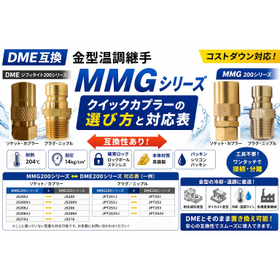
DME200 Compatible MMG200 Series | Selection Points and Features of Mold Cooling Couplers

  • Product news

The cooling couplers used in mold temperature control circuits are not just parts that "simply need to connect." Choosing the wrong one can lead to decreased cooling efficiency, liquid leaks, and increased setup time. Key points to particularly check are: - Workability during connection - Valve structure to prevent liquid leaks - Compatibility with existing equipment. For example, in environments where connections are made frequently, a structure that ensures a secure connection with a single touch becomes important. Additionally, the risk of liquid leaks during connection can vary depending on the valve mechanism, such as single/double shut-off. The MMG200 series is a quick coupler for mold temperature control that complies with the DME200 series standards. It features a space-saving design while incorporating a brass body and stainless steel lock, achieving both durability and stable connectivity. This series is suitable for sites that want to review or replace temperature control piping while maintaining compatibility with existing equipment. For more details, please refer to the product page.

May 11, 2026

Added to bookmarks

Bookmarks list

Bookmark has been removed

Bookmarks list

You can't add any more bookmarks

By registering as a member, you can increase the number of bookmarks you can save and organize them with labels.

Free membership registration
mmg-dme-compatible-mold-coupler-eyecatch1.jpg

Are you able to replace the DME Jifitite joint? | Reviewing costs and supply with MMG compatibility.

  • Product news

The DME Zifitite fittings, widely used in mold temperature control circuits, have recently become burdensome due to rising prices and longer delivery times for replacements and additions. In particular, there are increasing cases where parts are not readily available during sudden troubles, becoming a risk factor on-site. In response to these challenges, more sites are considering replacing them with DME-compatible fittings. The MMG series is a quick coupling for mold temperature control that is compatible with the DME Zifitite 200 series and can be used directly with existing equipment. If the connection dimensions and structure match, there are many cases where it can be introduced without any piping modifications, making it effective for cost and procurement reviews. Additionally, when selecting water inlet fittings, it is more important to check the connection thread size, shape, and usage conditions than to look for the same model number. Even if the model number is unknown, it is sometimes possible to select compatible products based on actual photos and dimensional information. If you are experiencing challenges with the cost or supply of DME fittings, why not consider utilizing compatible fittings? For more details, please visit the product page.

Apr 30, 2026

Added to bookmarks

Bookmarks list

Bookmark has been removed

Bookmarks list

You can't add any more bookmarks

By registering as a member, you can increase the number of bookmarks you can save and organize them with labels.

Free membership registration
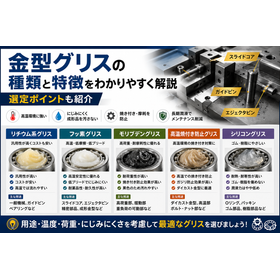
fluorine-grease-vs-silicone-grease.jpg

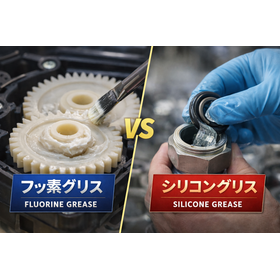
What is the difference between fluorine grease and silicone grease?

  • Product news

Fluorine grease and silicone grease are both lubricants with excellent heat resistance and chemical resistance, but there are clear differences in their applications and performance. Fluorine grease is primarily composed of PFPE (fluorinated oil) and PTFE, characterized by its excellent stability in high-temperature and chemical environments. For example, it maintains stable performance over a wide temperature range of -25°C to 280°C and is less affected by chemicals and solvents, making it suitable for lubricating sliding parts of molds and precision components. On the other hand, silicone grease is based on silicone oil and is characterized by its low tendency to damage rubber and resin, as well as its excellent waterproofing and insulation properties. Therefore, it is suitable for areas where material protection is important, such as O-rings, gaskets, and waterproof applications. In summary: - High temperature, chemical resistance, long lifespan → Fluorine grease - Waterproof, rubber protection, insulation → Silicone grease It is important to differentiate between them based on their uses. Selecting the appropriate lubricant according to the usage environment leads to trouble prevention and improved maintenance efficiency.

Apr 20, 2026

Added to bookmarks

Bookmarks list

Bookmark has been removed

Bookmarks list

You can't add any more bookmarks

By registering as a member, you can increase the number of bookmarks you can save and organize them with labels.

Free membership registration
fluorine-grease-uses-application.jpg

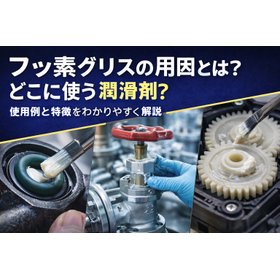
What are the uses of fluorine grease? Where is it used as a lubricant?

  • Product news

Fluorine grease is a high-performance lubricant that excels in heat resistance, chemical resistance, and low outgassing. It is used in environments where conventional mineral oil greases are inadequate. The main applications are as follows: - Mold components in high-temperature environments (approximately 200°C or higher) such as ejector pins and slides - Equipment parts exposed to chemicals or solvents - Clean environments (semiconductors, food, medical devices) - Areas requiring contamination control in resin molding Fluorine grease is chemically stable and has a characteristic that makes it difficult to mix with other greases. Therefore, degreasing and cleaning before application are crucial. Additionally, while it has excellent heat resistance, its extreme pressure performance is limited, which means it may not be suitable for areas subjected to high loads or shock loads. Proper selection according to the application directly contributes to preventing mold troubles and improving maintenance.

Apr 13, 2026

Added to bookmarks

Bookmarks list

Bookmark has been removed

Bookmarks list

You can't add any more bookmarks

By registering as a member, you can increase the number of bookmarks you can save and organize them with labels.

Free membership registration
fluorine-grease-lubricant.jpg

What are the disadvantages of fluorine grease? An explanation of its advantages and precautions.

  • Product news

Fluorine grease is used in a wide range of fields such as semiconductor equipment, chemical facilities, and food machinery as a high-performance lubricant with excellent heat resistance and chemical resistance. Its ability to maintain stable lubrication performance even in high-temperature environments and chemical contact environments is particularly noteworthy. On the other hand, there are also disadvantages. First, the high cost of raw materials tends to make the price expensive. Additionally, while it excels in low friction, its extreme pressure performance is not high, which may make it unsuitable for high-load applications such as large gears and heavy machinery. Furthermore, in general environments, its performance may be excessive, leading to cost disadvantages. Lubricants are not simply "high performance = optimal"; selecting the right one according to the usage environment is crucial. When chemical resistance and high-temperature compatibility are required, fluorine grease is appropriate, while for high loads, molybdenum grease may be needed, necessitating a distinction based on the application.

Mar 25, 2026

Added to bookmarks

Bookmarks list

Bookmark has been removed

Bookmarks list

You can't add any more bookmarks

By registering as a member, you can increase the number of bookmarks you can save and organize them with labels.

Free membership registration
mold-temperature-control-hose-disconnection-causes..png

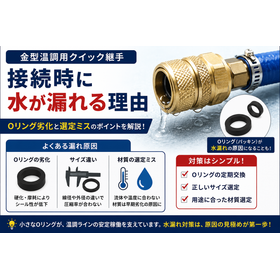
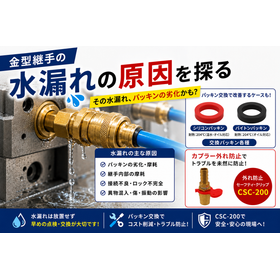
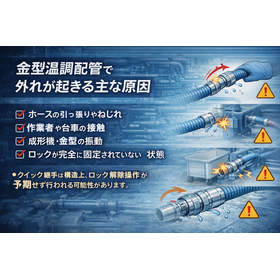
Safety measures to prevent hose disconnection in mold temperature control piping | Safety clip for quick couplings CSC-200

  • Product news

In mold temperature control circuits, quick couplings are widely used to supply cooling water and hot water. However, in the field, there are cases where piping can become disconnected due to factors such as pulling or twisting of hoses, contact with operators or carts, and vibrations from molding machines or molds. Additionally, hoses can become detached if the lock is not fully secured or due to unintended unlocking actions, leading to risks of temperature control water leaks and equipment shutdowns. The CSC-200 is a safety clip designed to prevent the unlocking of quick couplings by attaching to the lock section. It suppresses unintended disconnection of the couplings and enhances the safety of temperature control piping. It can be easily attached without tools and can be utilized as a safety measure for mold temperature control circuits. This product is recommended for sites considering measures to prevent hose disconnection in temperature control piping and enhance the safety of quick couplings. For more details, please visit the product page.

Mar 12, 2026

Added to bookmarks

Bookmarks list

Bookmark has been removed

Bookmarks list

You can't add any more bookmarks

By registering as a member, you can increase the number of bookmarks you can save and organize them with labels.

Free membership registration
エムアンドエム

The real reason why "maintenance frequency does not decrease" in high-temperature environments and the shortest route to take on-site (with checklist included).

  • Product news

In high-temperature environments, grease does not simply diminish; its "state" deteriorates due to hardening, separation, and carbonization. Even if there is some remaining, the lubrication function decreases, leading to increased sliding resistance, poor return, and fine seizure. If these warning signs are ignored, it will eventually progress to seizing or burning. Therefore, the idea that "using high-performance grease eliminates the need for reapplication" does not hold true in high-temperature areas. What is important is to visualize the signs of abnormalities and to establish rules for inspection, cleaning, and reapplication. Especially in die-casting molds, temperature changes, high surface pressure, and dust contamination overlap, causing lubrication conditions to fluctuate constantly. Maintaining a stable operational state takes precedence over reducing maintenance frequency. 【High-Temperature Sliding Component Checklist】 □ Is the return of the pin sluggish? □ Are there any signs of seizure or dust accumulation? □ Is the grease hardened or film-formed? □ Is there any catching when starting to move? □ After cleaning, is the appropriate amount reapplied? Rather than forcibly reducing maintenance frequency, the realistic approach is to operate in a way that prevents stoppage accidents before they occur.

Feb 27, 2026

Added to bookmarks

Bookmarks list

Bookmark has been removed

Bookmarks list

You can't add any more bookmarks

By registering as a member, you can increase the number of bookmarks you can save and organize them with labels.

Free membership registration
【Q&A】なぜ高温環境ではメンテナンス頻度が減らないのか?【第3弾】.png

【Q&A】Why doesn't the maintenance frequency decrease in high-temperature environments? 【Part 3】

  • Product news

In high-temperature environments such as die-casting molds, we sometimes receive inquiries stating that even when using high-temperature grease, the maintenance frequency does not decrease as expected. What are the reasons behind the notion that "heat-resistant grease = reduced maintenance frequency" not necessarily being true? In high-temperature environments, several complex factors come into play, including: - Evaporation and separation of oil - Oil film breakdown due to load and repeated sliding - Contamination by fine wear particles - Changes in properties due to temperature fluctuations As a result, simply having a high heat resistance does not guarantee the maintenance of a stable lubrication state. In this third installment, we will clarify: ✔ Why degradation progresses more easily in high-temperature environments ✔ The mechanisms behind seizure and sticking ✔ How to approach the decision for reapplication If you want to reassess the maintenance of high-temperature molds, please take a look. ▼ For more details, click here ▶︎ [Q&A] Why doesn't maintenance frequency decrease in high-temperature environments? [Part 3] (*https://mandm-goldengrease.com/why-grease-maintenance-frequency-high-temperature/)

Feb 16, 2026

Added to bookmarks

Bookmarks list

Bookmark has been removed

Bookmarks list

You can't add any more bookmarks

By registering as a member, you can increase the number of bookmarks you can save and organize them with labels.

Free membership registration
ChatGPT Image 2026年1月7日 13_50_21.png

【Q&A】What happens to grease at high temperatures? Does it stick? Deteriorate? Seize up?

  • Product news

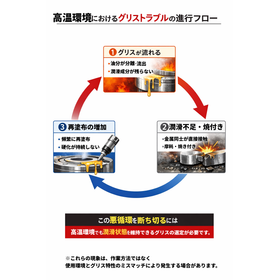
Q. What happens to grease in high-temperature environments? Does it stick, deteriorate, or seize? A. In high-temperature conditions, these phenomena often occur "gradually." In a high-temperature environment, the oil components in the grease become more prone to separation and movement, making it difficult for the lubricating components to remain in the moving parts. At this stage, stiffness in movement and insufficient lubrication begin to appear. If the condition where the lubricating film cannot be maintained continues, direct contact between metals increases, leading to friction and wear. As a result, issues such as seizing and sticking occur. In other words, the progression often follows this flow: deterioration → insufficient lubrication → seizing and sticking. Even if a problem seems to occur suddenly, there is always a change in lubrication condition in the preceding stages. In high-temperature environments, not only the heat resistance temperature values but also the ability to maintain lubrication under high temperatures become crucial points for grease selection. The changes in grease that occur at high temperatures and the mechanism of trouble occurrence are organized technically in the attached document.

Feb 02, 2026

Added to bookmarks

Bookmarks list

Bookmark has been removed

Bookmarks list

You can't add any more bookmarks

By registering as a member, you can increase the number of bookmarks you can save and organize them with labels.

Free membership registration
【Q&A】なぜ高温になると焼付きや動きの渋さが起きるのか?.png

【Q&A】Why do seizure and stiffness occur at high temperatures? 【Part 2】

  • Product news

In die-cast molds and movable parts used in high-temperature environments, issues such as "despite applying grease, movement becomes sluggish" and "eventually seizing occurs" can be observed. This phenomenon is not merely due to wear or insufficient lubrication; the main cause is the inability to maintain a lubricating film at high temperatures. As the temperature rises, the separation and volatilization of oil components progress, making it easier for metal parts to come into direct contact with each other, leading to increased friction and rising sliding resistance. Seizing does not occur suddenly; it is a phenomenon that surfaces as a result of the gradual deterioration of lubrication conditions. In high-temperature environments, it is not only the "heat resistance temperature value" that matters, but also whether lubrication conditions can be maintained at high temperatures, which becomes an important point in grease selection. The mechanisms behind seizing and sluggish movement, as well as considerations during selection, are organized technically in the attached materials.

Jan 19, 2026

Added to bookmarks

Bookmarks list

Bookmark has been removed

Bookmarks list

You can't add any more bookmarks

By registering as a member, you can increase the number of bookmarks you can save and organize them with labels.

Free membership registration
ダイカスト金型300.png

[Technical Issue] What causes grease to flow in high-temperature environments?

  • Product news

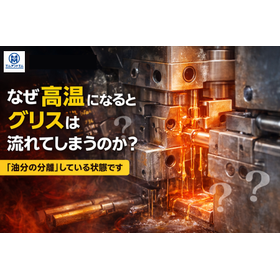
In high-temperature environments such as die-casting molds, there are many cases where, despite using high-temperature grease, "the grease flows away during operation." This phenomenon occurs not simply because the grease melts, but because the oil components separate under high temperatures, making it difficult for the lubricating components to remain in the moving parts. As a result, this leads to issues such as: - Oil splattering to the surroundings - Insufficient lubrication - Increased frequency of reapplication In high-temperature environments, it is not only the heat resistance temperature that matters, but also whether the lubrication state can be maintained under high temperatures, which becomes an important point in grease selection. Detailed causes and considerations for selection are organized technically in the attached document.

Jan 07, 2026

Added to bookmarks

Bookmarks list

Bookmark has been removed

Bookmarks list

You can't add any more bookmarks

By registering as a member, you can increase the number of bookmarks you can save and organize them with labels.

Free membership registration
Prev 1 Next
  • Contact this company

    Inquiry Form

Products

  • Search for Products

Company

  • Search for Companies

Special Features

  • Special Features

Ranking

  • Overall Products Ranking
  • Overall Company Ranking

support

  • site map
IPROS
  • privacy policy Regarding external transmission of information
  • terms of service
  • About Us
  • Careers
  • Advertising
COPYRIGHT © 2001-2026 IPROS CORPORATION ALL RIGHTS RESERVED.
Please note that the English text on this page is automatically translated and may contain inaccuracies.