【Q&A】What happens to grease at high temperatures? Does it stick? Deteriorate? Seize up?
 エムアンドエム
Q. What happens to grease in high-temperature environments? Does it stick, deteriorate, or seize?
A. In high-temperature conditions, these phenomena often occur "gradually."
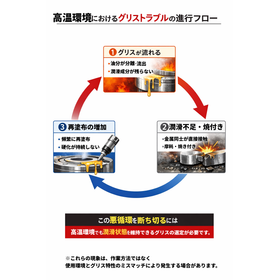
In a high-temperature environment, the oil components in the grease become more prone to separation and movement, making it difficult for the lubricating components to remain in the moving parts. At this stage, stiffness in movement and insufficient lubrication begin to appear.
If the condition where the lubricating film cannot be maintained continues, direct contact between metals increases, leading to friction and wear. As a result, issues such as seizing and sticking occur.
In other words, the progression often follows this flow: deterioration → insufficient lubrication → seizing and sticking. Even if a problem seems to occur suddenly, there is always a change in lubrication condition in the preceding stages.
In high-temperature environments, not only the heat resistance temperature values but also the ability to maintain lubrication under high temperatures become crucial points for grease selection.
The changes in grease that occur at high temperatures and the mechanism of trouble occurrence are organized technically in the attached document.
Inquiry about this news
Contact Us OnlineMore Details & Registration
Details & Registration
Related Documents
Related Links
How does grease change in high-temperature environments? This Q&A format explains the differences between flow, sticking/gelling, and seizing. It clearly organizes the concept of heat resistance temperature and the causes of high-temperature issues.
Related product


Related catalog(2)


Distributors