What are the reasons for the inability to disperse high-viscosity slurries? The mechanisms behind poor dispersion and design points for solutions.
 澁谷工業 メカトロ統轄本部
In the dispersion process of high-viscosity slurries, issues such as "not being dispersed despite being mixed" and "remaining clumps" occur. The main cause of these problems is that the increase in viscosity reduces fluidity, preventing dispersion energy from being evenly transmitted throughout the system. Generally, dispersion breaks apart agglomerated particles through shear force, but in a high-viscosity state, the flow becomes localized, leading to differences between areas experiencing shear and those that do not. As a result, undispersed areas and agglomerates remain, causing variations in particle size distribution and quality issues. Furthermore, the higher the viscosity, the weaker the circulation within the equipment, making it difficult for particles to pass uniformly through the processing area, which also decreases reproducibility. In batch processing, variations in residence time and mixing state become particularly pronounced, making it easier for lot differences to occur. To achieve stable dispersion in high-viscosity systems, not only shear enhancement but also flow design and ensuring circulation are important. By simultaneously controlling flow and shear, as in inline continuous processing, uniform and highly reproducible dispersion can be achieved. Additionally, the wettability of the powder and the method of introduction during the initial dispersion are also crucial; if the initial dispersion is insufficient, the subsequent breaking efficiency decreases.
Inquiry about this news
Contact Us OnlineMore Details & Registration
Details & Registration
Related Links
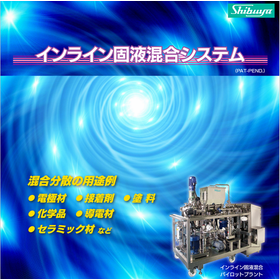
In the dispersion of high-viscosity slurries, not only shear force but also flow design and ensuring circulation are important. Our solid-liquid mixing system achieves stable dispersion even under high viscosity and high solid content conditions while maintaining consistent dispersion conditions through inline continuous processing. We offer process engineering that includes ensuring reproducibility during scale-up and process design.
Related product
Distributors