What are the reasons for the inability to disperse high solid content slurries? Causes of poor dispersion and design points for solutions.
 澁谷工業
澁谷工業
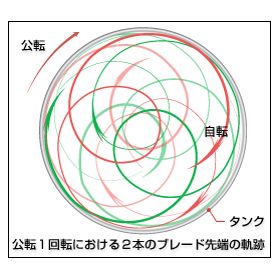
In the dispersion process of high solid content slurries, problems such as "too high viscosity to mix" and "unable to break down agglomerates" occur. The main cause of these issues is the increased frequency of particle contact, which strengthens the cohesive forces. As the solid content concentration increases, the distance between particles decreases, leading to interference between particles that reduces fluidity and prevents sufficient dispersion energy from being transmitted. Additionally, the crowding of particles restricts flow and makes shear localized, resulting in the persistence of undispersed areas and agglomerates. Furthermore, in a high solid content state, the increase in viscosity also leads to poor circulation and stagnation, causing variability in the dispersion state within the process. Particularly in batch processing, mixing inconsistencies and differences in processing history directly translate into quality differences, making it difficult to ensure reproducibility. To achieve stable dispersion under high solid content conditions, it is important not only to increase shear force but also to consider dispersion design that takes into account inter-particle interactions, as well as process design that simultaneously controls flow and shear. By establishing a mechanism like inline continuous processing, where particles pass through the processing area under constant conditions, uniform and highly reproducible dispersion can be achieved even at high solid contents.
Inquiry about this news
Contact Us OnlineMore Details & Registration
Details & Registration
Related Links
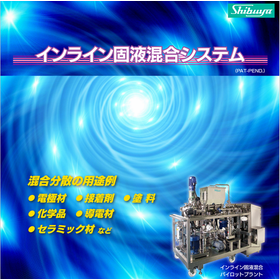
In the dispersion of high solid content slurries, issues such as flow reduction and enhanced aggregation due to particle interactions arise. Our solid-liquid mixing system simultaneously controls flow and shear through inline continuous processing, achieving a uniform dispersion even under high solid content conditions. We also offer proposals that include process design considering reproducibility and stable operation during scale-up.
Related product
Related catalog(1)

Distributors