Why can't powders be supplied stably? - What causes supply irregularities in low bulk density powders?
 澁谷工業 メカトロ統轄本部
In low bulk density powders and fine powders, issues such as "unstable supply," "pulsation," and "bridging without falling" frequently occur. Particularly with CNTs, carbon black, and flake powders, the particles tend to entangle easily and have low flowability, making stable quantitative supply difficult with conventional powder feeding methods.
When powder supply becomes unstable, instantaneous concentration fluctuations occur, significantly affecting the dispersion quality, viscosity, and conductivity in subsequent processes. In practice, even problems that appear to be "poor dispersion" often have their causes on the powder supply side.
Moreover, in low bulk density powders, bridging, rat-holing, and supply pulsations due to air entrapment are likely to occur within the hopper, and simply relying on feeder capacity may not resolve these issues. To achieve stable supply, it is crucial to design the entire process, including hopper design, supply methods, transport conditions, and feeding methods, according to the characteristics of the powder.
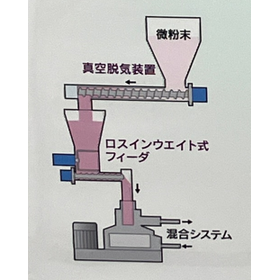
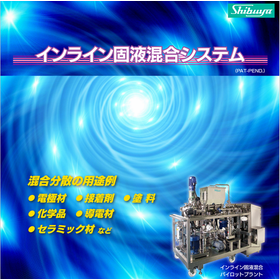
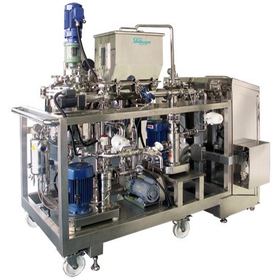
Our company offers a solid-liquid mixing process that includes quantitative supply using loss-in-weight feeders and integration with inline dispersion devices. By designing the entire process from powder supply to dispersion as a cohesive unit, we support the establishment of stable manufacturing conditions even for high-performance materials.
Inquiry about this news
Contact Us OnlineMore Details & Registration
Details & Registration
Related Links
Quality cannot be stabilized with just a disperser. This explains the reasons why fluctuations in supply volume, instantaneous concentration changes, and differences in process conditions lead to dispersion variability.
Related product

Related catalog(1)

Distributors