Tohoku University Technology: New CoCr alloys with low Young's modulus, high wear and corrosion resistance, and superelasticity: T20-542
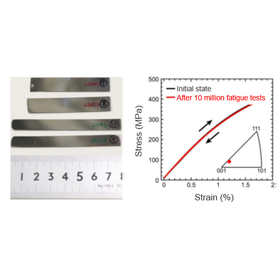
Alloys with high fatigue life and free of nickel element
β-Ti and conventional CoCr alloys are widely used for artificial joints because of their superior mechanical properties. Some β-Ti alloys show superelasticity and low Young's modulus; however, they have low wear resistance. Conventional CoCr alloys show excellent wear resistance, but they have very high Young's modulus, which is about 10 times that of human bones. Since low Young's modulus and wear resistance are properties with a trade-off relation, there has not been a biomaterial that realizes both. This invention is about new CoCr alloys that have an even lower Young's modulus than β-Ti alloys, which also boast high wear and corrosion resistance, and superelasticity. This invention shows a fatigue life of more than 10 million cycles up to a strain of 1.65% and it is expected to be the next-generation biological material. These alloys are characterized by a large elastic anisotropy. In the <100> direction, they show a Young's modulus of 30 GPa, comparable to human bones, making it suitable to use for artificial joints and bone plates. In the <111> direction, they have extremely high Young's modulus of 300 GPa, making it suitable to use for stents.
Inquire About This Product
basic information
For details, please contact us or refer to the PDF.
Price range
Delivery Time
Applications/Examples of results
For details, please contact us or refer to the PDF.
catalog(1)
Download All Catalogs
Company information
The revenue generated from technology transfer is reinvested as new research funding for universities and researchers, and is utilized to create further research outcomes. To ensure the smooth operation of this cycle, known as the "Intellectual Creation Cycle," we will vigorously promote technology transfer. The types of seeds we handle include patents, know-how, databases, and programs. We have established a collaborative framework by signing basic technology transfer agreements with the following universities (as of June 1, 2025): Tohoku University, Hirosaki University, Iwate University, Akita University, Fukushima University, Yamagata University, Tohoku Gakuin University, Iwate Medical University, Fukushima Medical University, Aizu University, Miyagi University, Hokkaido University, Muroran Institute of Technology, and Showa Medical University.

![[Information] Cases where seismic cable braces demonstrate their benefits.](https://image.mono.ipros.com/public/product/image/3a1/2000710116/IPROS00728117497524295849.png?w=280&h=280)