Tohoku University Technology: Spectrometer that can reduce stray light intensity to below 1/1000: T21-068

Able to detect wide range signal from nearultraviolet to near-infrared with good S/N ratio
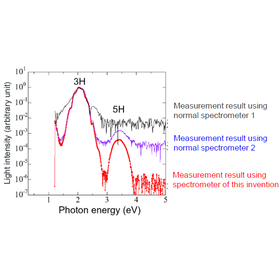
During spectroscopy, various stray light over a wide wavelength range is generated due to the effect of the 0th order reflected light, the 2nd order diffracted light and other scattered light generated in the spectrometer, in addition to the 1st order reflected light of the input light. In particular, for a measurement where a strong input light such as laser is used as a light source to detect weak signal light from sample, the signal light is difficult to detect due to stray light. In order to reduce stray light in spectrometer, cut filter using dielectric film and double monochromator-type spectrometer with monochromators connected in series have been developed. However, those methods cannot remove stray light over wide wavelength range at once. This invention is about a spectrometer equipped with a mechanism that can eliminate stray light in a wide wavelength range (from near-ultraviolet to near-infrared). The right figure shows the observed higher harmonics from the superconductor using this invention. Among the superconductor higher harmonics, the 3rd harmonic (around 2.1 eV = 590 nm) can be clearly observed with any spectrometer, but the 5th harmonic (around 3.4 eV = 360 nm) can be observed with good S/N ratio only with this invention. In particular, the noise of this invention is reduced by more than 3 orders of magnitude compared to the other spectrometers.
Inquire About This Product
basic information
For details, please contact us or refer to the PDF.
Price range
Delivery Time
Applications/Examples of results
For details, please contact us or refer to the PDF.
catalog(1)
Download All Catalogs
Company information

The revenue generated from technology transfer is reinvested as new research funding for universities and researchers, and is utilized to create further research outcomes. To ensure the smooth operation of this cycle, known as the "Intellectual Creation Cycle," we will vigorously promote technology transfer. The types of seeds we handle include patents, know-how, databases, and programs. We have established a collaborative framework by signing basic technology transfer agreements with the following universities (as of June 1, 2025): Tohoku University, Hirosaki University, Iwate University, Akita University, Fukushima University, Yamagata University, Tohoku Gakuin University, Iwate Medical University, Fukushima Medical University, Aizu University, Miyagi University, Hokkaido University, Muroran Institute of Technology, and Showa Medical University.


![[Introduction of Development and Manufacturing Achievements] Measurement/Analysis Equipment](https://image.mono.ipros.com/public/product/image/093/2000993969/IPROS37520067786752406875.png?w=280&h=280)


![Amenities Meter: Creating a Comfortable Working Space with IoT [Work Style Reform]](https://image.mono.ipros.com/public/product/image/6fb/2001027009/IPROS12754886358639934309.png?w=280&h=280)