Tohoku Univ. Technology : Biological image processing program : T21-091

New Lightweight DL Model for Medical Image Processing, Denoising, and Disease Classification
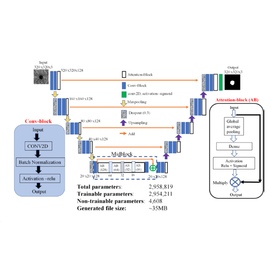
Medical images are complicated and noisy. Device manufacturers are conducting R&D on denoising technologies using deep learning (DL). Unet is a popular model developed for medical image segmentation and has been used for image denoising. Unet as well as other DL models with higher prediction accuracies require large computational resources and have become a barrier to use in standalone devices for remote diagnosis or deployment of AI-solutions in mobile devices for smart digital medicine. The "LWBNA-unet" of the present invention was designed with a focus on efficiency and reduction of computational resources. It succeeded in reducing weight by about 10 times as compared to the conventional Unet model. Similar to controlling the flow of information through a channel by changing its width, the LWBNA-Unet performs channel control by gradually decreasing the number of filters with attention to discriminate unnecessary features, which enables highly accurate segmentation of image features in complex and noisy images. The method is also capable of detecting and classifying diseases automatically with high accuracy under low computational resource environments. It is shown that the model has better capabilities of learning in terms of reproducibility and accuracy with smaller datasets as compared to conventional Unet and DeepLabv3+, models under same conditions.
Inquire About This Product
basic information
For details, please contact us or refer to the PDF.
Price range
Delivery Time
Applications/Examples of results
For details, please contact us or refer to the PDF.
catalog(1)
Download All Catalogs
Company information

The revenue generated from technology transfer is reinvested as new research funding for universities and researchers, and is utilized to create further research outcomes. To ensure the smooth operation of this cycle, known as the "Intellectual Creation Cycle," we will vigorously promote technology transfer. The types of seeds we handle include patents, know-how, databases, and programs. We have established a collaborative framework by signing basic technology transfer agreements with the following universities (as of June 1, 2025): Tohoku University, Hirosaki University, Iwate University, Akita University, Fukushima University, Yamagata University, Tohoku Gakuin University, Iwate Medical University, Fukushima Medical University, Aizu University, Miyagi University, Hokkaido University, Muroran Institute of Technology, and Showa Medical University.
![[Example] Automatic parallelization for image processing programs](https://image.mono.ipros.com/public/product/image/210/2000320403/IPROS94427310392788662937.png?w=280&h=280)




![[Leveling Correction] Leveling correction of concrete floors "Teratec Method"](https://image.mono.ipros.com/public/product/image/d08/1267539002/IPROS70063422645318547243.jpeg?w=280&h=280)