Hirosaki Univ. Technology : New catalyst for inducing same oxidation reaction under illumination even in the dark : K23-025

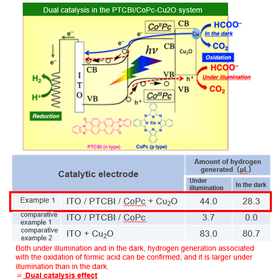
Can oxidize formic acid in the dark
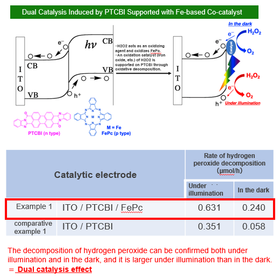
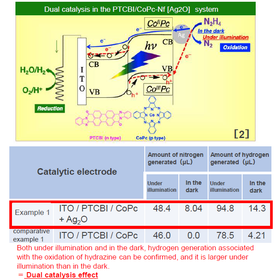
Photocatalysts are materials that induce redox reactions under illumination. In particular, it is effective for downhill reactions (oxidative degradation of hazardous and pollutants) and titanium oxide (TiO2) which is UV light responsive, is already in practical use. However, TiO2 photocatalytic technology is limited to small amounts and low concentrations of substances based on the solar light spectrum, and there is a problem that oxidation degradation treatment similar to that under illumination is never induced in the dark conditions. In his research for application as a photoelectrode and photocatalyst for organic p-n junctions, the inventor found that organic p-n junctions can catalyze (= dual catalysis) the oxidation of thiols even in the dark conditions [1]. In addition, as a result of his intensive research, he succeeded in expanding the target of dual catalysis to formic acid, hydrogen peroxide, and hydrazine by supporting a cocatalyst on organic p-n junctions. Dual catalysis is a new type of catalysis that TiO2 does not have. The selection of organic p-n junctions and co-catalysts is expected to expand the application range and market size of catalysts for environmental purification applications.
Inquire About This Product
basic information
For details, please contact us or refer to the PDF.
Price range
Delivery Time
Applications/Examples of results
For details, please contact us or refer to the PDF.
catalog(1)
Download All Catalogs
Company information

The revenue generated from technology transfer is reinvested as new research funding for universities and researchers, and is utilized to create further research outcomes. To ensure the smooth operation of this cycle, known as the "Intellectual Creation Cycle," we will vigorously promote technology transfer. The types of seeds we handle include patents, know-how, databases, and programs. We have established a collaborative framework by signing basic technology transfer agreements with the following universities (as of June 1, 2025): Tohoku University, Hirosaki University, Iwate University, Akita University, Fukushima University, Yamagata University, Tohoku Gakuin University, Iwate Medical University, Fukushima Medical University, Aizu University, Miyagi University, Hokkaido University, Muroran Institute of Technology, and Showa Medical University.


![Photocatalytic compounded resin [masterbatch] with antibacterial properties, freshness preservation, and environmental consideration.](https://image.mono.ipros.com/public/product/image/2077992/IPROS5927286732061576782.jpg?w=280&h=280)


![[Leveling Correction] Leveling correction of concrete floors "Teratec Method"](https://image.mono.ipros.com/public/product/image/d08/1267539002/IPROS70063422645318547243.jpeg?w=280&h=280)