
Automatic estimation of ground strength while excavating
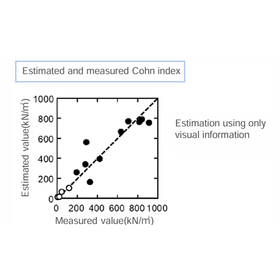
In civil engineering works, the need for unmanned construction of construction machinery is increasing, and it is required to ensure safety and improve work efficiency not only during disaster recovery but also in normal times. However, the current unmanned construction is only monitored by cameras, and the work efficiency is worse than manned construction. The shortage of ground information is a problem as a factor of this efficiency lowering. Generally, the cone index, an indicator to assess the running ability of construction equipment, is measured using a cone penetration tester, but the number of measurement points increases in a wide area of land due to ground variations from place to place. In addition, the measurement needs to be carried out independently from excavation and other earthworks, which is time-consuming. This invention is based on the relationship between the fracture morphology of soil excavated by hydraulic excavators widely used in the field and the cone index. It is possible to automatically estimate the strength of the ground from visual information by photographing the fracture morphology of the soil being excavated and extracting the features of the fracture morphology. In addition, the visual information can be combined with the force sense information acting on buckets. Since the invention can estimate in real time while excavating, it is expected to greatly improve the work efficiency in unmanned construction.
Inquire About This Product
basic information
For details, please contact us or refer to the PDF.
Price range
Delivery Time
Applications/Examples of results
For details, please contact us or refer to the PDF.
catalog(1)
Download All Catalogs
Company information

The revenue generated from technology transfer is reinvested as new research funding for universities and researchers, and is utilized to create further research outcomes. To ensure the smooth operation of this cycle, known as the "Intellectual Creation Cycle," we will vigorously promote technology transfer. The types of seeds we handle include patents, know-how, databases, and programs. We have established a collaborative framework by signing basic technology transfer agreements with the following universities (as of June 1, 2025): Tohoku University, Hirosaki University, Iwate University, Akita University, Fukushima University, Yamagata University, Tohoku Gakuin University, Iwate Medical University, Fukushima Medical University, Aizu University, Miyagi University, Hokkaido University, Muroran Institute of Technology, and Showa Medical University.


![[Construction Case] Retaining Wall Work Leaderless](https://image.mono.ipros.com/public/product/image/30c/2000584793/IPROS97842325495658233891.png?w=280&h=280)


![[Leveling Correction] Leveling correction of concrete floors "Teratec Method"](https://image.mono.ipros.com/public/product/image/d08/1267539002/IPROS70063422645318547243.jpeg?w=280&h=280)