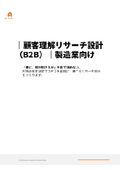
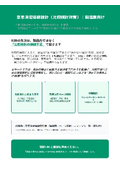
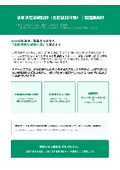
6. Customer Understanding Research Design (B2B) | For the Manufacturing Industry

Don't rely on intuition to decide 'who will be impacted by what.' We will create a winning research design based on the B2B decision-making process.
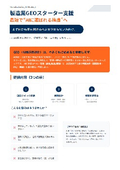
The reason why B2B web and sales efforts are ineffective is that "customer understanding design" is missing before implementing measures. Decision-makers are not just one person; they compare based on different axes such as technology, purchasing, on-site operations, and management. If you create pages or materials without capturing this, even if the amount of information increases, it won't resonate, and you will quietly continue to lose in the comparison process. This service is designed to establish a "foundation" for improving the accuracy of subsequent web design, proposal materials, and content production, based on the target customers' consideration process (DMU) and purchasing journey, specifically focusing on **"what to verify, with whom, and in what order."** ■ Provided Content (3 points) - Hypothesis organization (target/issue/selection criteria/competitive comparison axes) - Research design (research items, methods, samples, question design) - Connection design to measures (translation of messages, content, and pathways) Deliverables: B2B customer understanding research design document (hypotheses, design, questionnaire/guide, analysis framework) Scope/Assumptions: Primarily "up to design" (actual research = conducting interviews/surveys/log analysis is a separate option) *Please share the current URL, product, and assumed target. We will start organizing from the "hypotheses to be verified" as soon as possible.*

Inquire About This Product
basic information
■Provided Content DMU Organization: Interest axes and counterpoints for technology, field, purchasing, and management Purchasing Journey Design: Breakdown of information needs from awareness to comparison, approval, and decision-making Selection Criteria Extraction Design: Axes for customer comparison (criteria other than price) Competitive Comparison Design: Verification items for competitors' strengths/weaknesses and differentiation points Research Design: - Desk Research (market, standards, applications, implementation conditions) - Customer Interview Design (question guide, target conditions, collection design) - Survey Design (questionnaire, screening, sample design) - Web/Document Log Perspective Design (which data to use for hypothesis verification) Strategy Connection: Message framework, integration into FAQ/case studies/document structure ■Deliverables Research Design Document (objectives, hypotheses, verification items, research methods, overall design) Interview Guide (question proposals, probing branches, collection conditions) Survey Design (questionnaire draft, question intentions, aggregation axes) Analysis Framework (segmentation, comparison axes, decision-making factor organization methods) Strategy Translation Memo (points for reflecting in web structure, content, and sales materials)
Price information
Light: 200,000 yen (hypothesis organization + minimal design document + question guide) Standard: 400,000 yen (design document + interview/survey design + analysis framework) Extended: 700,000 yen and up (enhanced design for multiple products/multiple segments/competitive comparison) *Can be changed to require a quotation.
Delivery Time
※Minimum 10 business days to standard 2 to 3 weeks (depending on the scope).
Applications/Examples of results
■Concerns The target audience is too broad, making both web and sales ineffective. Even when explaining the product's strengths, people ask, "What’s good about it, after all?" The reasons for losing deals are vague, making it difficult to identify areas for improvement. There are downloads of materials, but they do not lead to business discussions (it's hard to gauge interest). The "deciding factor" when compared to competitors is not clearly articulated. ■Uses Preliminary steps for web redesign and GEO design (building a foundation for customer understanding). Improving the accuracy of sales materials and proposal talks (establishing comparison criteria). Identifying reasons for lost deals and improving FAQ/case studies/material structure. Narrowing down the target audience (identifying the right audience). ■Examples of Achievements (Confidentiality Consideration Format) Industrial equipment × 200 employees × lost deals due to comparisons × organized interest axes by DMU and redesigned messages. Precision machining × 80 employees × not leading to business discussions × designed interviews to verify selection criteria hypotheses. Chemical materials × 500 employees × dispersed across multiple businesses × designed consideration processes by segment.
catalog(20)
Download All Catalogs



Company information

A site that is just cheap ultimately increases costs and risks." We propose web development that maximizes business results while thoroughly addressing essential requirements. Are you creating a website like this? - It seems that the websites of competitors look better, but you don't know why. - Every update incurs additional costs, and before you know it, expenses have ballooned beyond expectations. - While the appearance is nice, it ignores laws and industry-specific rules, leading to complaint risks... - You want to attract customers and inquiries, but the production company only talks about design. - As a result of choosing a production that is simply cheap, you are overwhelmed with trouble handling and can't focus on your core business. Point 1. Avoid troubles with a design that has no "gaps or omissions." 2. Minimize operational costs with a design that assumes in-house updates. 3. Planning power that pursues business results. "Is the initial cost a bit high?" But in the long run, it's safe and cost-effective. We have prepared a plan to truly deliver results "correctly.