
Hamada-style AI Quality Standard
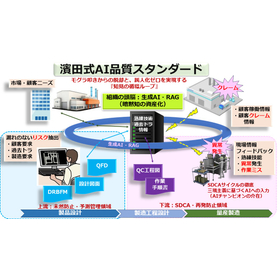
What is the "Hamada-style AI Quality Standard"? It is based on two pillars that simultaneously drive downstream site improvements and upstream prevention.

Starting tomorrow, it can be used on-site! Utilizing AI and RAG, we simultaneously implement two pillars: improving downstream operations and preventing issues upstream by leveraging skilled know-how.
Differences from Conventional Quality Management and DX: "Japan's First! Quality Management Using AI" Starting Point - Conventional ISO/TQM → Begins with the organization of documents and standards - IT Vendor-led DX → Begins with the introduction of systems - Hamada Method → Begins with the pain and tacit knowledge of the field Positioning of AI - Conventional ISO/TQM → Not applicable - IT Vendor-led DX → Objective - Hamada Method → Competent editor/search engine Handling of Tacit Knowledge - Conventional ISO/TQM → Left as individual knowledge - IT Vendor-led DX → Fragmented as data - Hamada Method → Integrated and utilized as organizational knowledge through RAG Human Resource Development - Conventional ISO/TQM → Dependent on OJT - IT Vendor-led DX → Only system operation training - Hamada Method → Gradually develop AI champions in 6 steps Prevention of Recurrence - Conventional ISO/TQM → Only documents corrective actions - IT Vendor-led DX → Data increases but is not utilized - Hamada Method → Past issues are returned to the next design as "living wisdom" Youtube: https://youtu.be/0eHTD1RvUYc
Inquire About This Product
basic information
"6-Step" Introduction Roadmap to Avoid Confusion: Implementable from Anywhere, at Any Scale Step 1: Visualization of Abnormalities and Proper Reporting, Communication, and Consultation Step 2: Leaders Lead Problem Solving with PDCA and Why-Why Analysis Step 3: Decision Making Using Data with QC Seven Tools and Statistical Analysis Step 4: Building a Recurrence Prevention System Using Generative AI × RAG Step 5: Establishing Prevention at the Design Stage with DRBFM + Generative AI
Price information
● "Free" Online Seminar (Held Monthly) Thoroughly understand quality management utilizing digital technology; special services available https://monozukuri-japan.seesaa.net/article/504158085.html ● "Generative AI × RAG: Quality Management Method" 6-Step Seminar for Immediate Practical Application (May, June) https://monozukuri-japan.seesaa.net/article/519455065.html <Each Step: 5000 yen/person>
Price range
Delivery Time
Applications/Examples of results
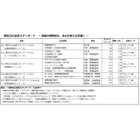
Major Seminar Achievements (Planned) for 2026 January - How to Conduct Why-Why Analysis Back to Design Issues and Utilize It for Recurrence Prevention - New Product Launch and Process Audit February - Evolved 4M Management, Real-Time Management with Digital Tools - Utilizing AI for Human Error Prevention and Recurrence Prevention - AI Utilization DRBFM Implementation Procedures March - Practical Techniques for Technology and Skill Inheritance and Quality Improvement Using Generative AI and RAG (March 11) - Misunderstandings of Why-Why Analysis (March 16) - Mechanizing AI! Human Error Countermeasures Utilizing Generative AI (March 17) - 4M Management Procedures in Manufacturing Sites (March 23) - The "Four Causes" of Procedure Document Formalism and "Breakthroughs with AI" (March 24) - Efficiency and Approach for FMEA and DRBFM Utilizing Generative AI (March 30) April - Human Error Countermeasures Using AI and Digital Technology (April 17 / April 23) - Basics of Quality Management (April 20) May - Data Utilization (May 11) - AI Quality Standard 6-Step Course (May 22 / May 29)
Detailed information
-
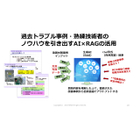
Inscribe veteran skills into AI. Concrete measures to transform "negative legacies" into the "strongest database" through RAG construction. <Transforming "negative legacies" into assets> Scattered notes, past trouble reports, and the "intuition" that only veterans possess are "negative legacies" if left unorganized. However, by using the technology of RAG (Retrieval-Augmented Generation), these fragments can be learned by AI, evolving into an "in-house knowledge base" that provides "answers based on veteran experience" in response to inquiries from younger employees. Now is the time to either ride this wave or wait for the technology to dry up. This is your last chance to connect your company's "on-site capabilities" to the next generation. ▼ Seminar details on 3/11 here https://monozukuri-japan.seesaa.net/article/517628579.html Theme: Practical inheritance of technology and skills and quality improvement through AI utilization (RAG) Date: March 11, 2026 (Wednesday) 13:30~17:00
-
What is the "Hamada-style AI Quality Standard"? It is a field-driven quality management method that integrates universal on-site fundamentals (analog) with cutting-edge generative AI and RAG (digital), transforming individuals' "tacit knowledge" into the organization's "digital assets." Its greatest feature is that it is based on "down-to-earth field capabilities," such as the three realities principle, SDCA/PDCA, and the iceberg model of systems. Rather than treating AI as a magic wand, it systematizes specific procedures to incorporate it into practical work as a "capable editor" or "past trouble search engine" (application of the SECI model, utilization of prompts, etc.).
Company information

■Company Name: Takasaki Swift Technology Solutions Co., Ltd. ■Established: March 1, 2014 ■Company Incorporation: August 15, 2017 ■Representative: Representative Employee Kanou Hamada ■Capital: 2 million yen ■Sales: 20 million yen ■Main Business: Manufacturing Technology Consulting (Quality Improvement/Productivity Enhancement) ● Subsidy Application Support (Restructuring Subsidy, Overseas Supply Chain Resilience Subsidy, etc.) ● Contract Design and Manufacturing of Molds, etc. (Prototype Molds, Parts Machining, Glossy Coating, etc.) ● Manuals and DVD Series for Immediate Use on Site (On-site Handbooks, Self-Learning, Employee Training Texts) ● Seminars (For Young and Mid-Career Employees / For Managers) ● Quality Improvement Support (Quality Improvement, New Product Launch, Contract Manufacturing)
![[Attention Companies in Okayama Prefecture] AI Development Case Study - AI × Anomaly Detection -](https://image.mono.ipros.com/public/product/image/f47/2000701943/IPROS16321505002534147884.PNG?w=280&h=280)


