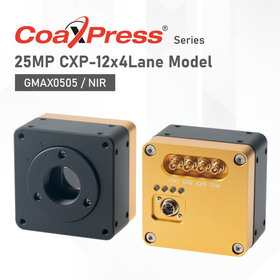
[For Biological Analysis] 25MP Near-Infrared Camera | 850–940nm High QE
BC-GN25M12X4

A high-speed, high-resolution NIR camera that accelerates the visualization of biological analysis.
In this field, it is necessary to observe deep tissues without damaging biological tissues and to capture weak luminescence and fluorescence. 【Application Scenes】 - Digital pathology (digital disease diagnosis) - Reading of biochips and microarrays - In-vivo imaging 【Effects of Introduction】 - High quantum efficiency (QE) at 850–940nm - Detailed analysis due to high resolution - Easier capture of dynamic phenomena through high-speed imaging - Improved near-infrared sensitivity for obtaining more information
Inquire About This Product
Related Videos
basic information
【Features】 - GMAX0505 Near Infrared (NIR) compatible - Up to 150.3 fps output with CXP-12×4Lane connection - Supports C-mount while maintaining high resolution - 70mm square housing - Fanless - Actively adopts next-generation key devices to achieve low power consumption and low heat generation
Price range
Delivery Time
Applications/Examples of results
Various inspection and monitoring applications using near-infrared wavelengths (monitoring systems, food, medical, etc.)
Line up(1)
| Model number | overview |
|---|---|
| BC-GN25M12X4 | 25MP / NIR / 150.3fps / CXP-12 / C mount / Micro-BNC connector |
catalog(3)
Download All Catalogs![25MP CoaXPress Area Camera [Near Infrared (NIR) Compatible Model]](https://image.mono.ipros.com/public/catalog/image/01/0f6/790848/IPROS79618208834297313.jpeg?w=120&h=170)
Company information

We focus on the design, development, manufacturing, and sales of high-speed, high-resolution, and highly reliable machine vision cameras primarily using CoaXPress and CameraLink. In addition to developing standard products, we also offer development and customization tailored to customer requests. All camera design and development is carried out by our Japanese staff, ensuring design and production techniques that guarantee delicate and highly reliable standards in Japan, while integrating the dynamic action and speed of China to provide competitive products. At Japan Bopixel, we have successfully become the first camera manufacturer to utilize Ultra Low Power FPGA instead of the standard FPGA adopted by the majority of camera manufacturers. This Ultra Low Power FPGA reduces power consumption by over 50% compared to similar class FPGAs, significantly lowering power consumption and heat generation in cameras by addressing the heat source at its root. By actively adopting these next-generation key devices, we are taking a new approach to the heat generation issues that have traditionally been a challenge.