

The belief that 'stainless steel shouldn't rust' is a misconception. This explains the conditions under which stainless steel can corrode and the measures to counteract it.
■Why Does Stainless Steel Rust? The corrosion resistance of stainless steel is maintained by a very thin oxide film (passivation film) that forms on its surface. When this film is damaged, the metal substrate is exposed and corrosion progresses. The typical causes of damage to the passivation film are as follows: - Pitting corrosion due to chloride ions: In environments containing chlorine, the passivation film can be locally destroyed, leading to localized corrosion. - Galvanic corrosion: When different types of metals come into contact and are exposed to an electrolyte solution, one metal preferentially corrodes due to the potential difference. - Stress corrosion cracking: This phenomenon occurs when tensile stress and a corrosive environment act simultaneously, causing the material to fracture in a brittle manner. While the above describes the typical corrosion mechanisms of stainless steel, the causes of corrosion can vary depending on factors such as the type and concentration of chemicals used, temperature, and stress conditions. At Yoshida SKT, we offer anti-corrosion coatings and linings tailored to our customers' usage environments. If you are troubled by metal corrosion, please feel free to consult us. *For information on anti-corrosion coatings and linings, please download the PDF for details.
Inquire About This Product
Related Videos
basic information
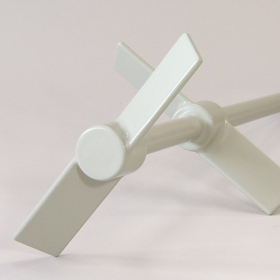
■ Thick Film Fluororesin Coating (Film Thickness 300–2000 μm) 【Fluororesin with Excellent Chemical Resistance】 Fluororesin is chemically stable, so it is not affected by most acids, alkalis, and other chemical substances, nor do its molecules dissolve and leak out. 【Thick Film Pinhole-Free Fluororesin Coating】 By applying a pinhole-free thick film coating to can bodies or substrates where lining and molding are not possible, it is possible to protect against corrosive liquids and gases such as acids and alkalis, as well as to prevent the leaching of metal ions.
Price information
-
Delivery Time
Applications/Examples of results
●Applications Equipment for semiconductor manufacturing processes Plating-related jigs Parts for chemical plants Chemical transport containers Laboratory instruments Centrifuges Heat exchangers, etc.
catalog(3)
Download All Catalogs


Company information

To maximize the performance of manufacturing equipment and machine parts, Yoshida SKT derives the "optimal solution" tailored to our customers from hundreds of surface treatment technologies. - Decreased productivity due to adhesive troubles - Instability in product quality due to friction - Early deterioration of equipment due to corrosion We respond to these challenges in the manufacturing field with our extensive track record and reliable technical expertise. In 1963, we began fluoropolymer processing. In 1968, we signed a licensing agreement with DuPont (now Chemours), supporting manufacturing innovations for over 2,000 customers across various industries, from automotive to medical and aerospace. Furthermore, in 2024, we are focusing on the development of next-generation products, such as PFAS-free coatings, contributing to the advancement of sustainable manufacturing. With a three-base system in Nagoya, Tokyo, and Yamaguchi, we flexibly respond to both mass production and custom orders. Our consistent quality management system ensures that we deliver reliable quality. For solving challenges in the manufacturing field, trust the surface treatment experts at Yoshida SKT.
![[Free Offer] Prevent Blade Troubles in Production Equipment! Non-Stick Thin Film Coating](https://image.mono.ipros.com/public/product/image/fde/2000612726/IPROS23915370847246220159.jpeg?w=280&h=280)
![[Free Giveaway] Non-Stick Coating | Prevent Blade Troubles in Production Equipment!](https://image.mono.ipros.com/public/product/image/a78/2000619955/IPROS37607432622075090550.jpeg?w=280&h=280)

![[Surface Treatment Case] Surface treatment that streamlines the manufacturing process of lithium-ion batteries.](https://image.mono.ipros.com/public/product/image/604/2000700111/IPROS81671406460541521470.jpeg?w=280&h=280)
![[Surface Treatment Case] Improving Production Equipment for Lithium-Ion Batteries!](https://image.mono.ipros.com/public/product/image/5b1/2000703368/IPROS15171996575415638336.jpeg?w=280&h=280)