1~45 item / All 611 items
Displayed results
Filter by category

Added to bookmarks
Bookmarks listBookmark has been removed
Bookmarks listYou can't add any more bookmarks
By registering as a member, you can increase the number of bookmarks you can save and organize them with labels.
Free membership registration
Contact this company
Inquiry FormBefore making an inquiry
Download Profile1~45 item / All 611 items
Filter by category

Fluororesin coatings have excellent electrical insulation properties, which makes them prone to charging in environments where static electricity is generated, potentially leading to issues such as dust adhesion, material sticking, and damage to electronic components. Yoshida SKT Co., Ltd.'s "Safron" is a fluororesin-based surface treatment that enables static electricity prevention by allowing the charges generated on the coating surface to flow to the substrate metal or ground. It maintains the characteristics of fluororesin, such as non-stickiness, low friction, chemical resistance, and water repellency, while reducing problems caused by adhesion and clogging due to static electricity. Depending on the application, the lineup includes "Safron AP+" with enhanced release properties and corrosion resistance for thick film applications, "AS+" for anti-fouling properties, "LF+" for low friction and low-temperature processing on resin substrates, and "CC+" which maintains transparency. A urethane-based anti-static grade is also available, and these products are widely adopted in various fields from semiconductors to the chemical industry and general manufacturing. Pre-evaluation using test pieces is also possible.
Added to bookmarks
Bookmarks listBookmark has been removed
Bookmarks listYou can't add any more bookmarks
By registering as a member, you can increase the number of bookmarks you can save and organize them with labels.
Free membership registration
Surface treatment encompasses a variety of methods, including resin coatings such as fluororesin, ceramic-based treatments, wet processes like plating, thermal spraying, and lining. It is crucial to clarify "what functions are needed" before determining "which treatment to use." Yoshida SKT Co., Ltd. selects surface treatments based on the specific functions required, such as non-stick properties, slip resistance, chemical resistance, heat and cold resistance, water and oil repellency, hydrophilicity, wear resistance, electrical properties, static prevention, dimensional stability, and coating surface roughness adjustment. In addition to coatings made from fluororesin, silicone, ceramics, urethane, and super engineering plastics (such as PI, PEEK, PBI, etc.), we also accommodate various processes, allowing for proposals that are not biased towards specific treatment methods. Since the functions required on-site are interrelated and complex, conducting technical discussions with a broad perspective leads to maximized effectiveness. We respond with a proven track record of supporting over 2,000 companies since 1963.
Added to bookmarks
Bookmarks listBookmark has been removed
Bookmarks listYou can't add any more bookmarks
By registering as a member, you can increase the number of bookmarks you can save and organize them with labels.
Free membership registration
In the production sites of medical and pharmaceutical industries, a very strict level of cleanliness is required alongside productivity. Yoshida SKT Co., Ltd. provides functional coatings for equipment parts in the medical and pharmaceutical fields, such as pharmaceutical packaging machines, tablet press machines, and pathology testing equipment. In pharmaceutical packaging machines, 'Bicoat' and fluororesin coatings are used to improve the non-stick properties, slip characteristics, and wear resistance of guides and sealers. In the tablet production line, 'Bicoat' is applied to tablet presses, hoppers, and guides to enhance the slip characteristics of tablets, contributing to quality improvement. Fluororesin coatings are used around stages, hot plates, and parts that use paraffin in pathology testing equipment. In the transport chute for eye drop bottles in sterile rooms, the convex surface-maintaining 'TP coating' achieves a lifespan more than ten times that of standard fluororesin (PTFE) coatings, with instances of contributing to nearly a year of unmanned operation without maintenance. We respond with licensed processing technology and inspection systems certified by Chemours (formerly DuPont) since 1968.
Added to bookmarks
Bookmarks listBookmark has been removed
Bookmarks listYou can't add any more bookmarks
By registering as a member, you can increase the number of bookmarks you can save and organize them with labels.
Free membership registration
We will guide you through the process of requesting Teflon coating (fluororesin coating) for the first time and provide points for selecting a contractor. Among industrial fluororesin coatings, only processing manufacturers certified by Chemours (formerly DuPont) are allowed to use the name "Teflon coating." Yoshida SKT Co., Ltd. started fluororesin processing in 1963 and became a certified processing manufacturer by signing a licensing agreement with DuPont in 1968. When making a request, it is smooth if you organize the following three points: (1) Purpose of introduction (2) Coating target (base material and shape) (3) Usage environment and conditions Costs will be individually estimated based on shape, quantity, type of film, film thickness, and condition of the substrate. We can accommodate requests from one piece to mass production, from precision parts to tanks with a depth of 6 meters, at our three factories located in Nagoya, Tokyo, and Yamaguchi. Please consult us by phone (052-524-5211) or through our web form.
Added to bookmarks
Bookmarks listBookmark has been removed
Bookmarks listYou can't add any more bookmarks
By registering as a member, you can increase the number of bookmarks you can save and organize them with labels.
Free membership registration
Fluororesin coating and silicone coating are representative methods of release and non-stick coatings. Yoshida SKT Co., Ltd. handles the processing of both methods in-house, and from that position, we will introduce the considerations for their appropriate use. Fluororesin (such as PTFE) has an extremely low critical surface tension, making it multifunctional with non-stick properties, chemical resistance, electrical characteristics, and low friction. The continuous use temperature is 260°C (PTFE, PFA). Silicone also exhibits excellent release and water-repellent properties due to its low surface tension. Furthermore, our silicone-based 'MRS coating' is a surface treatment that improves the solvent resistance and film hardness issues of conventional silicone coatings, providing better release properties than Teflon (TM) fluororesin coatings, and is effective for adhesive tapes, raw rubber, and hot melt adhesives. Depending on the grade, it can be used at temperatures up to 300°C or for low-temperature processing below 80°C (compatible with resin and rubber substrates).
Added to bookmarks
Bookmarks listBookmark has been removed
Bookmarks listYou can't add any more bookmarks
By registering as a member, you can increase the number of bookmarks you can save and organize them with labels.
Free membership registration
For addressing "sticking," "clogging," and "burning" issues in food manufacturing lines, coatings that excel in non-stick, water-repellent, oil-repellent, and slip properties are effective. Yoshida SKT Co., Ltd. offers fluororesin coatings that comply with the Positive List (PL) system introduced by the revised Food Sanitation Act, which came into effect in June 2020 and will be fully implemented by June 1, 2025. While adhering to this system that allows only substances evaluated for safety, we achieve high levels of non-stick, water-repellent, oil-repellent, and slip properties required in food manufacturing environments. We have a proven track record of applications in various parts of food machinery, such as preventing burning in baking and confectionery molds, preventing clogging in automatic packaging machine transport guides, preventing resin adhesion in heat sealers, and improving liquid drainage in measuring cups. We also accommodate prototype production starting from one piece and can conduct preliminary evaluations using test pieces. We will propose the optimal treatment, including compliance with the PL system, based on your application and cleaning conditions.
Added to bookmarks
Bookmarks listBookmark has been removed
Bookmarks listYou can't add any more bookmarks
By registering as a member, you can increase the number of bookmarks you can save and organize them with labels.
Free membership registration
For corrosion protection of tanks, piping, valves, and pumps in chemical plants, a fluoropolymer coating/lining with excellent chemical resistance is effective. Rubber linings are weak against heat and solvent-based substances, while glass linings have weaknesses against alkaline chemicals and thermal shock. However, perfluoropolymer resins can be used in a wide range of chemical environments, regardless of acids or alkalis. At Yoshida SKT Co., Ltd., we offer the highest performance PFA coating for corrosion protection, which provides a continuous film with minimal pinholes, as well as our 'MY Lining' that significantly enhances permeation resistance compared to standard PFA (thickness up to 2000μm, seamless processing, vacuum resistance), and 'Roto Lining' that forms a uniform thick film on the inner surface of tubular components (2000 to 5000μm). We also have 'Cerashield', a corrosion-resistant paint that does not use PFAS and can be cured at room temperature, allowing for on-site application. We can process tanks up to a depth of 6 meters at our own factory.
Added to bookmarks
Bookmarks listBookmark has been removed
Bookmarks listYou can't add any more bookmarks
By registering as a member, you can increase the number of bookmarks you can save and organize them with labels.
Free membership registration
Yoshida SKT Co., Ltd. offers contract processing of functional coatings (surface treatments) from technical consultation to prototyping and mass production in a consistent manner. We address production site challenges such as "wanting to prevent adhesion" and "wanting to improve slip" by translating these needs into necessary functions such as non-adhesiveness, slip properties, chemical resistance, heat/cold resistance, water and oil repellency, hydrophilicity, wear resistance, electrical properties, static prevention, dimensional stability, and surface roughness adjustment. We propose optimal surface treatments using a wide range of materials and processing methods, including fluororesins, silicones, ceramics, urethanes, and super engineering plastics. During the selection phase, we provide a "coating performance measurement service" that quantifies adhesion using the actual materials our customers will use, allowing for smooth progress in real machine testing. Since 1963, we have been researching and developing surface treatment technologies and have a proven track record of supporting manufacturing innovations for over 2,000 customers. Please feel free to consult us, regardless of the industry.
Added to bookmarks
Bookmarks listBookmark has been removed
Bookmarks listYou can't add any more bookmarks
By registering as a member, you can increase the number of bookmarks you can save and organize them with labels.
Free membership registration
"Can I request just one coating?" "First, I want to confirm the effectiveness with a prototype." — Yoshida SKT Co., Ltd. offers contract fluororesin coating services starting from one prototype or small lot. We can propose processing tailored to the application and usage environment, even for parts of machines that only exist in one factory, as well as for mass-produced items. We can process everything from fine precision parts to large tanks with a depth of 6 meters at our three factories located in Nagoya, Tokyo, and Yamaguchi. Before adoption, we can provide test pieces tailored to the customer's usage environment and conditions, and we also offer a "Coating Performance Measurement Service" that quantifies the adhesion of the coating with the materials the customer will actually use, allowing for a preliminary evaluation. You can proceed to mass production after confirming the effectiveness with a prototype. Delivery times vary depending on the shape, quantity, and processing details. If you can provide us with information about the drawings or actual items, we can guide you smoothly, so please feel free to consult with us.
Added to bookmarks
Bookmarks listBookmark has been removed
Bookmarks listYou can't add any more bookmarks
By registering as a member, you can increase the number of bookmarks you can save and organize them with labels.
Free membership registration
The representative resins used for fluoropolymer coatings, PTFE, PFA, FEP, and ETFE, have different heat resistance and film-forming properties, making it important to select the right one for the intended application. ■PTFE: The highest continuous use temperature at 260°C, it is a representative fluoropolymer known for its excellent non-stick and low-friction properties. ■PFA: An improved resin of PTFE. In addition to the same heat resistance of 260°C, it provides a continuous film with fewer pinholes, making it the best performer for anti-corrosion coatings. It is also used for high-temperature release applications. ■FEP: Although its heat resistance is lower at 200°C compared to PTFE, it forms a smooth film with fewer pinholes through sintering. ■ETFE: A resin with a continuous use temperature of 150°C. It is also used for thick film linings such as roto-lining. Yoshida SKT Co., Ltd. has been engaged in fluoropolymer processing since 1963 and can accommodate coatings of PTFE, PFA, FEP, and ETFE. We will inquire about your application and usage environment to propose the optimal resin and processing method. You can also utilize our pre-evaluation with test pieces and numerical evaluation services for coating performance measurement.
Added to bookmarks
Bookmarks listBookmark has been removed
Bookmarks listYou can't add any more bookmarks
By registering as a member, you can increase the number of bookmarks you can save and organize them with labels.
Free membership registration
■Do you have any of these problems? - Transport and operation are unstable due to friction or snagging. ■General countermeasures and criteria for selecting surface treatments In packaging machine transport guides, increased speed can lead to increased friction with products and films, resulting in jams, scratches, and guide wear. If surface polishing, changing guide materials, or using rollers does not provide sufficient durability, surface treatments that balance slip resistance and wear resistance become candidates. ■You can consult us from the stage of your concerns - Even if the target object or usage conditions are not yet determined, please let us know your concerns. - Based on the information you provide, we will suggest candidates for surface treatments and points to check. - We will propose the provision of test pieces or prototypes depending on the situation. Please contact us first. - If you want to know the functions and features of surface treatments, please download and view the catalog.
Added to bookmarks
Bookmarks listBookmark has been removed
Bookmarks listYou can't add any more bookmarks
By registering as a member, you can increase the number of bookmarks you can save and organize them with labels.
Free membership registration
■Do you have any of these concerns? - Stopping equipment for the removal of contaminants or cleaning - Wanting to reduce the use of release agents ■General countermeasures and criteria for selecting surface treatments When sheets stick to vacuum forming molds, a review of mold temperature, cooling time, release angle, air holes, and release agents is conducted. If deformation during demolding or poor air release still occurs, surface shapes that minimize contact area and coatings that provide non-stick properties become candidates. ■You can consult us at any stage of your concerns - Even if the target object or usage conditions are not determined, please let us know your concerns. - Based on the information you provide, we will suggest candidates for surface treatments and points to confirm. - We will propose the provision of test pieces or prototypes depending on the situation. Please contact us first. - If you want to know about the functions and features of surface treatments, please download and view the catalog.
Added to bookmarks
Bookmarks listBookmark has been removed
Bookmarks listYou can't add any more bookmarks
By registering as a member, you can increase the number of bookmarks you can save and organize them with labels.
Free membership registration
■Do you have any of these concerns? - Stopping equipment for the removal or cleaning of contaminants - Wanting to reduce the use of release agents, tapes, covers, etc. ■General countermeasures and criteria for selecting surface treatments When adhesive packaging film adheres to the cutter blade, cleaning or replacing the blade, applying release agents, and adjusting cutting conditions are performed. If the effect of the release agent does not last, if the blade shape cannot be significantly changed, or if you want to reduce cleaning stoppages, thin non-adhesive coatings that can be processed at low temperatures become candidates. ■You can consult us from the stage of your concerns - Even if the target object or usage conditions are not determined, please let us know your concerns. - Based on the information you provide, we will suggest candidates for surface treatments and points to confirm. - We will propose the provision of test pieces or prototypes depending on the situation. Please contact us first. - If you want to know about the functions and features of surface treatments, please download and view the catalog.
Added to bookmarks
Bookmarks listBookmark has been removed
Bookmarks listYou can't add any more bookmarks
By registering as a member, you can increase the number of bookmarks you can save and organize them with labels.
Free membership registration
■Do you have any of these concerns? - Stopping equipment for the removal or cleaning of contaminants - Wanting to reduce the use of release agents, tapes, covers, etc. ■General measures and criteria for selecting surface treatments When film or contents adhere to the heat sealers of pillow packaging machines, adjustments to temperature, pressure, and sealing time, application of release tape, and regular cleaning are performed. If tape replacement and cleaning are frequent and re-adhesion occurs due to wear, surface treatments that provide non-stick and abrasion resistance become candidates. ■You can consult us from the stage of your concerns - Even if the target objects or usage conditions are not determined, please let us know your concerns. - Based on the information you provide, we will suggest candidates for surface treatments and points to check. - We will propose the provision of test pieces or prototypes depending on the situation. Please contact us first. - If you want to know about the functions and features of surface treatments, please download and view the catalog.
Added to bookmarks
Bookmarks listBookmark has been removed
Bookmarks listYou can't add any more bookmarks
By registering as a member, you can increase the number of bookmarks you can save and organize them with labels.
Free membership registration
■Do you have any of these concerns? - The burden of parts replacement and maintenance due to corrosion is significant. ■General measures and criteria for selecting surface treatments For static electricity countermeasures in chemical equipment, grounding, conductive materials, and ionizers are generally considered. However, common fluororesins have high insulation properties, and static electricity may remain even with chemical resistance alone. For applications that require corrosion resistance, release properties, and static electricity prevention simultaneously, antistatic fluororesin coatings such as SafeLon and SafeLon AP+ are candidates. ■You can consult us from the stage of your concerns - Even if the target objects or usage conditions are not determined, please let us know your concerns. - Based on the information you provide, we will suggest candidates for surface treatments and points to confirm. - We will propose the provision of test pieces or prototypes depending on the situation. Please contact us first. - If you want to know about the functions and features of surface treatments, please download and view the catalog.
Added to bookmarks
Bookmarks listBookmark has been removed
Bookmarks listYou can't add any more bookmarks
By registering as a member, you can increase the number of bookmarks you can save and organize them with labels.
Free membership registration
■Do you have any of these concerns? - The burden of parts replacement and maintenance due to corrosion is significant. ■General measures and criteria for selecting surface treatments Blistering of the coating occurs due to pinholes, chemical penetration, temperature differences, and poor adhesion. If reoccurrence happens even after reviewing the material and film thickness, coatings or linings with enhanced permeability resistance are candidates. We will check the chemicals, temperature, pressure, and film thickness, and suggest options such as MY lining or Cerashield. ■You can consult us from the stage of your concerns - Even if the target object or usage conditions are not determined, please let us know your concerns. - Based on the information you provide, we will suggest candidates for surface treatments and verification items. - We will propose the provision of test pieces or prototypes depending on the situation. Please contact us first. - If you want to know about the functions and features of surface treatments, please download and view the catalog.
Added to bookmarks
Bookmarks listBookmark has been removed
Bookmarks listYou can't add any more bookmarks
By registering as a member, you can increase the number of bookmarks you can save and organize them with labels.
Free membership registration
■Do you have any of these concerns? - The burden of part replacement and maintenance due to corrosion is significant. - I want to reduce the costs of material changes and equipment updates. ■General measures and criteria for selecting surface treatments For chemical piping, it is common to change to resin pipes, SUS316L, titanium, or highly corrosion-resistant alloys. If you want to use metal piping for pressure and strength, maintain the existing shape, or reduce metal leaching, inner lining is a candidate. Depending on the pipe diameter, bends, flanges, and chemical conditions, options like PFA-based or roto-lining should be considered. ■You can consult us from the stage of your concerns - Even if the target objects or usage conditions are not determined, please let us know your concerns. - Based on the information you provide, we will suggest candidates for surface treatments and points to confirm. - We will propose the provision of test pieces or prototypes depending on the situation. Please contact us first. - If you want to know about the functions and features of surface treatments, please download and view the catalog.
Added to bookmarks
Bookmarks listBookmark has been removed
Bookmarks listYou can't add any more bookmarks
By registering as a member, you can increase the number of bookmarks you can save and organize them with labels.
Free membership registration
■Do you have any of these concerns? - The burden of parts replacement and maintenance due to corrosion is significant. - I want to reduce the costs of material changes or equipment updates. ■General measures and criteria for selecting surface treatments For corrosion prevention of stirring blades, options include changing to SUS316L, titanium, high corrosion-resistant alloys, or resin blades. If changing materials is difficult due to strength, weight, cost, or manufacturability, corrosion-resistant coatings or linings that isolate the metal substrate from the chemical solution are candidates. We will check the chemicals, temperature, rotation, and wear, and suggest options such as PFA-based or MY linings. ■You can consult us from the stage of your concerns - Even if you haven't decided on the target object or usage conditions, please let us know your concerns. - Based on the information you provide, we will suggest candidates for surface treatments and points to confirm. - We will propose the provision of test pieces or prototypes depending on the situation. Please contact us first. - If you want to know about the functions and features of surface treatments, please download and view the catalog.
Added to bookmarks
Bookmarks listBookmark has been removed
Bookmarks listYou can't add any more bookmarks
By registering as a member, you can increase the number of bookmarks you can save and organize them with labels.
Free membership registration
■Do you have any of these concerns? - Equipment operation is unstable due to friction or snagging. - I want to reduce the burden of lubrication, cleaning, and parts replacement. ■General measures and criteria for selecting surface treatments For scratches on resin guides, first consider material changes, reducing contact width, using rollers, and adjusting surface pressure and position. If the shape cannot be changed and friction or wear debris with the conveyed items is an issue, low-temperature processable low-friction coatings are candidates. Consider low-temperature process coatings based on the resin's heat resistance, deformation, and whether it generates static electricity. ■You can consult us from the stage of your concerns - Even if the target object or usage conditions are not determined, please let us know your concerns. - Based on the information you provide, we will suggest candidates for surface treatments and points to confirm. - We will propose the provision of test pieces or prototypes depending on the situation. Please contact us first. - If you want to know about the functions and features of surface treatments, please download and view the catalog.
Added to bookmarks
Bookmarks listBookmark has been removed
Bookmarks listYou can't add any more bookmarks
By registering as a member, you can increase the number of bookmarks you can save and organize them with labels.
Free membership registration
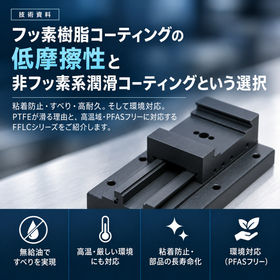
■Do you have any of these concerns? - The operation of equipment is unstable due to friction or snagging. - I want to reduce the burden of lubrication, cleaning, and parts replacement. ■General measures and criteria for selecting surface treatments To reduce sliding resistance, it is necessary to check alignment, surface roughness, clearance, bearings, lubricants, and material changes. If design changes are difficult, oil cannot be used, or if you want to achieve both wear resistance and low friction, functional surface treatments are a candidate. We will check the contact pressure, speed, temperature, and counterpart materials, and suggest options such as Bicoat, FFLC, and fluoropolymer-based treatments. ■You can consult us from the stage of your concerns - Even if the target object or usage conditions are not determined, please let us know your concerns. - Based on the information you provide, we will suggest candidates for surface treatments and points to check. - We will propose the provision of test pieces or prototypes depending on the situation. Please contact us first. - If you want to know about the functions and features of surface treatments, please download and view the catalog.
Added to bookmarks
Bookmarks listBookmark has been removed
Bookmarks listYou can't add any more bookmarks
By registering as a member, you can increase the number of bookmarks you can save and organize them with labels.
Free membership registration
■Do you have any of these concerns? - Equipment operation is unstable due to friction or snagging. - I want to reduce the burden of lubrication, cleaning, and parts replacement. ■General measures and criteria for selecting surface treatments For sliding parts that cannot be lubricated, self-lubricating materials, bearings, sealed mechanisms, and a review of parts replacement cycles are common solutions. If you cannot add these due to space or structural constraints and want to maintain the shape of metal parts, thin-film solid lubrication coatings become candidates. We will check the load, speed, temperature, and lifespan, and suggest options such as fluororesin-based materials or FFLC. ■You can consult us at any stage of your concerns - Even if you haven't decided on the target object or usage conditions, please let us know your concerns. - Based on the information you provide, we will suggest candidates for surface treatments and points to confirm. - We will propose the provision of test pieces or prototypes depending on the situation. Please contact us first. - If you want to know the functions and features of surface treatments, please download and view the catalog.
Added to bookmarks
Bookmarks listBookmark has been removed
Bookmarks listYou can't add any more bookmarks
By registering as a member, you can increase the number of bookmarks you can save and organize them with labels.
Free membership registration
■Do you have any of these concerns? - Equipment operation is unstable due to friction or snagging. - I want to reduce the burden of lubrication, cleaning, and parts replacement. ■General measures and criteria for selecting surface treatments Rubber products have high friction, and methods to reduce transport resistance include adjusting guide width, contact area, using rollers, and lubricants. If oil cannot be used, equipment shape cannot be changed, or if you want to reduce friction on the rubber side or the opposing surface, low-friction coatings are a candidate. Direct processing on rubber can be done with GLC, and for the metal side, fluororesin-based options can be considered. ■You can consult with us from the stage of your concerns - Even if the target object or usage conditions are not determined, please let us know your concerns. - Based on the information you provide, we will suggest candidates for surface treatments and points to confirm. - We will propose the provision of test pieces or prototypes depending on the situation. Please contact us first. - If you want to know about the functions and features of surface treatments, please download and view the catalog.
Added to bookmarks
Bookmarks listBookmark has been removed
Bookmarks listYou can't add any more bookmarks
By registering as a member, you can increase the number of bookmarks you can save and organize them with labels.
Free membership registration
■Do you have any of these concerns? - It takes time to remove contaminants and clean - I want to reduce the use of release agents, oils, and solvents ■General measures and criteria for selecting surface treatments For resin adhesion and eye contamination around the extrusion die, first consider adjusting temperature and residence time, die polishing, and regular cleaning. If high-temperature molten resin still adheres and contaminates the product, surface treatments with heat resistance and release properties become candidates. We will check the type of resin, temperature, cleaning methods, and dimensional accuracy, and suggest candidates such as FSR or heat-resistant, high-hardness types. ■You can consult us at any stage of your concerns - Even if you haven't decided on the target object or usage conditions, please let us know your concerns - Based on the information you provide, we will suggest candidates for surface treatments and points to confirm - We will propose the provision of test pieces or prototypes depending on the situation. Please contact us first - If you want to know about the functions and features of surface treatments, please download and view the catalog.
Added to bookmarks
Bookmarks listBookmark has been removed
Bookmarks listYou can't add any more bookmarks
By registering as a member, you can increase the number of bookmarks you can save and organize them with labels.
Free membership registration
■Do you have any of these concerns? - It takes time to remove or clean contaminants. - I want to reduce the use of release agents, oils, and solvents. ■General measures and criteria for selecting surface treatments In label applicators, adhesives transfer to guides, peeling areas, and receiving parts, leading to wrinkling and clogging. If regular wiping, part replacement, and the use of release sheets still result in re-adhesion in a short period, coatings that excel in adhesive release or coatings that reduce contact area are candidates. We will check the adhesive strength and wear conditions and suggest options such as MRS or TP systems. ■You can consult with us at any stage of your concerns - Even if you haven't decided on the target object or usage conditions, please let us know your concerns. - Based on the information you provide, we will suggest candidates for surface treatments and points to check. - We will propose the provision of test pieces or prototypes depending on the situation. Please contact us first. - If you want to know about the functions and features of surface treatments, please download and view our catalog.
Added to bookmarks
Bookmarks listBookmark has been removed
Bookmarks listYou can't add any more bookmarks
By registering as a member, you can increase the number of bookmarks you can save and organize them with labels.
Free membership registration
■Do you have any of these concerns? - It takes time to remove or clean contaminants. - I want to reduce the use of release agents, oils, and solvents. ■General countermeasures and criteria for selecting surface treatments When paint accumulates on painting jigs, chemical stripping, incineration stripping, removal with tools, or jig replacement becomes necessary. For shapes that cannot be addressed with masking or disposable covers, and in processes where we want to reduce cleaning downtime, non-stick coatings that make it difficult for paint to adhere are candidates. We will check the type of paint, curing temperature, and impact on the jigs, and suggest candidates such as fluoropolymer-based coatings. ■You can consult us from the stage of your concerns - Even if the target object or usage conditions are not determined, please let us know your concerns. - Based on the information you provide, we will suggest candidates for surface treatments and points to confirm. - We will propose the provision of test pieces or prototypes depending on the situation. Please contact us first. - If you want to know the functions and features of surface treatments, please download and view the catalog.
Added to bookmarks
Bookmarks listBookmark has been removed
Bookmarks listYou can't add any more bookmarks
By registering as a member, you can increase the number of bookmarks you can save and organize them with labels.
Free membership registration
■Do you have any of these concerns? - It takes time to remove or clean contaminants. - I want to reduce the use of release agents, oils, and solvents. ■General measures and criteria for selecting surface treatments If food adheres to the chute, options include increasing the incline, buff polishing, or adding vibration and scrapers. If adhesion due to moisture, oil, or sugar persists, or if the equipment shape cannot be changed, surface treatments that provide non-stick and slip properties are effective options. Depending on the characteristics of the conveyed items, consider fluororesin, MRS, or convex types. ■You can consult us from the stage of your concerns - Even if you haven't decided on the target items or usage conditions, please let us know your concerns. - Based on the information you provide, we will suggest candidates for surface treatments and points to confirm. - We will propose the provision of test pieces or prototypes as appropriate to the situation. Please contact us first. - If you want to know about the functions and features of surface treatments, please download and view the catalog.
Added to bookmarks
Bookmarks listBookmark has been removed
Bookmarks listYou can't add any more bookmarks
By registering as a member, you can increase the number of bookmarks you can save and organize them with labels.
Free membership registration
The heat resistance temperature of MRS coatings varies by grade. In particular, the MRS-004 grade, which has excellent heat resistance, can be used at temperatures up to 300°C under certain conditions. For specific usage temperature conditions, please consult our technical sales representative.
Added to bookmarks
Bookmarks listBookmark has been removed
Bookmarks listYou can't add any more bookmarks
By registering as a member, you can increase the number of bookmarks you can save and organize them with labels.
Free membership registration
The substrates compatible with MRS coating are mainly metals (iron-based materials, stainless steel, aluminum, etc.) and ceramics. In grades such as MRS-230, which allow for low-temperature processing, it is also possible to process substrates with low heat resistance, such as resins. The applicability and pre-treatment methods vary depending on the type and condition of the substrate, so please consult our technical sales representatives regarding the applicability to specific substrates.
Added to bookmarks
Bookmarks listBookmark has been removed
Bookmarks listYou can't add any more bookmarks
By registering as a member, you can increase the number of bookmarks you can save and organize them with labels.
Free membership registration
The film thickness of MRS coatings varies depending on the grade and application. Grades such as MRS-014, which feature thin films, have a thickness suitable for cutting tools and precision parts, causing minimal changes to the surface shape. For specific film thicknesses and the range of thicknesses we can accommodate, please contact our technical sales representative. We will propose the optimal film thickness based on your application and requirements.
Added to bookmarks
Bookmarks listBookmark has been removed
Bookmarks listYou can't add any more bookmarks
By registering as a member, you can increase the number of bookmarks you can save and organize them with labels.
Free membership registration
MRS coating is widely used in various industries such as packaging, food, rubber and resin manufacturing, printing, electronic component manufacturing, automotive parts, and medical and pharmaceutical equipment. In the packaging industry, it is applied to devices and packaging machines that handle labels and tapes, while in the food industry, it is used in food processing equipment and conveyor systems. In the rubber and resin manufacturing industry, it is utilized in molding dies and deburring devices, and in the printing industry, it is used in devices that handle adhesive paper and seals. Additionally, in electronic component manufacturing, it is applied to manufacturing equipment that deals with adhesive materials, in the automotive parts industry, it is used in manufacturing equipment for rubber molded parts, and in the medical and pharmaceutical equipment sector, it is utilized in manufacturing devices.
Added to bookmarks
Bookmarks listBookmark has been removed
Bookmarks listYou can't add any more bookmarks
By registering as a member, you can increase the number of bookmarks you can save and organize them with labels.
Free membership registration
The main reason why silicone coatings excel in release properties is their "excellent repellency (low surface tension)." This property exhibits "water repellency" against water and "release properties" against sticky substances. Because silicone has low surface tension, it does not easily adhere to other materials, resulting in superior release and water-repellent properties. MRS coatings are an innovative coating that leverages these silicone properties while incorporating characteristics such as solvent resistance, high hardness, and high heat resistance, which were difficult to achieve with conventional silicone coatings.
Added to bookmarks
Bookmarks listBookmark has been removed
Bookmarks listYou can't add any more bookmarks
By registering as a member, you can increase the number of bookmarks you can save and organize them with labels.
Free membership registration
MRS coatings have different grades depending on the usage environment and the required performance. For environments that require frequent cleaning with solvents, "MRS-102," which has excellent solvent resistance, is suitable. For cases where it is necessary to maintain surface shape with a thin film, such as with cutting tools and precision parts, "MRS-014" or "MRS-003" are chosen. If used in high-temperature environments, "MRS-004" is appropriate, and for processing resin products at low temperatures, "MRS-230" is suitable. After understanding the specific usage environment and performance requirements, our technical sales representatives will provide appropriate suggestions.
Added to bookmarks
Bookmarks listBookmark has been removed
Bookmarks listYou can't add any more bookmarks
By registering as a member, you can increase the number of bookmarks you can save and organize them with labels.
Free membership registration
The substrates compatible with "Safron(R)" include iron (ferrous materials), stainless steel (SUS), and aluminum. Additionally, some grades such as "Safron(R) LF+" are available in types that can be processed at low temperatures below 100°C, making them applicable to substrates with low heat resistance, such as resins. The applicability and pretreatment methods vary depending on the type and condition of the substrate, so please consult our technical sales representative for specific applicability.
Added to bookmarks
Bookmarks listBookmark has been removed
Bookmarks listYou can't add any more bookmarks
By registering as a member, you can increase the number of bookmarks you can save and organize them with labels.
Free membership registration
"SafeLon(R)" is suitable for preventing adhesion in environments where static electricity is a concern, such as preventing the adhesion of dust due to static electricity. By processing conveyor guides and chutes, it helps prevent poor flow and clogging during transport. In piping and chemical tanks, its chemical resistance contributes to protection from corrosion and improved safety. In stirring blades, it prevents the adhesion of chemicals and materials, reducing cleaning efforts. In the field of electronic components, it suppresses defects and the occurrence of defective products caused by static electricity in manufacturing equipment, while in food-related equipment, it achieves prevention of food adhesion and improved cleanability. The "SafeLon(R) CC+" specialized for transparency can provide anti-static properties while maintaining transparency in glass and transparent resin components.
Added to bookmarks
Bookmarks listBookmark has been removed
Bookmarks listYou can't add any more bookmarks
By registering as a member, you can increase the number of bookmarks you can save and organize them with labels.
Free membership registration
"SafeLon(R) LF+" is a grade developed as a new option for applications that require not only static electricity prevention but also mechanical strength, which the conventional SafeLon(R) series could not adequately address. LF stands for "Low Friction," meaning it has a low coefficient of friction and excellent lubricity. It also excels in coating hardness and wear resistance, making it suitable for applications that require mechanical strength. Furthermore, while conventional fluoropolymer coatings typically require firing at around 400°C, there are product numbers that allow for low-temperature processing below 100°C, making it applicable not only to metals but also to resin substrates.
Added to bookmarks
Bookmarks listBookmark has been removed
Bookmarks listYou can't add any more bookmarks
By registering as a member, you can increase the number of bookmarks you can save and organize them with labels.
Free membership registration
The various grades of "Saflon(R)" are selected based on the usage environment and required performance. For applications where corrosion resistance is particularly important, "Saflon(R) AP+" is suitable, while "Saflon(R) AS+" is appropriate for environments requiring stain resistance and release properties. If lubrication is needed or for applications on heat-sensitive substrates like resins, please choose "Saflon(R) LF+," and for applications requiring transparency, "Saflon(R) CC+" is recommended. After understanding your specific usage environment and performance requirements, our technical sales representatives will propose the optimal grade. Please feel free to consult with us.
Added to bookmarks
Bookmarks listBookmark has been removed
Bookmarks listYou can't add any more bookmarks
By registering as a member, you can increase the number of bookmarks you can save and organize them with labels.
Free membership registration
The biggest difference between SafeLon® and conventional fluoropolymer coatings (such as Teflon® coatings) is the anti-static performance. While conventional fluoropolymer coatings excel in electrical insulation and tend to accumulate static electricity, SafeLon® can dissipate the charges that build up on the coating surface into the substrate. It achieves a low electrical resistance value, and its ability to conduct electricity helps reduce the adhesion of dust and other particles caused by static electricity. In addition to these features, it maintains the basic properties of fluoropolymer coatings, such as non-stick and chemical resistance.
Added to bookmarks
Bookmarks listBookmark has been removed
Bookmarks listYou can't add any more bookmarks
By registering as a member, you can increase the number of bookmarks you can save and organize them with labels.
Free membership registration
Bikote(R) also offers PFAS-free product numbers that do not contain PFAS (fluororesin). For information on the presence or absence of PFAS for each product number, please contact us. Additionally, we are advancing the development of environmentally friendly PFAS-free coatings as part of our next-generation product development. If you are considering compliance with PFAS regulations, please feel free to consult with us.
Added to bookmarks
Bookmarks listBookmark has been removed
Bookmarks listYou can't add any more bookmarks
By registering as a member, you can increase the number of bookmarks you can save and organize them with labels.
Free membership registration
Here are some representative application examples of "Bicoat(R)." In blow molding molds for PET bottles, a release coating on the inner surface prevents the adhesion of softened PET resin due to heat, reducing maintenance burdens while maintaining the transparency of the PET bottles. In heat sealers for pillow packaging machines, non-stick and wear-resistant properties prevent resin adhesion and improve productivity. Additionally, it demonstrates effectiveness in a wide range of applications, including decorative sheet transfer molds, transport jigs, vacuum transfer molds, suction pads, ejector pins, and biodegradable plastic molding molds.
Added to bookmarks
Bookmarks listBookmark has been removed
Bookmarks listYou can't add any more bookmarks
By registering as a member, you can increase the number of bookmarks you can save and organize them with labels.
Free membership registration
"Bycoat(R)" is suitable for preventing resin adhesion and improving release properties in injection molding molds, and can also be used in precision molds where micron-level dimensional accuracy is required. It provides excellent lubrication for guides and chutes in various packaging machines, achieving wear resistance and improved sliding in areas where friction occurs. It is also useful for releasing components that come into contact with particularly adhesive substances, such as adhesives. Due to its excellent durability, it can be confidently used in applications subject to mechanical loads, such as IC encapsulation cavities, piezoelectric ceramic manufacturing equipment, molds for rubber and resin, and sliding parts.
Added to bookmarks
Bookmarks listBookmark has been removed
Bookmarks listYou can't add any more bookmarks
By registering as a member, you can increase the number of bookmarks you can save and organize them with labels.
Free membership registration
"Bycoat® Exceed" is an evolved product that enhances the non-stick properties, corrosion resistance, and heat resistance in addition to the basic performance of the conventional Bycoat®. It demonstrates more reliable release properties and durability in applications such as molds that use resins with strong adhesion. The series has two variations. In addition to the basic performance of Bycoat® (high hardness, long lifespan, dimensional stability), "Exceed CR" improves corrosion resistance, while "Exceed HR" enhances heat resistance.
Added to bookmarks
Bookmarks listBookmark has been removed
Bookmarks listYou can't add any more bookmarks
By registering as a member, you can increase the number of bookmarks you can save and organize them with labels.
Free membership registration
The grades of "Bicoat(R)" are selected based on the usage environment and required performance. There are three main criteria for selection: (1) Type of substrate: Since compatibility varies depending on the substrate, such as iron, stainless steel, aluminum, or copper alloys, selection must be tailored to the substrate. (2) Operating temperature (3) The type of substances in contact will also affect the optimal grade. After understanding the specific usage environment and performance requirements, our technical sales representatives will propose the most suitable grade. Please feel free to consult with us.
Added to bookmarks
Bookmarks listBookmark has been removed
Bookmarks listYou can't add any more bookmarks
By registering as a member, you can increase the number of bookmarks you can save and organize them with labels.
Free membership registration
The features of "Bicoat(R)" can be summarized in three main points. The first is "remarkable durability." It has high hardness, making it resistant to scratches and suitable for long-term use. The second is "excellent wear resistance." With a high surface hardness, it is strong against wear, ensuring longevity even in harsh usage environments. The third is "superior non-stick and release properties." It demonstrates excellent release properties even against highly adhesive substances. Additionally, it allows for micron-level dimensional precision, making it suitable for applications requiring dimensional accuracy such as precision parts and molds, and it also possesses pressure resistance to maintain performance in high-pressure environments. *For more details, please download the PDF or contact us.
Added to bookmarks
Bookmarks listBookmark has been removed
Bookmarks listYou can't add any more bookmarks
By registering as a member, you can increase the number of bookmarks you can save and organize them with labels.
Free membership registration
"Bi-Coat®" is a coating that achieves excellent non-stick and release properties through a treatment that combines inorganic and organic materials. Compared to conventional fluoropolymer coatings, it has high hardness, is resistant to scratches, and experiences less wear, making it durable for long-term use. It also has high dimensional accuracy and is suitable for applications requiring micron-level precision. *For detailed explanations, please check the link.*
Added to bookmarks
Bookmarks listBookmark has been removed
Bookmarks listYou can't add any more bookmarks
By registering as a member, you can increase the number of bookmarks you can save and organize them with labels.
Free membership registration
"Bicoat(R)" is an organic-inorganic composite coating system that combines inorganic materials with high hardness, such as metals, ceramics, and chemical conversion coatings, with organic materials that excel in lubricity and release properties, such as fluororesins and siloxane resins. It successfully balances the often conflicting properties of "hardness" and "non-stickiness," making it a reliable choice for applications requiring micron-level dimensional precision, such as molds. The name is an abbreviation of "bicomponent coating" and is a registered trademark of our company.
Added to bookmarks
Bookmarks listBookmark has been removed
Bookmarks listYou can't add any more bookmarks
By registering as a member, you can increase the number of bookmarks you can save and organize them with labels.
Free membership registration