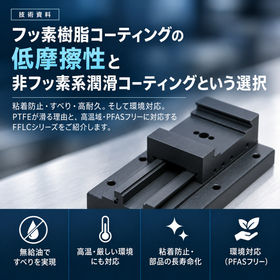
Comparison of heat resistance, release properties, and cleanability. Yoshida SKT, which processes both methods in-house, will explain the criteria for choosing between them.
Fluororesin coating and silicone coating are representative methods of release and non-stick coatings. Yoshida SKT Co., Ltd. handles the processing of both methods in-house, and from that position, we will introduce the considerations for their appropriate use. Fluororesin (such as PTFE) has an extremely low critical surface tension, making it multifunctional with non-stick properties, chemical resistance, electrical characteristics, and low friction. The continuous use temperature is 260°C (PTFE, PFA). Silicone also exhibits excellent release and water-repellent properties due to its low surface tension. Furthermore, our silicone-based 'MRS coating' is a surface treatment that improves the solvent resistance and film hardness issues of conventional silicone coatings, providing better release properties than Teflon (TM) fluororesin coatings, and is effective for adhesive tapes, raw rubber, and hot melt adhesives. Depending on the grade, it can be used at temperatures up to 300°C or for low-temperature processing below 80°C (compatible with resin and rubber substrates).

Inquire About This Product
basic information
【Comparison Guidelines】 ■Release from high-adhesion materials (tape, natural rubber, hot melt) → MRS coating (silicone-based) is superior ■Chemical resistance and corrosion resistance → Fluororesin (hardly affected by acids and alkalis) ■Electrical properties and static electricity countermeasures → Fluororesin-based (insulating/static prevention 'Safron') ■Heat resistance → PTFE/PFA: 260℃ / MRS-004: up to 300℃ depending on conditions ■Equipment that is frequently cleaned with solvents → MRS-102 (release properties remain almost unchanged after solvent cleaning) ■Processing on resin and rubber substrates → Low-temperature processing grade (MRS-230: below 80℃ / Safron LF+: below 100℃) ■Maintaining shapes such as cutting edges and textures → MRS-014 (thin film, film hardness 9H)
Price information
Please feel free to contact us.
Delivery Time
Applications/Examples of results
Selection of release and adhesion prevention treatment methods for items such as molding dies, packaging machines, conveyor rollers, cutting tools and tables, and food and pharmaceutical manufacturing equipment.
catalog(1)
Download All Catalogs
Company information

To maximize the performance of manufacturing equipment and machine parts, Yoshida SKT derives the "optimal solution" tailored to our customers from hundreds of surface treatment technologies. - Decreased productivity due to adhesive troubles - Instability in product quality due to friction - Early deterioration of equipment due to corrosion We respond to these challenges in the manufacturing field with our extensive track record and reliable technical expertise. In 1963, we began fluoropolymer processing. In 1968, we signed a licensing agreement with DuPont (now Chemours), supporting manufacturing innovations for over 2,000 customers across various industries, from automotive to medical and aerospace. Furthermore, in 2024, we are focusing on the development of next-generation products, such as PFAS-free coatings, contributing to the advancement of sustainable manufacturing. With a three-base system in Nagoya, Tokyo, and Yamaguchi, we flexibly respond to both mass production and custom orders. Our consistent quality management system ensures that we deliver reliable quality. For solving challenges in the manufacturing field, trust the surface treatment experts at Yoshida SKT.
![[Comprehensive Catalog] High-performance pharmaceuticals packed with 110 years of history and technology.](https://image.mono.ipros.com/public/product/image/7fc/2000153777/IPROS51294870868527324567.jpeg?w=280&h=280)