Friction countermeasures for non-lubricated sliding parts | Provision of technical materials on solid lubrication

Cannot be refueled, oil spillage is not allowed, exposed to high temperatures. Explanation of options for sliding parts where liquid lubrication cannot be used in technical documentation.
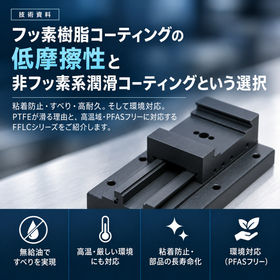
The basic principle of reducing friction is liquid lubrication using oil or grease, but there are situations where this cannot be used depending on the operating environment. ■ Cannot allocate maintenance man-hours or equipment downtime for regular lubrication ■ In environments like food processing, electronic components, and clean rooms, oil splatter directly leads to product defects ■ At high temperatures, viscosity decreases or carbonization occurs, making it impossible to use oil in the first place In such sliding parts, a viable option is lubrication coatings. They can maintain low friction without the need for lubrication. This document explains the characteristics and sliding mechanism of PTFE, a representative solid lubricant, as well as application examples of fluoropolymer coatings. It also covers the non-fluorinated lubrication coating 'FFLC series' that responds to high-temperature environments and is PFAS-free, all in 22 pages. Comparison data on the friction coefficients and temperature-dependent durability of fluoropolymer coatings (PTFE) and the FFLC series is also included. *For more details, please click on "PDF Download" to view.
Inquire About This Product
basic information
**Features of Solid Lubrication Coating (from the document)** - Does not contaminate the surroundings: does not scatter or adhere like lubricating oil or grease - Does not color the counterpart material (in the case of PTFE) - Functions in environments where liquid lubrication cannot be used, such as high temperatures, chemicals, and outdoors **Static Friction Coefficients of Fluororesins (measured by our company)** PTFE: 0.06 / PFA: 0.08 / FEP: 0.14 **Main Contents of the Document** - The three states of lubrication materials (gas, liquid, solid) and situations where solid lubrication is necessary - Reasons why PTFE slides (molecular structure, bond energy, lamellar structure) - Application examples and case studies of fluororesin coatings - Limitations in high-temperature ranges and comparative data with non-fluorine-based lubrication coatings
Price range
Delivery Time
Applications/Examples of results
■Rotating and reciprocating parts that cannot be lubricated, such as bearings, bushes, and guides ■Sliding parts of OA equipment ■Conveying and driving parts in food, electronic components, and clean rooms ■Sliding parts in high-temperature areas and vacuum environments
catalog(1)
Download All Catalogs
Company information

To maximize the performance of manufacturing equipment and machine parts, Yoshida SKT derives the "optimal solution" tailored to our customers from hundreds of surface treatment technologies. - Decreased productivity due to adhesive troubles - Instability in product quality due to friction - Early deterioration of equipment due to corrosion We respond to these challenges in the manufacturing field with our extensive track record and reliable technical expertise. In 1963, we began fluoropolymer processing. In 1968, we signed a licensing agreement with DuPont (now Chemours), supporting manufacturing innovations for over 2,000 customers across various industries, from automotive to medical and aerospace. Furthermore, in 2024, we are focusing on the development of next-generation products, such as PFAS-free coatings, contributing to the advancement of sustainable manufacturing. With a three-base system in Nagoya, Tokyo, and Yamaguchi, we flexibly respond to both mass production and custom orders. Our consistent quality management system ensures that we deliver reliable quality. For solving challenges in the manufacturing field, trust the surface treatment experts at Yoshida SKT.