What is the film thickness defect caused by the Faraday cage effect during electrostatic powder coating?

Causes and countermeasures for insufficient film thickness and coating defects in electrostatic powder coating during fluororesin coating and PEEK coating.
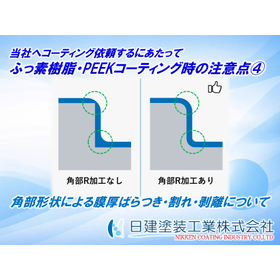
In fluoropolymer coatings and PEEK coatings using electrostatic powder coating, the "Faraday cage effect" can make it difficult for paint to adhere to recessed or deep areas. As a result, there may be insufficient film thickness or pinholes, which can lead to a decrease in corrosion resistance and durability. On the other hand, paint tends to concentrate on protruding areas, which can sometimes cause cracking or peeling due to localized thickening. We optimize the coating conditions and film thickness specifications according to product shape and required performance, reducing the risk of film thickness defects. If you are considering coating for complex-shaped parts, please feel free to consult us.
Inquire About This Product
basic information
In electrostatic powder coating, charged powder paint is adhered to the substrate by electrostatic forces. However, in recessed or deep shapes, the electrostatic field lines have difficulty penetrating, leading to the "Faraday cage effect," where the powder paint adheres poorly. As a result, in recessed areas, there is a higher likelihood of insufficient film thickness and pinholes, while in protruding areas or tips, the paint tends to concentrate, which can lead to stress concentration due to thick films. Especially for corrosion-resistant applications or thick film specifications, the impact of film thickness distribution significantly affects quality, making the optimization of coating conditions according to product shape crucial. Our company offers optimal specifications, including coating methods and film thickness design.
Price range
Delivery Time
Applications/Examples of results
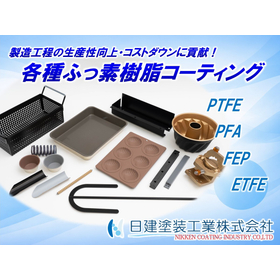
- Powder coating for box-shaped components: Apply painting conditions considering the insufficient film thickness in recessed areas. - Chemical-resistant coating for chemical equipment parts: Improve corrosion resistance by reducing pinholes. - Functional coating for complex-shaped guide components: Enhance durability by achieving uniform film thickness. - Fluororesin coating for conveying equipment parts: Reduce the risk of cracking by increasing the thickness on protruding areas. - Non-stick coating for food equipment parts: Optimize painting conditions according to the shape. We can propose optimal coating specifications tailored to the application, even for products with complex shapes and uneven surfaces.
Company information

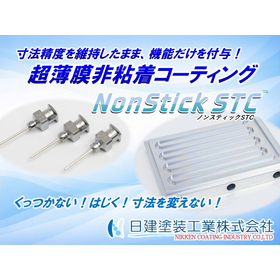
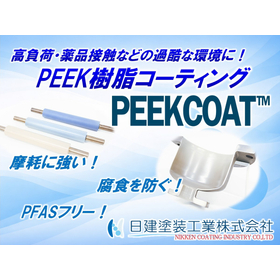
Nikken Coating Industry Co., Ltd. has been a specialized manufacturer of functional coatings for contract processing, earning the trust of customers across various industries for 79 years since its founding. We leverage our processing technology to maximize the properties of fluororesins, such as non-stick, lubricity, and chemical resistance, providing high-performance coatings that directly address customer challenges, including "Thermo Pro Release" for thermal welding processes and "NonStick STC" for blades and precision molds. In recent years, in response to movements regarding regulations on fluorinated compounds (PFAS), "PEEK resin," which is gaining attention as a substitute for fluororesins, has become a focus. Nikken Coating Industry commercialized the world's first PEEK resin coating, "PEEKCOAT," in 1999. Based on the solid knowledge and know-how accumulated over more than 20 years, we are further intensifying our research and development efforts to explore the potential of next-generation PEEK coatings! We aim to be recognized as "the go-to for PEEK coatings" and will continue to lead the way. As "the best partner for functional coatings that builds trust through technology," Nikken Coating Industry will continue to contribute to the creation of high-quality, high-performance products.