We have compiled a list of manufacturers, distributors, product information, reference prices, and rankings for Coating.
ipros is IPROS GMS ・ IPROS One of the largest technical database sites in Japan that collects information on.

Coating(CVD) - List of Manufacturers, Suppliers, Companies and Products | IPROS GMS

Last Updated: Aggregation Period:Sep 09, 2026~Oct 06, 2026
This ranking is based on the number of page views on our site.

Coating Product List

61~74 item / All 74 items

Displayed results

Multi-functional Sputtering Device 【MiniLab-S060】

A compact multi-thin film device that incorporates sputtering, deposition, electron beam (EB), and annealing thin film modules in a 60-liter volume chamber, suitable for various applications.

4 cathodes with Φ2 inch mounted Simultaneous film formation: 3-component simultaneous film formation (RF 500W or DC 850W) + HiPIMS (Pulse DC 5KW) x 1 Power distribution and configuration settings for 4 cathodes can be freely changed from the HMI screen using the plasma relay switch MFC x 3 systems (Ar, O2, N2) for reactive sputtering RIE etching stage RF 300W (main chamber) + <30W soft etching (LL chamber) Substrate heating: Max 500℃, 800℃, or 1000℃ (C/C or SiC coat) Substrate rotation and vertical movement (automatically controlled by stepping motor) APC automatic control: Upstream (MFC flow adjustment) or downstream (automatic valve opening adjustment on the exhaust side) Dimensions: 1,120(W) x 800(D) ● Plasma etching can be installed in either the main chamber or the load lock chamber. ● Mixed specifications such as resistance heating deposition, organic material deposition, EB deposition, and PECVD can also be configured.

  • Sputtering Equipment
  • Evaporation Equipment
  • CVD Equipment
  • Coating

Added to bookmarks

Bookmarks list

Bookmark has been removed

Bookmarks list

You can't add any more bookmarks

By registering as a member, you can increase the number of bookmarks you can save and organize them with labels.

Free membership registration

[PFAS Regulation Measures] Water and Oil Repellent Coatings, Stain Resistant Coatings

PFAS-free water and oil repellent coating! Prepare alternative products in advance in anticipation of regulations.

◆What are PFAS? PFAS refers to a collective term for organic fluorine compounds, of which there are said to be over 4,700 types. Not all PFAS have the same properties, and some are designated as regulated substances under international treaties. ◆PFAS-Free Water and Oil Repellent Coating "JC Coat PS" This is a contract coating based on DLC coating using the CVD method, which imparts water and oil repellent functions without using organic fluorine compounds. 【Features】 - Due to its thin film, redesigning with consideration for the coating is unnecessary. - Strong adhesion to the substrate makes it difficult to peel off, eliminating concerns about foreign substance contamination. - Being PFAS (organic fluorine compound) free alleviates worries about future regulations. PFOA, PFOS, PFCAs, PFHxS are not used. ◆What other types of JC Coat are there? Among PFAS, it does not contain the already regulated PFOS and PFOA. Similarly, it does not include PFCAs and PFHxS, which may be regulated in the future. For inquiries or requests for prototypes regarding JC Coat PS, please use the contact form below. Feel free to contact us for more details.

  • Other metal materials
  • Coating Agent
  • Surface treatment contract service
  • Coating

Added to bookmarks

Bookmarks list

Bookmark has been removed

Bookmarks list

You can't add any more bookmarks

By registering as a member, you can increase the number of bookmarks you can save and organize them with labels.

Free membership registration

Improvement of plasma resistance for quartz components with Ittria coating.

[New Technology] Full coating possible on complex structures with a new method different from thermal spraying and CVD! *Case-specific coating examples are currently being offered.

Narasaki Industries has developed a ceramic DIP coating that achieves an extremely precise control of film thickness. This allows for greater flexibility in ceramic coatings for a wide range of materials. 【Four Features】 ◆ High freedom of shape, capable of coating 3D shapes at meter scale ◆ Coating possible for most high-performance materials ◆ Average thick film of 50μ achievable ◆ Coating surface has good roughness and excellent smoothness (Ra 0.8 or less) 【Applicable Materials for Coating】 ■ Fine ceramics (alumina, zirconia, aluminum nitride, etc.) ■ Heat-resistant glass such as quartz glass ■ Graphite, high melting point metals *Currently, we are conducting improvement tests to further enhance the density of the film. *Please download and view our coating case collection. We utilize composite ceramic films to achieve optimization according to your application. Feel free to contact us.

  • スクリーンショット 2022-10-19 135815.png
  • IPROS41773619475751603317.jpeg
  • Fine Ceramics
  • Processing Contract
  • Surface treatment contract service
  • Coating

Added to bookmarks

Bookmarks list

Bookmark has been removed

Bookmarks list

You can't add any more bookmarks

By registering as a member, you can increase the number of bookmarks you can save and organize them with labels.

Free membership registration

Aerospace PVD Coating Film Type Selection Support

Proposing the optimal PVD film type for heat resistance enhancement in the aerospace field.

In the aerospace field, high heat resistance is required to maintain the reliability of components under extreme environments. Particularly in areas exposed to high temperatures, such as engine parts and structural materials, improving the heat resistance of the material itself and protecting it through surface treatments are essential. Inappropriate selection of coating types may fail to deliver the expected performance and could impact safety and durability. Our company addresses this challenge by thoroughly understanding our customers' usage conditions and proposing the optimal coating type from similar options across various manufacturers, considering QCD (Quality, Cost, Delivery). 【Application Scenarios】 - Improving heat resistance of aircraft engine components - Enhancing durability of space equipment in high-temperature environments - Thermal load countermeasures for rocket components 【Benefits of Implementation】 - Achieving longer lifespans compared to conventional coatings - Performance improvement through the proposal of suitable coating types tailored to usage conditions - Enhanced usability for customers (ease of use)

  • Company:LSI
  • Price:Other
  • Processing Contract
  • Coating

Added to bookmarks

Bookmarks list

Bookmark has been removed

Bookmarks list

You can't add any more bookmarks

By registering as a member, you can increase the number of bookmarks you can save and organize them with labels.

Free membership registration

Solving your concerns about selecting PVD coating types for automobiles.

Proposing membrane types tailored to usage conditions, achieving extended lifespan compared to conventional membranes.

In the automotive industry, wear resistance is required to improve the durability of parts. Particularly in harsh operating environments, performance degradation due to wear can affect product lifespan. Selecting the appropriate type of coating is crucial for enhancing the reliability of components. Our company will carefully inquire about your current usage conditions and propose the optimal coating type from similar types offered by various manufacturers, considering QCD (Quality, Cost, Delivery). 【Application Scenarios】 - Improvement of wear resistance in automotive parts - Extension of mold lifespan - Enhancement of production efficiency 【Effects of Implementation】 - Achieving extended lifespan compared to conventional coating types - Evaluating customer usability (ease of handling) - Contributing to problem-solving

  • Company:LSI
  • Price:Other
  • Processing Contract
  • Coating

Added to bookmarks

Bookmarks list

Bookmark has been removed

Bookmarks list

You can't add any more bookmarks

By registering as a member, you can increase the number of bookmarks you can save and organize them with labels.

Free membership registration

Solving the dilemma of selecting PVD coating types for electronic components.

Proposing membrane types tailored to usage conditions to achieve improved conductivity and extended lifespan.

In the electronic components industry, appropriate surface treatment is required to maintain product performance and improve reliability. Particularly in coatings related to conductivity, it is important to select the optimal type from a variety of film types; however, with many manufacturers and types available, there are cases where selection can be confusing. Traditionally, if film types were selected based on convention without fully considering usage conditions, there may be issues such as not achieving the expected performance or having a short lifespan. Our company will carefully inquire about your current usage conditions and propose the optimal film type from similar types across various manufacturers, taking into account QCD (Quality, Cost, Delivery). 【Application Scenarios】 - Improvement of conductivity in electronic components - Enhancement of component durability - Streamlining of manufacturing processes 【Benefits of Implementation】 - Achieving extended lifespan compared to conventional film types - Improving user-friendliness for customers (ease of handling)

  • Company:LSI
  • Price:Other
  • Processing Contract
  • Coating

Added to bookmarks

Bookmarks list

Bookmark has been removed

Bookmarks list

You can't add any more bookmarks

By registering as a member, you can increase the number of bookmarks you can save and organize them with labels.

Free membership registration

Support for Selecting PVD Coating Types for Cutting Tools

Achieving extended tool life through tailored coating proposals based on usage conditions.

In the cutting tool industry, selecting the optimal PVD coating type from a variety of options is essential for maintaining tool performance and extending lifespan. However, the wide range of coating types offered by different manufacturers can lead to confusion about which one to choose. Continuing to use a previously employed coating type may mean that the tool's potential is not being fully realized. Our company addresses this issue by thoroughly understanding the current usage situation of our customers, comparing similar coating types from various manufacturers based on QCD (Quality, Cost, Delivery), and proposing the most suitable coating type. As a result of our proposals, customers have reported that our solutions are "user-friendly and easy to handle," and they have experienced extended lifespans compared to traditional coating types. 【Usage Scenarios】 - Unsure about selecting a coating type for cutting tools - Existing coatings have lifespan issues - Seeking higher-performance cutting tools 【Benefits of Implementation】 - Extended tool lifespan through optimal coating selection - Efficient coating selection based on QCD - Improved user-friendliness for customers

  • Company:LSI
  • Price:Other
  • Processing Contract
  • Coating

Added to bookmarks

Bookmarks list

Bookmark has been removed

Bookmarks list

You can't add any more bookmarks

By registering as a member, you can increase the number of bookmarks you can save and organize them with labels.

Free membership registration

"DLC coating" with a rich variety of membrane types, including hydrogen-free options. *Case studies available.

Prevent wear and scratches on cutting tools, molds, and machine parts! Types compatible with resin and rubber are also available.

Our "DLC Coating" not only offers high wear resistance but also possesses the characteristics required for mechanical relative motion such as rotation, sliding, and reciprocation, making it widely applicable to cutting tools, molds, automotive parts, sealing materials, and more. We offer a variety of film types that can be selected according to specific challenges, including the hydrogen-free "Genius Coat HA," which reduces friction resistance, and "Genius Coat F," which adapts to the deformation of resin and rubber materials. 【Examples of Applications】 ■ Automotive engine parts: Improved fuel efficiency by reducing friction resistance in oil ■ Various molds: Enhanced resistance to welding and wear ■ Industrial cutting tools: Improved resistance to welding and adhesion (burr prevention) ■ O-rings: Improved sliding properties while maintaining sealing performance 【We will be exhibiting at the 23rd Mechanical Elements Technology Exhibition Tokyo 2019!】 ■ Dates: February 6 (Wednesday) to February 8 (Friday), 2019 ■ Venue: Tokyo Big Sight ■ Booth Number: East 35-24 (East Hall 4) We will showcase various products, including DLC coatings. Please take this opportunity to visit our booth. *We are currently offering materials summarizing the features and application examples of DLC! For more details, please check the materials available for "PDF Download."

  • Surface treatment contract service
  • Coating

Added to bookmarks

Bookmarks list

Bookmark has been removed

Bookmarks list

You can't add any more bookmarks

By registering as a member, you can increase the number of bookmarks you can save and organize them with labels.

Free membership registration

We are currently offering a document summarizing the basics of DLC coating, case studies, and selection criteria.

Prevent wear and scratches on cutting tools, molds, and machine parts! Types compatible with resin and rubber are also available! 【We will be exhibiting at INTERMOLD Nagoya!】

Our "DLC Coating" not only offers high wear resistance but also possesses the characteristics required for mechanical relative motion such as rotation, sliding, and reciprocation, making it widely applicable to cutting tools, molds, automotive parts, sealing materials, and more. We offer a variety of film types that can be selected according to specific challenges, including hydrogen-free "Genius Coat HA," which reduces friction resistance, and "Genius Coat F," which adapts to the deformation of resin and rubber materials. 【Examples of Applications】 ■ Automotive engine parts: Improved fuel efficiency by reducing friction resistance in oil ■ Various molds: Enhanced resistance to welding and wear ■ Industrial cutting tools: Improved resistance to welding and adhesion (deburring measures) ■ O-rings: Improved sliding properties while maintaining sealing performance We will be exhibiting at the "INTERMOLD Nagoya/Mold Expo Nagoya" held at Port Messe Nagoya from June 19, 2019. *We are currently offering materials summarizing the features and application examples of DLC! For more details, please check the materials available for "PDF Download."

  • Surface treatment contract service
  • Coating

Added to bookmarks

Bookmarks list

Bookmark has been removed

Bookmarks list

You can't add any more bookmarks

By registering as a member, you can increase the number of bookmarks you can save and organize them with labels.

Free membership registration

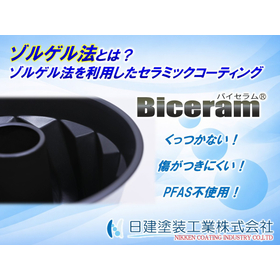
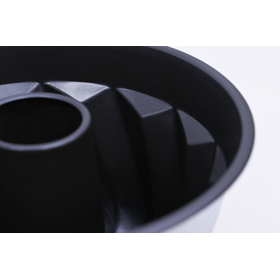
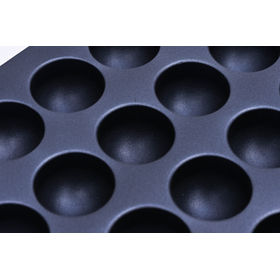
Uniform application on complex shapes and inner surfaces! Sol-gel method ceramic coating.

Suppresses thermal impact on the substrate with low-temperature baking. Coating on complex three-dimensional shapes and uneven surfaces. Achieves both pencil hardness of 9H and release properties.

Conventional ceramic coatings (such as thermal spraying and CVD/PVD) typically involve large-scale processes that require high-temperature plasma or vacuum equipment, which limits the shapes and substrates that can be coated. ■ Formation of Ceramic Coating Films by Sol-Gel Method Our "Biceram" utilizes the "Sol-Gel method," which is a liquid-phase process that involves applying a liquid (starting material) and then curing it. - A strong coating is formed at a lower temperature (200–250°C) than the usual ceramic sintering temperature, minimizing thermal impact on the substrate. - Due to the liquid process, it can coat complex three-dimensional shapes, fine irregularities, and the inner surfaces of pipes. - The coating itself has a hybrid structure that incorporates silicone release agents within a three-dimensional network of silica (SiO2). In addition to the "uniform applicability" unique to the Sol-Gel method, it simultaneously achieves scratch resistance that surpasses conventional fluororesins with a pencil hardness of 9H and excellent initial release properties.

  • DSC_5876.jpg
  • DSC_5867.jpg
  • Surface treatment contract service
  • Coating

Added to bookmarks

Bookmarks list

Bookmark has been removed

Bookmarks list

You can't add any more bookmarks

By registering as a member, you can increase the number of bookmarks you can save and organize them with labels.

Free membership registration

Onward Technology Co., Ltd.

Under a consistent quality management system, we respond with advanced coating technology.

In addition to TiN, TiCN, TiAlN, CrN, and DLC-EX, we apply various OS series films, DLC-Prism, CFCACX, and other proprietary high-precision, high-quality thin film PVD coatings to various tools, molds, and parts. We offer PVD and PCVD coating contract processing, surface treatment services, and PVD coating equipment sales. Our main products are PVD and PCVD coating contract processing products.

Added to bookmarks

Bookmarks list

Bookmark has been removed

Bookmarks list

You can't add any more bookmarks

By registering as a member, you can increase the number of bookmarks you can save and organize them with labels.

Free membership registration