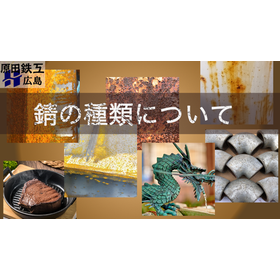
Did you know that there are seven types of rust: "red rust," "black rust," "white rust," "blue rust," "green rust," "yellow rust," and "brown rust"?
"Red Rust"
Chemical formula: Fe₂O₃, Cu₂O
Target metals: Iron, steel, copper, copper alloys
The "red rust" is something we often encounter in our daily lives.
For red rust to occur, air and moisture are necessary, and corrosion begins through "ionization," which robs electrons from iron.
As long as it is in contact with air and moisture, red rust (Fe₂O₃) will erode inward, ultimately causing the metal to crumble.
However, the red rust that forms on copper (Cu₂O) has some ability to prevent corrosion from water and seawater, which is why it is sometimes used as a raw material for ship bottom paint.
"Black Rust"
Chemical formula: Fe₃O₄, Ag₂S
Target metals: Iron, silver
This "black rust" is commonly seen on iron frying pans and cast iron skillets.
It is generated by heating the target metal at high temperatures and is referred to as "dry corrosion" because it does not involve water.
Since black rust (Fe₃O₄) does not erode inward, it can actually suppress red rust by covering it.
The black rust (Ag₂S) that forms on silver items such as tableware and accessories occurs due to a "sulfide reaction," where sulfur components found in skin and hair bind to silver.
This black rust also does not erode inward.
Continues to basic information ↓