We have compiled a list of manufacturers, distributors, product information, reference prices, and rankings for Surface Treatment.
ipros is IPROS GMS IPROS One of the largest technical database sites in Japan that collects information on.

Surface Treatment Product List and Ranking from 290 Manufacturers, Suppliers and Companies | IPROS GMS

Last Updated: Aggregation Period:Aug 05, 2026~Sep 01, 2026
This ranking is based on the number of page views on our site.

Surface Treatment Manufacturer, Suppliers and Company Rankings

Last Updated: Aggregation Period:Aug 05, 2026~Sep 01, 2026
This ranking is based on the number of page views on our site.

  1. 吉田SKT Aichi//Manufacturing and processing contract
  2. 日本プロトン Osaka//Machine elements and parts
  3. MCシステムズ Aichi//Manufacturing and processing contract
  4. 4 日本酸素東関東 Ibaraki//Electricity, Gas and Water Industry
  5. 5 旭プレシジョン 京都西工場 Kyoto//Manufacturing and processing contract

Surface Treatment Product ranking

Last Updated: Aggregation Period:Aug 05, 2026~Sep 01, 2026
This ranking is based on the number of page views on our site.

  1. Compliant with the Food Sanitation Act! Are you struggling with dirt and stickiness? 日本プロトン
  2. What is stainless steel insulation surface treatment? 吉田SKT
  3. Type A welder / Type B welder / Type 3 welder (torch mixing type) 日酸TANAKA 産業機器事業部
  4. 4 Metal surface treatment "Ozone Passivation" 岩谷産業
  5. 5 Rust and corrosion-resistant surface treatment "San Coat" 三和鉄工

Surface Treatment Product List

511~540 item / All 636 items

Displayed results

[Case Study] Excess oil in the foundation, causing the sieve to clog.

Improved cleanliness will also lead to a reduction in setup time!

We would like to introduce a case that solved the issue faced by our customer in the cosmetics industry regarding "the foundation having too much oil, causing the sieve to clog immediately." Although an automatic sifter is used to prevent the foundation powder from clumping, the excess oil causes it to not sift at all. Due to the adhesion, the powders stick together and cause clogging, so cutting through the interconnected powder improves the sifting process. Additionally, this enhances washability, leading to reduced setup time. 【Case Summary】 ■Challenges - The foundation powder clumps due to excessive oil adhesion. - It cannot be sifted at all. ■Processing Effects - The passage time through the sieve is shortened, resolving the bottleneck. - Yield has also increased. *For more details, please refer to the related links or feel free to contact us.

  • Processing Contract
  • Surface Treatment

Added to bookmarks

Bookmarks list

Bookmark has been removed

Bookmarks list

You can't add any more bookmarks

By registering as a member, you can increase the number of bookmarks you can save and organize them with labels.

Free membership registration

Micronized silica blended blast furnace slag cement 'VIDR-H-C0'

Mix with concrete for increased longevity, high durability, and enhanced strength!

"VIDR-H-C0" is a powder that imparts acid resistance, alkali resistance, heat resistance, fire resistance, water resistance, and abrasion resistance to concrete through the power of silicon (glass). It is suitable as a crack injection agent for concrete, a water-stopping injection agent, and can also be mixed with concrete for long life, high durability, and increased strength. Additionally, we offer other products such as the calcium-based admixture "VIDR-H-C1," the silicate-based deterioration prevention agent "VIDR-H-C2," and the stone protection penetrating waterproofing agent "VIDR-H-C3." 【Product Lineup】 ■VIDR-H-C0 ■VIDR-H-C1 ■VIDR-H-C2 ■VIDR-H-C3 *For more details, please download the PDF or feel free to contact us.

  • Glass
  • Surface Treatment

Added to bookmarks

Bookmarks list

Bookmark has been removed

Bookmarks list

You can't add any more bookmarks

By registering as a member, you can increase the number of bookmarks you can save and organize them with labels.

Free membership registration

Surface treatment

If you're wondering where to request such surface treatment, here's the answer!

We accept various surface treatments for different materials. Of course, we can also accept orders in conjunction with machining. Additionally, we offer services for parts repair and regeneration, such as thermal spraying. Please feel free to contact us when you need our services. 【Available Surface Treatments (Partial)】 ■ Ferric oxide coating (black dyeing) ■ Parkerizing ■ Lube-rite ■ Chromate ■ Electroless nickel plating ■ Hard chrome plating *For more details, please download the PDF or feel free to contact us.

  • Company:NBK
  • Price:Other
  • 表面処理2.jpg
  • 表面処理3.jpg
  • 表面処理4.jpg
  • 表面処理5.jpg
  • Processing Contract
  • Surface treatment contract service
  • Surface Treatment

Added to bookmarks

Bookmarks list

Bookmark has been removed

Bookmarks list

You can't add any more bookmarks

By registering as a member, you can increase the number of bookmarks you can save and organize them with labels.

Free membership registration

Zero dispersion concrete surface treatment [water jet method]

First Water Jet Construction: Concrete Chipping with Hand Aqua Blast

Our company has been providing rental services for ultra-high-pressure water jet equipment for many years, allowing you to perform water jet work even without owning the machinery. We have all the necessary equipment for water jet work, and we offer a safe and reliable support system even for first-time projects. We will assist you in selecting the equipment needed for construction, as well as in optimizing settings such as water flow, pressure, and nozzles, and in evaluating construction capabilities. 【Features】 ■ Complete range of pumps, hoses, various accessories, and transport trucks ■ Tailored proposals for applications such as paint stripping, surface treatment, and demolition ■ A new training program for beginners to ensure peace of mind ■ Ability to perform work without purchasing expensive machinery ■ Replacement machines available in case of equipment failure ■ Opportunity to try water jet work even if it is not your main focus ■ Flexible rental periods available for both short-term and long-term needs *For more details, please download the PDF or feel free to contact us.

  • Rental/lease
  • High pressure cleaner
  • Surface Treatment

Added to bookmarks

Bookmarks list

Bookmark has been removed

Bookmarks list

You can't add any more bookmarks

By registering as a member, you can increase the number of bookmarks you can save and organize them with labels.

Free membership registration

Super-thin film surface treatment 'Nano Process TC-10S' with excellent water and oil repellency.

A super-thin film coating process with excellent precision, visible light transmittance, water repellency, and oil repellency! We are currently offering technical materials summarizing the new series.

The "Nano Process TC-10S" enables ultra-thin functional coatings of less than 100μm, excelling in precision, visible light transmittance, water repellency, and oil repellency. It can maintain optical properties with minimal dimensional changes, making it possible to process "precision parts" and in fields that require high dimensional and surface accuracy, where fluororesin coatings have previously been difficult. <Application Examples> - Sealing and water-repellent treatment for electronic devices and components - Water repellency for optical lenses - Oil diffusion prevention for bearing components - Oil sludge prevention for sealing parts, etc. Additionally, Nano Process has been renewed with three other new functions, each with different features and applications. <Features of Each Series> ■ TLS Series Excellent non-adhesiveness to sticky substances like tape ■ NCFPC Series Excellent liquid repellency for water and oil ■ HP Series Excellent hydrophilicity Currently, we are offering technical documents summarizing the details of each series. If you are interested in more details or are facing challenges with surface treatment in precision fields, please download the documents or contact us directly.

  • Other semiconductors
  • Surface Treatment

Added to bookmarks

Bookmarks list

Bookmark has been removed

Bookmarks list

You can't add any more bookmarks

By registering as a member, you can increase the number of bookmarks you can save and organize them with labels.

Free membership registration

Surface treatment "Bicoat(R)"

Incredible durability! Surface treatment suitable for applications with mechanical loads.

"Bycoat(R)" is a surface treatment that combines inorganic and organic material surface treatment technologies to achieve the ideal functions of "sliding property" + "release property" + "wear resistance." It withstands harsh usage areas such as the shoots and guides of injection molds and food packaging machines, providing reliable release and sliding properties. Additionally, due to its excellent dimensional accuracy, it is suitable for areas requiring micron-level dimensional precision. 【Features】 ■ Incredible durability ■ High hardness and scratch resistance ■ Excellent wear resistance ■ Outstanding non-stick and release properties ■ Safe for use in molds requiring micron-level dimensional accuracy *For more details, please refer to the PDF materials or feel free to contact us.

  • TYS-03K_edited.jpg
  • NYF-11-S 1_edited.jpg
  • 2021-05-22 (4)_edited.jpg
  • IMG_8528_edited_edited.jpg
  • IMG_0957edit_edited.jpg
  • Other surface treatment equipment
  • Surface Treatment

Added to bookmarks

Bookmarks list

Bookmark has been removed

Bookmarks list

You can't add any more bookmarks

By registering as a member, you can increase the number of bookmarks you can save and organize them with labels.

Free membership registration

Surface treatment "Super Alloy Coating"

A surface treatment that imparts non-stick properties to the surfaces of resins and metals! It can also maintain the flexibility of the processed materials and is a groundbreaking surface treatment that can be applied to rubber and curved surfaces.

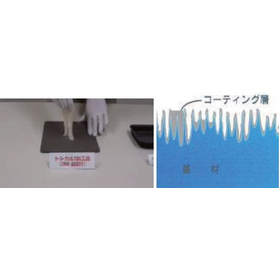
◆What is Super Alloy Coating◆ Super Alloy Coating is a surface treatment that covers soft substrates such as plastics and rubber, as well as lightweight metals like aluminum and thin sheets, with an alloy that has a hardness of Hv 600 or higher, while also providing flexibility. It effectively prevents dirt on various manufacturing equipment and components, reduces maintenance tasks such as the peeling of adhesive materials, and exhibits excellent mechanical strength and durability. The surface of the coating has rounded protrusions, which minimizes scratching of contact objects. Additionally, despite being a metal coating, it has the ability to conform to slight bends and can accommodate curved surfaces. It allows for excellent release properties from adhesive materials and strength while maintaining the flexibility of the processed material. 【Features】 ■ Non-adhesive convex surface formation ■ Alloy coating with Hv hardness of 600 ■ Excellent mechanical strength and durability ■ Minimization of scratches on contact objects ■ Processable with various materials *For more details, please refer to the PDF document or feel free to contact us.

  • image_012.png
  • image_013.png
  • Other surface treatment equipment
  • Surface Treatment

Added to bookmarks

Bookmarks list

Bookmark has been removed

Bookmarks list

You can't add any more bookmarks

By registering as a member, you can increase the number of bookmarks you can save and organize them with labels.

Free membership registration

What are the types of mold materials? An introduction to surface treatments as well.

We will introduce the main materials used for molds, as well as surface treatments and case studies that can solve molding troubles.

The materials used for molds are durable materials such as metals and plastics. The selection of materials for molds is determined by factors such as the shape of the product, the number of products to be mass-produced, the production process, and the types of materials used. Generally, for metals, the following types are available: 【Types of Mold Materials】 - Steel: It has high wear resistance, corrosion resistance, heat resistance, and strength. Examples include P20, S136, and NAK80. - Aluminum Alloy: Lightweight and highly heat-resistant, it may be used in processes such as injection molding. - Copper Alloy: It has high conductivity and excellent thermal conductivity. An example is beryllium copper. - Magnesium Alloy: Lightweight, strong, and has excellent thermal conductivity. It may be used in automotive parts. - Tungsten Alloy: It has high hardness and is suitable for use at high temperatures. It may be used in injection molding molds. The materials used for molds directly affect the quality of the products and production efficiency, so it is important to select appropriate materials and surface treatments according to the properties of the materials. Do you have any concerns regarding surface treatment for molds?

  • シーラー.png
  • NYK-01 (4)_edited.jpg
  • edit_edited.jpg
  • 2021-05-16 (2).png
  • s-0181UC_edited.jpg
  • Other molds
  • Surface Treatment

Added to bookmarks

Bookmarks list

Bookmark has been removed

Bookmarks list

You can't add any more bookmarks

By registering as a member, you can increase the number of bookmarks you can save and organize them with labels.

Free membership registration

What is delamination? Introducing surface treatments that excel in delamination resistance.

[Presentation of Materials] What is release property? We will introduce methods to improve release property and coatings that are particularly excellent in release property.

Release properties refer to the characteristic of materials or products that allows them to be easily removed from molds or forming tools without sticking. This property is important in the manufacturing process and affects product quality and production efficiency. ■ Methods to Improve Release Properties By applying a release agent to the surface, a thin film is created between the mold and the product, preventing adhesion. Silicone and fluorine-based release agents provide excellent release properties for many materials. ■ Resin Coating Applying a resin coating to the surface exhibits non-stick properties, making it easier to remove the product. Fluororesin coatings are commonly used. ■ Metal Plating For example, chrome plating has high hardness and is less reactive with other substances, aiding in product removal. Fluororesin-containing types of plating also exhibit non-stick properties. ■ Surface Roughness Adjustment By designing the surface with fine uneven structures, the contact area is reduced, thereby decreasing adhesion. As mentioned above, there are various methods, but we will introduce surface treatment technologies and coatings that are particularly effective in enhancing release properties, reducing product defects, and improving productivity. For more details, please download the PDF document or feel free to contact us.

  • s-2021-06-22 (3).gif
  • ホットメルト_edited.jpg
  • IMG_9472_edited2.jpg
  • s-ロール.jpg
  • IMG_9363_edited.jpg
  • s-0197UJedit.jpg
  • DSC04626_edited.jpg
  • Processing Contract
  • Surface Treatment

Added to bookmarks

Bookmarks list

Bookmark has been removed

Bookmarks list

You can't add any more bookmarks

By registering as a member, you can increase the number of bookmarks you can save and organize them with labels.

Free membership registration

What is the surface treatment of molds suitable for rubber molding?

Surface treatment of molds refers to the surface treatment techniques that impart new characteristics to the mold's surface or improve its durability.

The purpose of surface treatment for molding dies is as follows: ■ Improvement of Wear Resistance Molding dies experience wear due to friction with materials such as resin and metal during the molding process. If the surface of the die becomes rough due to wear, it can affect the finish of the molded products and shorten the lifespan of the die. ■ Improvement of Corrosion Resistance Molding dies may be subject to corrosion depending on the usage environment. If the die deteriorates due to corrosion, it can affect the finish of the molded products and shorten the lifespan of the die. ■ Improvement of Release Properties Molded products need to be removed from the die after molding. Poor release properties can cause the molded products to stick to the die, making them difficult to remove, or can damage the surface of the die. Surface treatment of molding dies must be selected appropriately according to the type of die and usage conditions. Bicoat, which excels in wear resistance, corrosion resistance, and is expected to improve release properties, is recommended. Bicoat offers many types tailored to specific purposes. For more details, please visit the official Yoshida SKT website or contact us.

  • image_012.png
  • image_013.png
  • Other surface treatment equipment
  • Surface Treatment

Added to bookmarks

Bookmarks list

Bookmark has been removed

Bookmarks list

You can't add any more bookmarks

By registering as a member, you can increase the number of bookmarks you can save and organize them with labels.

Free membership registration

Yoshida SKT's surface treatment directly solves the problems of molding and packaging processes!

Experts in surface treatment will help improve mold longevity and packaging quality, assisting in the enhancement of production sites.

Do you have any concerns regarding surface treatment for molding and conveying equipment? <Molding Equipment> - Mold damage - Dimensional accuracy of molds - Coating peeling <Conveying Equipment> - Poor flow of powder - Resin sticking to sealing jigs not improving - Coating peeling, contamination At Yoshida SKT, we have resolved numerous issues related to molding and conveying equipment and are currently offering free samples of surface treatments that our customers can adopt. Please take this opportunity to apply through the link.

  • シーラー.png
  • NYK-01 (4)_edited.jpg
  • edit_edited.jpg
  • 2021-05-16 (2).png
  • IMG_8528_edited_edited.jpg
  • s-0181UC_edited.jpg
  • Other molds
  • Surface Treatment

Added to bookmarks

Bookmarks list

Bookmark has been removed

Bookmarks list

You can't add any more bookmarks

By registering as a member, you can increase the number of bookmarks you can save and organize them with labels.

Free membership registration

Optimal surface treatment for those struggling to remove hardened epoxy resin.

Silicone-free, prevents adhesive adhesion to molds with low-temperature processing. By utilizing surface treatment, various production challenges can be solved. Samples and case studies are currently available.

Problems I wanted to solve and things I wanted to achieve There was an issue with epoxy adhesives adhering to the mold. The silicone-based release agent used had good release properties, but it easily transferred to the molded products, causing adhesion failures in subsequent bonding processes. Background/Conditions for Choosing Treatment What was needed was mold release without silicone. Additionally, materials that could withstand the pressure of molding and allow for low-temperature processing applicable to aluminum molds, which are prone to thermal deformation, were required. Achieved Effects Among the Bi-Coat series, "Bi-Coat Exceed NYK-2000E-C" was chosen. This is a fluorine-based coating that does not cause silicone transfer issues and allows for low-temperature processing, making it safe to use on aluminum molds. With this coating, the use of silicone-based release agents became unnecessary, achieving a silicone-free environment. Mold release troubles were resolved, and the quality and productivity of the products improved. **Features of Bi-Coat NYK-2000E-C** - Silicone-free - Low-temperature processing available - Prevents adhesive adhesion to molds For more detailed inquiries about Bi-Coat, please contact Yoshida SKT!

  • Other surface treatment equipment
  • Surface Treatment

Added to bookmarks

Bookmarks list

Bookmark has been removed

Bookmarks list

You can't add any more bookmarks

By registering as a member, you can increase the number of bookmarks you can save and organize them with labels.

Free membership registration

Achieve double the mold lifespan! "Bicoat NYK-01" ultra-durable surface treatment.

Free distribution of a case study on mold coating that doubled the productivity of automotive parts manufacturing.

Here is a case study of a certain automotive parts manufacturer. In the process of injection molding epoxy resin under high temperature and high pressure of 150°C, resin adhesion began after about 2,000 shots, necessitating frequent mold changes. The introduction of "Bicoat NYK-01" improved mold life by approximately twice, achieving a significant enhancement in productivity. 【Issues that can be addressed】 ■ Short lifespan of surface treatment for injection molding molds ■ Decreased productivity due to frequent mold changes ■ Resin adhesion issues in high temperature and high pressure environments 【Expected effects】 ■ Achieving approximately twice the mold (surface treatment) lifespan compared to conventional methods ■ Significant reduction in mold change operations leading to increased productivity ■ Reduction in replacement and material costs ■ Stable production due to excellent non-stick and release properties For more details on the case, please refer to the page "Doubling the Durability of Mold Surface Treatment in Automotive Motor Parts Manufacturing." *Product data PDF is available for download.

  • 2021-05-22 (4)_edited.jpg
  • IMG_8528_edited_edited.jpg
  • s-0186XT.jpg
  • Surface treatment contract service
  • Surface Treatment

Added to bookmarks

Bookmarks list

Bookmark has been removed

Bookmarks list

You can't add any more bookmarks

By registering as a member, you can increase the number of bookmarks you can save and organize them with labels.

Free membership registration

Surface treatment processing service - Surface treatment of stainless steel

We will introduce surface treatment and coating processes that can add characteristics to stainless steel surfaces.

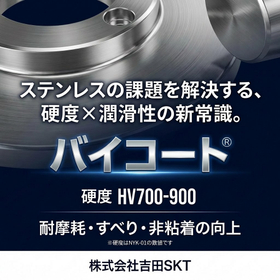
■What about the surface of stainless steel? Among stainless steels, the surface of austenitic stainless steel (SUS304) is covered with a passive film, making it resistant to rust in normal environments and maintaining a beautiful luster. However, in specific environments, it may corrode, and when used as machine parts, properties such as slip resistance and wear resistance become necessary. 【Types of Surface Treatment and Coating for SUS304】 - Electropolishing - Sandblasting / Bead blasting - Plating - Teflon coating There are methods like the above to modify the surface of stainless steel. Generally, these methods provide sufficient functionality, but if you want to further enhance durability, slip resistance, and non-stick properties, we would like to introduce a coating that can meet such demands. 'Bicoat,' with its hard coating of HV700-900 and the lubricating properties of fluororesin, combines wear resistance, slip resistance, and non-stick properties, making it recommended for those who are not satisfied with conventional surface treatments and coatings. If you are interested in more detailed product information about 'Bicoat(R),' please download the PDF materials to learn more.

  • 2021-05-22 (4)_edited.jpg
  • NYK-01 (4)_edited.jpg
  • Other surface treatment equipment
  • Surface Treatment

Added to bookmarks

Bookmarks list

Bookmark has been removed

Bookmarks list

You can't add any more bookmarks

By registering as a member, you can increase the number of bookmarks you can save and organize them with labels.

Free membership registration

PFAS regulation compliance fluoropolymer alternative engineering plastic coating

Proactive response to environmental regulations! High-performance non-fluorinated coatings as alternatives to fluoropolymer.

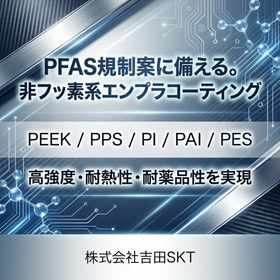
Introducing the "Non-Fluorinated Engineering Plastic Coating" provided by Yoshida SKT. In preparation for the recent strengthening of PFAS regulations, we have started new contract processing using engineering plastics (EPL) as an alternative coating technology that does not use fluororesins. We offer five types of engineering plastic materials, including PEEK, PPS, PI, PAI, and PES, and will propose the most suitable coating for your application. 【Features】 ■ Proactive response to PFAS regulations ■ Excellent properties such as high strength, heat resistance, and chemical resistance ■ Five types of engineering plastic materials: PEEK, PPS, PI, PAI, PES ■ A lineup of our uniquely developed PFAS-free coatings (FFLC series, CAS) ■ Free coating technology consultation by technical sales representatives 【Applications】 Surface treatment for manufacturing equipment and parts such as aircraft components, automotive parts, medical devices, semiconductor manufacturing equipment, electronic substrates, and electrical connectors. *We will listen to your challenges and propose the optimal coating. For more details, please download the materials or feel free to contact us.

  • Surface treatment contract service
  • Surface Treatment

Added to bookmarks

Bookmarks list

Bookmark has been removed

Bookmarks list

You can't add any more bookmarks

By registering as a member, you can increase the number of bookmarks you can save and organize them with labels.

Free membership registration

For those troubled by high sliding resistance of equipment.

Suppressing drive load due to friction, supporting operational stabilization and improving component lifespan.

■Do you have any of these concerns? - The operation of equipment is unstable due to friction or snagging. - I want to reduce the burden of lubrication, cleaning, and parts replacement. ■General measures and criteria for selecting surface treatments To reduce sliding resistance, it is necessary to check alignment, surface roughness, clearance, bearings, lubricants, and material changes. If design changes are difficult, oil cannot be used, or if you want to achieve both wear resistance and low friction, functional surface treatments are a candidate. We will check the contact pressure, speed, temperature, and counterpart materials, and suggest options such as Bicoat, FFLC, and fluoropolymer-based treatments. ■You can consult us from the stage of your concerns - Even if the target object or usage conditions are not determined, please let us know your concerns. - Based on the information you provide, we will suggest candidates for surface treatments and points to check. - We will propose the provision of test pieces or prototypes depending on the situation. Please contact us first. - If you want to know about the functions and features of surface treatments, please download and view the catalog.

  • Surface treatment contract service
  • Surface Treatment

Added to bookmarks

Bookmarks list

Bookmark has been removed

Bookmarks list

You can't add any more bookmarks

By registering as a member, you can increase the number of bookmarks you can save and organize them with labels.

Free membership registration

Functions and characteristics of DLC coating - Surface treatment by Minoru Industries

It is a general term for thin films that have carbon as the main component, possessing both diamond and graphite carbon-carbon bonds, and exhibiting intermediate characteristics of each.

Various types of DLC exist and are widely used for a diverse range of applications (tools, precision molds, medical equipment), particularly in electronic components. They demonstrate excellent performance in processing copper (copper alloys), Inconel, and solder-plated products, and are used for dies and punches for bending and cutting, as well as guides for positioning pin transport. They also possess various functions such as low wear resistance (high hardness), low friction coefficient, anti-adhesion, infrared permeability, design flexibility, biocompatibility, gas barrier properties, and corrosion resistance. Additionally, their application as gas barrier coatings for PET bottles has significantly expanded. Functions of DLC Coating: Non-stick / Slip resistance / Chemical resistance / Water and oil repellency / Wear resistance / Electrical properties and static prevention / Dimensional stability Low Friction Coefficient: With a low friction coefficient (μ=0.1), impulsiveness is improved, and high lubrication properties can be expected. High Hardness: With a hardness of HV3000 to 5,000, it possesses a hardness close to that of diamond. Thin Film: Film thickness of 1μ (ultra-thin films of several tens of nanometers are also possible) and can accommodate thick films. Peeling Treatment: The film can be removed through plasma etching treatment, making regeneration easy.

  • Other surface treatment equipment
  • Surface Treatment

Added to bookmarks

Bookmarks list

Bookmark has been removed

Bookmarks list

You can't add any more bookmarks

By registering as a member, you can increase the number of bookmarks you can save and organize them with labels.

Free membership registration

Thermal Spray Processing Services - Surface Treatment by Minoru Sangyo Co., Ltd.

By softening materials such as metals and ceramics, atomizing them into fine particles, spraying them onto a substrate, and allowing the particles that collide and flatten to solidify and accumulate, a high-performance coating is formed.

There are various methods of thermal spraying, which are classified in different ways depending on the materials used and the type of heat source. Considering the application and usage environment, it is important to select the most suitable thermal spraying method and materials for properties such as wear resistance, corrosion resistance, electrical insulation, and dimensional restoration. Functions of thermal spraying: Slipperiness / Non-stickiness / Heat resistance / Corrosion resistance / Hydrophilicity / Wear resistance / Electrical properties / Dimensional restoration / High friction Characteristics of thermal spraying: Wide range of materials The sprayed materials (thermal spray materials) include metals, ceramics, plastics, cermets, etc. The substrates (base materials) include metals, ceramics, plastics, wood, etc. It can be applied to large substrates such as bridges and transmission towers, and can be performed on-site. Thick films can be relatively easily produced, and film formation is faster compared to other surface treatment methods. The thermal impact on the substrate is relatively low, making it less likely to cause deformation or distortion (there are residual stresses and distortions other than thermal effects).

  • Surface treatment contract service
  • Surface Treatment

Added to bookmarks

Bookmarks list

Bookmark has been removed

Bookmarks list

You can't add any more bookmarks

By registering as a member, you can increase the number of bookmarks you can save and organize them with labels.

Free membership registration

Various plating processing services - Surface treatment by Minoru Sangyo Co., Ltd.

Plating is a technology that forms a metal film on the surface of a solid. Various products are treated with plating and are utilized for many purposes beyond just appearance.

Common types of plating include electroplating, electroless nickel plating, nickel-chromium plating, low-temperature black chromium plating, hot-dip galvanizing, zinc plating, and hard chrome plating. There are various methods such as electroplating, which uses electricity; chemical plating, which utilizes chemical reactions; molten plating, where the substrate is immersed in molten metal to form a coating; and vapor deposition plating, where vapor from other metals is sprayed to create a coating. The characteristics and properties of the films differ based on the type of plating and the method of film formation, leading to their selective use according to applications and purposes. Characteristics of plating include decorative plating and functional plating, which provide decorative qualities, rust resistance, wear resistance, and electrical conductivity. To enhance corrosion resistance To impart thermal properties To provide electrical properties To enhance wear resistance To add decoration The features of plating treatment include rust and corrosion resistance. By depositing metal onto the substrate through electrolysis or electroless methods, it protects the material from corrosion. Common plating treatments include zinc plating, decorative nickel-chromium plating, and electroless nickel plating, which are representative processes.

  • Surface treatment contract service
  • Surface Treatment

Added to bookmarks

Bookmarks list

Bookmark has been removed

Bookmarks list

You can't add any more bookmarks

By registering as a member, you can increase the number of bookmarks you can save and organize them with labels.

Free membership registration

ETFE, a fluororesin, is a surface treatment by Minoru Sangyo Co., Ltd.

It is a fluororesin copolymer of tetrafluoroethylene and ethylene that has thermoplastic properties similar to PFA.

It has high chemical resistance, a wide range of heat resistance, electrical insulation properties, and low friction, while also excelling in mechanical strength. Due to its transparency and weather resistance, it is used in outdoor applications. Features: Heat Resistance - Usable over a wide temperature range It can be used over a wide temperature range from -200 to +180°C, maintaining stable mechanical and electrical properties. Continuous use at +150°C is possible. Chemical Resistance - Compatible with a wide range of chemicals It exhibits excellent chemical resistance to most chemicals, including strong acids and strong alkalis. Insulation - Outstanding electrical properties It has excellent insulation properties, demonstrating high insulation strength with a thin film, and shows low dielectric constant and dielectric loss tangent over a wide frequency range. Flame Retardant and Non-toxic It is a flame-retardant material that meets UL standard 94V-0. Additionally, it is tasteless, odorless, and non-toxic, making it safe for use in various fields. Weather Resistance - Proven for over 10 years It is resistant to ultraviolet rays and can withstand long-term outdoor use. Excellent Low Surface Energy It has reliable surface properties such as low friction, non-stickiness, and water/oil repellency, demonstrating excellent effects such as reducing the resistance of fluids.

  • Surface treatment contract service
  • Surface Treatment

Added to bookmarks

Bookmarks list

Bookmark has been removed

Bookmarks list

You can't add any more bookmarks

By registering as a member, you can increase the number of bookmarks you can save and organize them with labels.

Free membership registration

Technical Data: Comparison of Electrolytic Polishing, Chemical Polishing, and Mechanical Polishing

We will introduce technical data comparing electrolytic polishing, chemical polishing, and mechanical polishing.

At Kyushu Denka, we conduct surface treatment of various metals and have established a research and development department to flexibly respond to advanced order requirements through multifaceted technical research. The specialized staff who work diligently in research here are an important presence that supports the company from a technical standpoint. We continue to challenge ourselves in pursuit of cutting-edge technology that leads the plating industry. [Contents] - Electrolytic polishing - Chemical polishing - Mechanical polishing For more details, please contact us or download the catalog.

  • Surface treatment contract service
  • Surface Treatment

Added to bookmarks

Bookmarks list

Bookmark has been removed

Bookmarks list

You can't add any more bookmarks

By registering as a member, you can increase the number of bookmarks you can save and organize them with labels.

Free membership registration

Technical Data: Physical Properties of Anodized Coatings

We will introduce the technical data on the physical properties of anodized oxide films.

Aluminum has good thermal and electrical conductivity, and it forms a natural oxide film in the air that protects the interior. However, the artificially generated insulating anodized film has a strong adhesion to the material and forms a coating with excellent toughness, corrosion resistance, and wear resistance. [Content] [Pure Aluminum / Anodized Coating] ○ Density (g/cm²) 2.7 / 2.5–3.1 ○ Hardness (Vickers) 17–130 / 300–600 ○ Elastic Modulus (kgf/mm²) 7000 / 7300–9300 For more details, please contact us or download the catalog.

  • Surface treatment contract service
  • Surface Treatment

Added to bookmarks

Bookmarks list

Bookmark has been removed

Bookmarks list

You can't add any more bookmarks

By registering as a member, you can increase the number of bookmarks you can save and organize them with labels.

Free membership registration

Technical Data: Secondary Contamination and Cleaning Difficulty

We will introduce technical data on secondary contamination and the difficulty of cleaning.

At Kyushu Denka, we perform surface treatment of various metals and have established a research and development department to flexibly respond to advanced order requirements through multifaceted technical research. The specialized staff who work diligently in research here are an important presence that supports the company from a technical standpoint. We continue to challenge ourselves in pursuit of cutting-edge technology that leads the plating industry. [Contents] - Dust - Metal powder - Oxidation of adhering oil - Oxidation of adhering oil + dust + metal powder - Secondary processing, oil entrapment, welding For more details, please contact us or download the catalog.

  • Surface treatment contract service
  • Surface Treatment

Added to bookmarks

Bookmarks list

Bookmark has been removed

Bookmarks list

You can't add any more bookmarks

By registering as a member, you can increase the number of bookmarks you can save and organize them with labels.

Free membership registration

Professional expertise shared! Basic knowledge of stainless steel and surface treatment.

Professional expertise shared! A simple and detailed explanation of surface treatment for stainless steel plates and containers (electropolishing, fluororesin coating).

The 'Secret Notebook Full of Information on Stainless Steel and Surface Treatments (Electropolishing and Fluororesin Coating)' is a document that introduces the electropolishing and fluororesin coating of stainless steel and stainless containers used at MONOVATE. Regarding stainless steel, we explain the symbols SUS304, SUS316, and SUS316L. Our company manufactures containers from this stainless steel sheet, primarily providing them to pharmaceutical manufacturers, as well as cosmetics, food, and chemical manufacturing companies. For electropolishing, we present methods for electropolishing the stainless steel (SUS304, SUS316L) we use, as well as the characteristics exhibited by electropolishing. Additionally, concerning fluororesin coating, we explain the properties of fluororesin coating and the selection of materials. *This document can be viewed immediately from the [Download] section.

  • Technical and Reference Books
  • Surface Treatment

Added to bookmarks

Bookmarks list

Bookmark has been removed

Bookmarks list

You can't add any more bookmarks

By registering as a member, you can increase the number of bookmarks you can save and organize them with labels.

Free membership registration

Q&A about corona discharge surface treatment

Here are some frequently asked questions and answers regarding the corona discharge surface modification device!

"Corona discharge surface treatment" improves painting properties, coating properties, deposition properties, and lining properties. Additionally, it enhances the adhesion of adhesives to water-repellent materials and strengthens adhesive strength. We have compiled frequently asked questions and answers regarding this product. Other questions are also available on our website. 【Q&A】 ■ What is corona discharge surface treatment? A: It is a process that increases the wettability of the target object by irradiating it with corona discharge. By increasing wettability, improvements in printing and adhesion can be expected. ■ What are the target objects for treatment? A: Depending on the selection of models, it can generally accommodate almost anything. ■ What is the difference between Corona Master and Corona Fit? A: The difference lies in the target objects for treatment. Master is mainly applied to sheet-like materials and metals, while Fit is primarily used for three-dimensional objects. *For more details, please refer to the PDF document or feel free to contact us.

  • Other surface treatment equipment
  • Surface Treatment

Added to bookmarks

Bookmarks list

Bookmark has been removed

Bookmarks list

You can't add any more bookmarks

By registering as a member, you can increase the number of bookmarks you can save and organize them with labels.

Free membership registration

If you are having trouble with surface treatment for aluminum, please consult us!

Leave the plating and anodizing chemicals to Okuno. We provide the entire process from pre-treatment to post-treatment! Complete support from prototyping to mass production!

Our products have a proven track record in various areas, including smartphones, home appliances, portable devices, music players, digital cameras, and bicycles. They are widely adopted in flagship model specifications. We particularly recommend our aluminum anodizing dyes (TAC dyes), which excel in a rich variety of colors and high-quality color reproduction. Additionally, we provide comprehensive support for other processes such as electroless plating and various surface treatments, from prototyping to mass production.

Added to bookmarks

Bookmarks list

Bookmark has been removed

Bookmarks list

You can't add any more bookmarks

By registering as a member, you can increase the number of bookmarks you can save and organize them with labels.

Free membership registration

Eco-friendly surface treatment "Ionis Coat/Y"

Indoor specifications (chrome-free three-layer coating) plating possible size: M12 and above

"Ionis Coat/Y" is an indoor specification, chrome-free three-layer coating. It is an environmentally friendly surface treatment with high corrosion resistance, prevention of electrolysis, and self-repairing properties. It can demonstrate corrosion resistance superior to that of electroplating, paint-based treatments, and hot-dip galvanizing. It significantly reduces electrolysis on galvanized steel sheets and aluminum materials. The main component of the top coat, silica, has high water solubility, allowing it to dissolve in scratches and cover damaged areas to enhance corrosion resistance. 【Features】 ○ Corrosion resistance ○ Electrolysis prevention performance ○ Self-repairing properties ○ Environmentally friendly specifications For more details, please contact us or download the catalog.

  • Surface treatment contract service
  • Surface Treatment

Added to bookmarks

Bookmarks list

Bookmark has been removed

Bookmarks list

You can't add any more bookmarks

By registering as a member, you can increase the number of bookmarks you can save and organize them with labels.

Free membership registration

Environmentally friendly surface treatment "Ionis Coat/WS"

Heavy-duty anti-corrosion specification (chrome-free 4-layer coating) plating possible size: M12 and above.

"Ionis Coat/Z" is a heavy-duty, hexavalent chromium-free four-layer coating. It is an environmentally friendly surface treatment with high corrosion resistance, electric corrosion prevention, and self-repairing properties. It can demonstrate corrosion resistance superior to that of electroplating, painting treatments, and hot-dip galvanizing. It significantly reduces electric corrosion on galvanized steel sheets and aluminum materials. The main component of the top coat, silica, has high water solubility, allowing it to dissolve into scratches and cover the damaged areas, enhancing corrosion resistance. 【Features】 ○ Corrosion resistance ○ Electric corrosion prevention ○ Self-repairing properties ○ Environmentally friendly specifications For more details, please contact us or download the catalog.

  • Surface treatment contract service
  • Surface Treatment

Added to bookmarks

Bookmarks list

Bookmark has been removed

Bookmarks list

You can't add any more bookmarks

By registering as a member, you can increase the number of bookmarks you can save and organize them with labels.

Free membership registration