We have compiled a list of manufacturers, distributors, product information, reference prices, and rankings for clay.
ipros is IPROS GMS IPROS One of the largest technical database sites in Japan that collects information on.

clay Product List and Ranking from 4 Manufacturers, Suppliers and Companies

clay Product List

1~4 item / All 4 items

Displayed results

Edible oil refining clay "Oil-Dri manufactured activated white clay"

For the removal of impurities contained in edible oils! Clay that can be selected based on the type of oil and refining level.

"Oil-Dri Active White Clay" is an effective clay for removing pigments such as chlorophyll found in edible oils, as well as impurities like 3-MCPD and GE. We offer a lineup including the "Pure-flo Series" suitable for coconut oil and palm oil, the "Supreme Series" for soybean oil and sunflower oil, and the "Perform Series" that pairs well with canola oil and flaxseed oil. You can choose based on the type of oil and the level of refinement. [Features] ■ Removal of impurities contained in edible oils ■ A lineup that can be selected based on the type of oil and the level of refinement *For more details, please refer to the PDF materials or feel free to contact us.

Added to bookmarks

Bookmarks list

Bookmark has been removed

Bookmarks list

You can't add any more bookmarks

By registering as a member, you can increase the number of bookmarks you can save and organize them with labels.

Free membership registration

Cosmetic ingredient, French origin, green clay.

This is green clay from France. It has purifying properties for the skin, with cleansing effects, the ability to absorb oil and dirt, moisturizing benefits, and the potential for skin regeneration.

Green clay is a natural mineral from the phyllosilicate family (such as talc and mica). It is composed of hydrated aluminum silicate, and its color appears green due to its high iron oxide content. Its lamellar structure provides very excellent absorption properties. Clay has the ability to absorb liquids such as water and swell like a sponge. Clay has the ability to adsorb, meaning it can fix molecules to its surface. This ability to fix molecules is due to the negative charge of the clay. The negative charge is explained by the presence of minerals (the more concentrated the clay is in inorganic salts, the more negatively charged it becomes). In the Middle Ages, clay was used for healing purposes both externally and internally. Externally, clay was mainly used in the form of masks and poultices, possessing astringent, soothing, and healing properties. 〇 Reports of effectiveness: Adsorption/absorption action (Gubitosa et al., 2019) Cleansing action (Gubitosa et al., 2019) Regenerative action (Valenti et al., 2012) 〇 Components (Williams et al., 2008) Aluminum, calcium, iron, magnesium, silicon, etc.

  • Cosmetic materials and raw materials
  • Other pharmaceutical intermediates and cosmetic ingredients
  • Other medical supplies and cosmetic manufacturing materials

Added to bookmarks

Bookmarks list

Bookmark has been removed

Bookmarks list

You can't add any more bookmarks

By registering as a member, you can increase the number of bookmarks you can save and organize them with labels.

Free membership registration

Inorganic barrier clay for suppressing gas permeability in food packaging materials and films.

Inorganic barrier clay for suppressing gas permeability in food packaging materials and films.

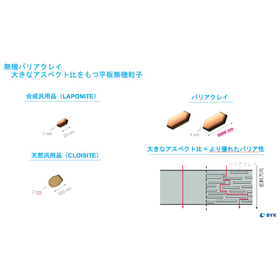
LAPONITE is effective in suppressing gas permeability in various packaging materials and films, including food packaging. In the membrane, the flat layered silicate aligns, which increases the gas flow path and suppresses permeability. Unlike types that are refined and classified from natural clay, LAPONITE is synthesized from inorganic chemicals, resulting in high purity, making it suitable for use in medical and cosmetic applications. There is a demand for improved barrier properties in materials for applications such as the conversion from glass to film in solar cells, as well as for hydrogen storage and transportation. LAPONITE is known as a rheology control agent and is used not only to thicken various coating liquids but also to create hydrogels. Unlike organic materials, it is an inorganic particle with a hectorite structure similar to clay, which also reduces the environmental impact during the disposal of liquids and films.

  • Other polymer materials

Added to bookmarks

Bookmarks list

Bookmark has been removed

Bookmarks list

You can't add any more bookmarks

By registering as a member, you can increase the number of bookmarks you can save and organize them with labels.

Free membership registration

[Market Report] Global Nanoclay Market

The global nano clay market is expected to grow rapidly and reach 1.84 billion USD by 2031.

The global nano clay market is experiencing robust expansion, with revenues reaching approximately 600 million USD in 2022. Recent market analysis suggests that this sector is expected to exhibit a compound annual growth rate (CAGR) of 13.3% during the forecast period from 2023 to 2023. This significant growth is attributed to the widespread adoption of nano clay across various industries and its versatile applications in diverse fields. The increasing awareness of the benefits of nano clay and the rising demand for sustainable and high-performance materials have positioned the global nano clay market for accelerated growth and expansion. As industries continue to explore the multifaceted applications of nano clay and invest in research and development initiatives, the market is anticipated to witness further innovation and evolution in the coming years. For application methods, please check the [PDF download] button or apply directly through the related links.

Added to bookmarks

Bookmarks list

Bookmark has been removed

Bookmarks list

You can't add any more bookmarks

By registering as a member, you can increase the number of bookmarks you can save and organize them with labels.

Free membership registration

Search Keywords Related to clay