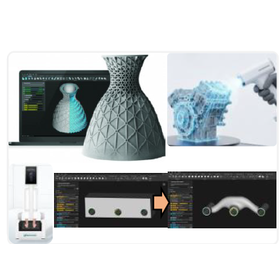
We have compiled a list of manufacturers, distributors, product information, reference prices, and rankings for Method 3D Printer.
ipros is IPROS GMS IPROS One of the largest technical database sites in Japan that collects information on.

Method 3D Printer Product List and Ranking from 22 Manufacturers, Suppliers and Companies | IPROS GMS

Last Updated: Aggregation Period:Feb 04, 2026~Mar 03, 2026
This ranking is based on the number of page views on our site.

Method 3D Printer Manufacturer, Suppliers and Company Rankings

Last Updated: Aggregation Period:Feb 04, 2026~Mar 03, 2026
This ranking is based on the number of page views on our site.

  1. システムクリエイト Osaka//Industrial Machinery
  2. オルテコーポレーション 本社 Kyoto//Electronic Components and Semiconductors
  3. インタコンポ 東京本社、大阪支店、長野支店、横浜事業所 Tokyo//Trading company/Wholesale
  4. 4 フュージョンテクノロジー 本社 Tokyo//Industrial Electrical Equipment
  5. 5 3D Printing Corporation Kanagawa//Manufacturing and processing contract

Method 3D Printer Product ranking

Last Updated: Aggregation Period:Feb 04, 2026~Mar 03, 2026
This ranking is based on the number of page views on our site.

  1. I measured the dimensions of the work created at each position! システムクリエイト
  2. Mitarepo: Challenging the limits of thin-walled reproduction with a powder sintering 3D printer! システムクリエイト
  3. I tried structuring a lattice and creating it with a 3D printer! システムクリエイト
  4. 4 I tried creating something with recycled ABS pellets! システムクリエイト
  5. 5 Large Pellet Type 3D Printer P800 システムクリエイト

Method 3D Printer Product List

1~30 item / All 100 items

Displayed results

FUNMAT PRO 410-G2

Industrial 3D printer compatible with super engineering plastics. An all-in-one model equipped with dual heads that can use all types of resin materials.

The "FUNMAT" series of 3D printers that can use "super engineering plastics," which have particularly excellent performance among engineering plastics. The FUNMAT PRO 410-G2 is an all-in-one model equipped with dual heads that can use all types of resin materials. The FUNMAT series is developed by the 3D printer manufacturer "INTAMSYS," specializing in 3D printing high-performance engineering plastics. It is an FDM 3D printer designed for the use of super engineering plastics, capable of stably printing large engineering plastics that have been difficult to shape due to issues like thermal shrinkage, making it a high-performance 3D printer. It is active in various industrial scenes such as aerospace, research and development, medical, and automotive industries. *For more details, please refer to the PDF materials or feel free to contact us.

  • 3D Printer
  • Method 3D Printer

Added to bookmarks

Bookmarks list

Bookmark has been removed

Bookmarks list

You can't add any more bookmarks

By registering as a member, you can increase the number of bookmarks you can save and organize them with labels.

Free membership registration

FUNMAT PRO

A large industrial 3D printer capable of solidly shaping large ABS and PC. For creating vehicle mock-ups and large jigs.

The "FUNMAT" series of 3D printers that can use "super engineering plastics" (super engineering plastics) with particularly excellent performance among engineering plastics. The FUNMAT PRO is a large industrial 3D printer with a large build area. (*Note: FUNMAT PRO is not compatible with super engineering plastics.) The FUNMAT series is developed by the 3D printer manufacturer "INTAMSYS," specializing in high-performance engineering plastic 3D printing. It is an FDM 3D printer designed for the use of super engineering plastics, capable of stably printing not only super engineering plastics but also large engineering plastics that have previously been difficult to print due to thermal shrinkage and distortion, making it a high-performance 3D printer. It is active in various industrial scenes such as aerospace, research and development, medical, and automotive industries. *For more details, please refer to the PDF document or feel free to contact us.

  • 3D Printer
  • Method 3D Printer

Added to bookmarks

Bookmarks list

Bookmark has been removed

Bookmarks list

You can't add any more bookmarks

By registering as a member, you can increase the number of bookmarks you can save and organize them with labels.

Free membership registration

Problem-Solving Materials: Utilizing 3D Data Part 4 | Human Costs of 3D Printing

What are the "troublesome" challenges of operating a 3D printer? A resource for identifying and solving issues in the production field.

This document is a series that proposes solutions to various challenges faced in production sites, from identifying issues to finding resolutions. In the "3D Data Utilization Edition," we will introduce various solutions to manufacturing challenges through the use of 3D data. This document focuses on the theme of "human costs of 3D printers," presenting the operational challenges of 3D printers and their solutions. [Document Overview] Low-cost entry-level 3D printers have emerged in the market and are widely adopted in design and development settings. However, as one repeatedly prototypes with a 3D printer, the post-processing tasks, such as removing support material, can become cumbersome. In this document, we will explain the challenges that become apparent during operation, such as those mentioned above, based on the characteristics of different 3D printing methods. *You can download the document using the button below.*

  • others
  • Method 3D Printer

Added to bookmarks

Bookmarks list

Bookmark has been removed

Bookmarks list

You can't add any more bookmarks

By registering as a member, you can increase the number of bookmarks you can save and organize them with labels.

Free membership registration

Issue Resolution Document: Utilizing 3D Data Edition 4-1 | Reducing Post-Processing Time

How can we shorten the "post-processing time" challenge of 3D printers? A resource for identifying and solving challenges in the production field.

This document is a series that proposes solutions to various challenges faced in production sites, from identifying issues to finding resolutions. In the "3D Data Utilization Edition," we will introduce various solutions to manufacturing challenges through the use of 3D data. In Vol. 4-1, we will focus on the theme of "reducing post-processing time" and introduce a printing method that can reduce the human costs associated with 3D printing. [Document Overview] The largest human cost during 3D printer operation is the time involved in finishing work. A significant portion of this finishing work consists of "removing supports." Therefore, introducing a device that makes support removal easy is key to reducing human costs. By alleviating the workload for operators and shortening the time previously spent on post-processing, productivity can be improved, allowing for rapid prototyping and repeated evaluation and testing in a short period. This document will further explain how differences in printing methods can lead to reductions in human costs, including mechanisms for printing without support materials and an introduction to implementation concepts. *You can download the document using the button below.

  • 3D Printer
  • Method 3D Printer

Added to bookmarks

Bookmarks list

Bookmark has been removed

Bookmarks list

You can't add any more bookmarks

By registering as a member, you can increase the number of bookmarks you can save and organize them with labels.

Free membership registration

Quickly resolve Form3 errors! 'Troubleshooting Guide'

This is a response manual that allows for quick action when errors occur with the popular 3D printer 'Form3'. It clearly explains the causes and solutions with accompanying photos.

This is the troubleshooting manual for the Formlabs LFS 3D printer 'Form3'. "Why won't the print start even though I'm ready?" "The error message displayed is in English and hard to understand." "I don't know the specific measures to take for the error." ...and other common questions that may arise during the operation of the Form3 can be addressed using this reference material. Under the supervision of certified technicians trained by Formlabs, we have compiled common issues, along with their causes and solutions, complete with photographs. Please also use this when contacting our technical support. [Features of the Document] ■ Actual error contents and causes presented in Japanese Examples of potential errors and their causes are clearly summarized in Japanese. ■ Easy-to-understand solutions with accompanying photos Specific solutions are explained with photos, making it easier to visualize the steps to take. For more details, please request a catalog or view the PDF data via the download button below.

  • 3D Printer
  • Technical and Reference Books
  • Method 3D Printer

Added to bookmarks

Bookmarks list

Bookmark has been removed

Bookmarks list

You can't add any more bookmarks

By registering as a member, you can increase the number of bookmarks you can save and organize them with labels.

Free membership registration

I tried the new feature of Form3, the adaptive pitch!

In the 【Mitarepo】, we tested whether the new feature "Adaptive Layer Pitch" of Form3 can really "create models beautifully and quickly"!

"Mitarepo" is a series based on the concept of "I tried doing this!" that introduces what can be done using various products. We deliver useful information each time from the wide range of product genres handled by System Create. The theme of Vol. 8 is "Trying out the new feature of Form3: Adaptive Layer Height." The new feature of "Form 3," Adaptive Layer Height, automatically sets the optimal variable layer height based on the model's shape and angle, balancing quality and time. We examined whether it can really "create beautiful and fast prints." In the materials, we prepared a model with surfaces inclined at 10° intervals and actually printed three patterns: "Time-priority printing," "Quality-priority printing," and "Adaptive layer height printing," comparing and verifying each. - "How is the layer height set based on the angle?" - "If you seek beautiful prints, won't it take more time?" - "If the printing time is shorter, will the surface quality ultimately suffer?" We will explain these points of interest along with actual images and comments from our technical staff! *You can download the materials from the button below.

  • 3D Printer
  • Other polymer materials
  • plastic
  • Method 3D Printer

Added to bookmarks

Bookmarks list

Bookmark has been removed

Bookmarks list

You can't add any more bookmarks

By registering as a member, you can increase the number of bookmarks you can save and organize them with labels.

Free membership registration

How accurately can powdered nylon molding reproduce dimensions?

How accurately can the powder sintering 3D printer 'Fuse1' reproduce dimensions? We measured it!

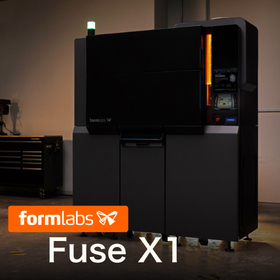
"Mitarepo" is a series based on the concept of "I tried doing this!" where we introduce what can be done using various products. From the wide range of product categories handled by System Create, we deliver useful information each time. The theme of Vol. 35 is "How accurately can a powder sintering 3D printer reproduce dimensions?" We measured various shapes of models created with a powder sintering 3D printer to verify the level of dimensional reproducibility it can achieve. In the materials, we created a plate with convex circles and holes using the powder material "Nylon 12" from the powder sintering 3D printer "Fuse 1," and a box shape surrounded by 1mm thick walls with bosses. Each shape and element was measured with a digital caliper. "Isn't powder sintering too powdery to achieve accurate dimensions?" "Isn't a design change necessary for printing?" We will explain these points of concern and the verification process with comments from our technical staff as we utilize 3D printers. *You can download the materials from the button above.

  • 3D Printer
  • Resin processing machine
  • plastic
  • Method 3D Printer

Added to bookmarks

Bookmarks list

Bookmark has been removed

Bookmarks list

You can't add any more bookmarks

By registering as a member, you can increase the number of bookmarks you can save and organize them with labels.

Free membership registration

I tried creating an assembly as a single print with a powdered 3D printer!

I tried creating a movable assembly in one piece with the powder 3D printer Fuse 1!

"Mitarepo" is a series that introduces what can be done using various products with the concept of "I tried doing this!" From the wide range of product genres handled by System Create, we deliver useful information each time. The theme of Vol. 40 is "We tried creating an assembly in one piece with a powder 3D printer!" So far, through Mitarepo Vol. 39 and Marusugo, we have shared the process of CT scanning a Rubik's Cube and converting it to STL. This time, using that STL data, we challenged ourselves to create a movable assembly model in one piece with the powder sintering layer method (SLS) 3D printer "Fuse 1"! We tested whether we could maintain the functionality of the assembly through one-piece printing, taking advantage of the SLS method's feature of not requiring supports. How powerful is a powder 3D printer? Does it really work when printed in one piece? We will explain the results of the prints, along with verification photos and comments from our technical staff. *You can download the materials from the button below.

  • 3D Printer
  • Resin processing machine
  • plastic
  • Method 3D Printer

Added to bookmarks

Bookmarks list

Bookmark has been removed

Bookmarks list

You can't add any more bookmarks

By registering as a member, you can increase the number of bookmarks you can save and organize them with labels.

Free membership registration

I tried out the latest update in Form 3!

【Mitarepo】Is the modeling time shortened with the Form 3 update!? We thoroughly compared the old and new versions!

"Mitarepo" is a series that introduces what can be done using various products with the concept of "I tried doing this!" We deliver useful information each time from the wide range of product genres handled by System Create. The theme of Vol. 43 is "We tested the latest software update on the Form 3!" In January of this year (2022), a major update for the "Form 3" was announced, featuring improvements such as "increased printing speed" and "reduced post-processing time." This time, we examined how much improvement there actually is due to the changes mentioned above. We will print and compare the print data of the "latest version" and the "old version" created from the same model. We will investigate how the "printing speed," "support shape," and "surface after support removal" have changed due to improvements in the laser system and changes in support shapes. We will provide explanations along with actual print data, details of printing times, and images of the surface after support removal. *You can download the materials from the button below.

  • 3D Printer
  • plastic
  • Prototype Services
  • Method 3D Printer

Added to bookmarks

Bookmarks list

Bookmark has been removed

Bookmarks list

You can't add any more bookmarks

By registering as a member, you can increase the number of bookmarks you can save and organize them with labels.

Free membership registration

I tried using the Form 3 model for vacuum forming!

"Did Form 3 just end with 'just looking at the shape'? We tried using the mold for vacuum forming!" | System Create

"Mitarepo" is a series that introduces what can be done using various products with the concept of "I tried doing this!" From the wide range of product categories handled by System Create, we deliver useful information each time. The theme of Vol. 46 is "Using the Form 3 model as a vacuum forming mold!" The resin printer "Form 3" is often used primarily for purposes such as shape verification and assembly, essentially for "seeing shapes." However, depending on the combination with other tools, it can actually be used in completely different ways! One such method is using the printed model as a "mold." Among these, vacuum forming pairs well with printed models and allows for great flexibility in shape. Therefore, this time, to verify this new usage, we actually vacuum formed the printed model and tested how much power it can exert as a mold. We will explain, along with actual print data and images of the printed model and the formed products, questions like, "How do you create a forming mold?" and "Can it be formed neatly?" *You can download the materials from the button below.

  • 3D Printer
  • Vacuum forming machine
  • plastic
  • Method 3D Printer

Added to bookmarks

Bookmarks list

Bookmark has been removed

Bookmarks list

You can't add any more bookmarks

By registering as a member, you can increase the number of bookmarks you can save and organize them with labels.

Free membership registration

Malsugo: Control the temperature environment with the thermal insulation effect of a vacuum flask structure!

The amazing features of the "CreatBot PEEK-300," a 3D printer that can use super engineering plastics and does not let heat escape!

Marsgo is a document that picks up the functions and features of various products and introduces the "amazing!" aspects. Super engineering plastics are known for their lightweight yet high heat resistance and mechanical strength. Due to these characteristics, they are gaining attention as versatile materials that can replace metals. To use super engineering plastics with high melting points, a printer that can handle high-temperature environments and maintain temperature is necessary. Have you ever thought, "I want to try using super engineering plastics...!" or "I want to suppress warping during molding...!"? In this context, we introduce the thermoplastic filament 3D printer "CreatBot PEEK-300." By using a high-output heater, it quickly heats up and can maintain a high-temperature environment without losing that heat. The document explains the mechanism of the insulation structure and the importance of maintaining temperature, so please take a moment to read it. *You can download the document using the button below.*

  • 3D Printer
  • Engineering Plastics
  • Other polymer materials
  • Method 3D Printer

Added to bookmarks

Bookmarks list

Bookmark has been removed

Bookmarks list

You can't add any more bookmarks

By registering as a member, you can increase the number of bookmarks you can save and organize them with labels.

Free membership registration

I tried changing the layer pitch to challenge myself to reduce the printing time!

[Mitarepo] I want to create 3D printed models as quickly as possible! I challenged myself to shorten the printing time of FDM prints! | System Create

"Mitarepo" is a series that introduces what can be done using various products with the concept of "I tried doing this!" From the wide range of product categories handled by System Create, we deliver useful information each time. In Vol. 56, we challenged ourselves to see how much we could reduce the printing time by changing the layer height for different parts of the model. While utilizing FDM 3D printers, "Everyone must have thought at least once, 'I want to reduce the printing time for 3D printing!'" However, the methods to shorten printing time are limited, and achieving this without compromising quality is quite challenging. This time, we attempted to see how much we could reduce printing time by using the "Anisoprint Composer," which allows for the use of multiple layer heights depending on the part being printed. We will explain the results of our actual printing, along with the printing conditions and photos, to see if we can reduce printing time while maintaining quality. *You can download the materials from the button below.

  • 3D Printer
  • plastic
  • Composite Materials
  • Method 3D Printer

Added to bookmarks

Bookmarks list

Bookmark has been removed

Bookmarks list

You can't add any more bookmarks

By registering as a member, you can increase the number of bookmarks you can save and organize them with labels.

Free membership registration

I tried FDM printing with a carbon composite printer!

[Mitarepo] Challenging ABS Modeling! What is the Power of the Carbon Composite Printer "Anisoprint Composer"? | System Create

"Mitarepo" is a series that introduces what can be done using various products with the concept of "I tried doing this!" From the wide range of product genres handled by System Create, we deliver useful information each time. In Vol. 68, we tested how beautifully we could create a print using only the resin nozzle of the carbon composite printer "Anisoprint Composer" with ABS FDM printing. The Composer, which allows for the incorporation of carbon fibers inside the print model, is also appealing because it allows for the free selection of commercially available materials. By being able to handle various materials, it enables flexible operations tailored to different applications, such as using long fiber carbon or typically using resin materials. For the first challenge, we decided to print using ABS, which is known for its tendency to warp. "Can it really create a clean print?" "Is there a difference in the print model compared to other FDM machines?" We will explain the finishing of the model along with actual images and dimensional measurement results. *You can download the materials from the button below.

  • 3D Printer
  • Composite Materials
  • Engineering Plastics
  • Method 3D Printer

Added to bookmarks

Bookmarks list

Bookmark has been removed

Bookmarks list

You can't add any more bookmarks

By registering as a member, you can increase the number of bookmarks you can save and organize them with labels.

Free membership registration

I tried the laser seam line minimization feature!

【Mitarepo】No need for surface treatment?? Tried out the new feature of Form 3L 'Minimization of Laser Seam Lines'! | System Create

"Mitarepo" is a series that introduces what can be done using various products with the concept of "I tried doing this!" We will deliver useful information each time from the wide range of product genres handled by System Create. In Vol. 78, we actually tested the new feature "minimization of laser seam lines" in modeling using the Form 3L. The Form 3L reproduces beautifully smooth surfaces even with conventional modeling settings, but during the modeling of large models, a seam line from the two lasers, known as the "laser seam line," occurs. While the line can be easily removed with sanding, if it appears on detailed areas, sanding can negatively impact the model, which is a process we want to avoid as much as possible. By using this new feature, it has become possible to model without the seam lines being printed on the model, prioritizing surface quality. In this article, we will actually try out the settings to prevent seam lines from occurring, and compare them with models created using conventional methods, along with explanations and images. You can download the materials from the button below.

  • 3D Printer
  • plastic
  • Prototype Services
  • Method 3D Printer

Added to bookmarks

Bookmarks list

Bookmark has been removed

Bookmarks list

You can't add any more bookmarks

By registering as a member, you can increase the number of bookmarks you can save and organize them with labels.

Free membership registration

Mitarepo [81] 168 hours! Tried UV exposure on a light-formed model.

[Mitarepo] A light sculpture that doesn't lose to the sun!? We tested a weather-resistant resin model with 168 hours of UV exposure! | System Create

"Mitarepo" is a series that introduces what can be done using various products with the concept of "I tried doing this!" From the wide range of product genres handled by System Create, we deliver useful information each time. In Vol. 81, we used a weather-resistant resin print model to verify how resistant it is to material changes through prolonged UV exposure. While light curing allows for fine details, doesn't it make you worry about breakage or color changes over time? There are surprisingly many environments unsuitable for UV-curable resin, not just outdoors but also indoors in places exposed to direct sunlight, as well as areas with temperature and humidity fluctuations. It would be great if we could maintain beauty without worrying about storage methods or placement, thanks to weather resistance. This time, we conducted extensive UV exposure to answer questions like, "How weather-resistant is it?" and "Does it really resist changes?" In the materials, we will explain dimensional changes and the appearance with measurement records and images of the actual models. You can download the materials from the button below.

  • 3D Printer
  • plastic
  • Other polymer materials
  • Method 3D Printer

Added to bookmarks

Bookmarks list

Bookmark has been removed

Bookmarks list

You can't add any more bookmarks

By registering as a member, you can increase the number of bookmarks you can save and organize them with labels.

Free membership registration

Marsgo" can create super large-scale models! FDM method printer "D1000

A drive mechanism that enables large-scale modeling with a 1000mm square! We will explain the amazing features of the 3D printer "CreatBot D1000."

Marsgo is a document that picks up the functions and features of various products and introduces the "amazing!" aspects. As the scale of the model increases and the printing time becomes longer, any misalignment in the layers can be quite shocking. When it comes to large-scale printing that runs day and night, failures are something we definitely want to avoid. Above all, isn't it important to be able to "proceed with printing reliably"? That's why we are introducing the CreatBot D1000 this time. It's a printer that you can trust for ultra-large prints measuring 1000mm on each side! It enables stable printing through position control based on the current information of the print head and a robust mechanism that reliably reflects that control. The document provides a detailed explanation of the features of the operating motors and the internal structure, so please take a look. *You can download the document using the button below.

  • 3D Printer
  • plastic
  • Method 3D Printer

Added to bookmarks

Bookmarks list

Bookmark has been removed

Bookmarks list

You can't add any more bookmarks

By registering as a member, you can increase the number of bookmarks you can save and organize them with labels.

Free membership registration

I checked the print quality of the D600 Pro2!

[Mitarepo] Checked the surface quality of a large 3D printed model! | System Create

"Mitarepo" is a series based on the concept of "I tried doing this!" where we introduce what can be done using various products. From the wide range of product categories handled by System Create, we deliver useful information each time. In Vol. 85, we checked the surface quality of a model created with the newly launched large FDM 3D printer "D600 Pro2" from the CreatBot series. The latest model from CreatBot, the "D600 Pro2," reflects customer feedback and has become a large FDM 3D printer that is "easier and more user-friendly." The D600 Pro2 is packed with various innovations for stable large-scale printing. Additionally, it is equipped with a mechanism called "Magic Box," which acts on the Z-axis movement to smooth the model's surface. What kind of finish can we expect? In this document, we will create a tall model with the D600 Pro2 and explain the surface condition with images. You can download the document using the button below.

  • 3D Printer
  • plastic
  • Prototype Services
  • Method 3D Printer

Added to bookmarks

Bookmarks list

Bookmark has been removed

Bookmarks list

You can't add any more bookmarks

By registering as a member, you can increase the number of bookmarks you can save and organize them with labels.

Free membership registration

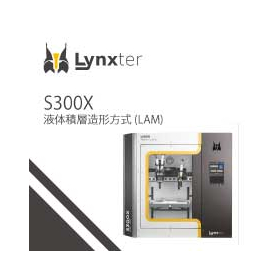
Liquid Layer Forming 3D Printer 'Lynxter S300X'

The "Lynxter S300X" is a 3D printer that utilizes cutting-edge technology with a liquid additive manufacturing (LAM) method. *Demonstrations available.

■Two Types of Print Heads Equipped with two print heads: the LIQ11 head, which can use single-component materials, and the LIQ21 head, which can use two-component materials. ■IDEX System Print Head By adopting the IDEX system, each head can be controlled independently. This allows for the separation of model material and support material, enabling the creation of complex silicone models. ■Wide Range of Silicone Materials We have independently developed high-performance and easy-to-handle excellent materials. The developed silicone materials are available in different hardness levels, allowing you to freely choose the hardness needed for the model you want to create or according to your application. *For more details, please request a catalog or view the PDF data from the download button below.

  • 3D Printer
  • Method 3D Printer

Added to bookmarks

Bookmarks list

Bookmark has been removed

Bookmarks list

You can't add any more bookmarks

By registering as a member, you can increase the number of bookmarks you can save and organize them with labels.

Free membership registration

I tried printing with clear resin in Form 4!

[Mitarepo] [Form 4] I tried to see how transparent the latest SLA 3D printer's creations can be! | System Create

"Mitarepo" is a series that introduces what can be done using various products with the concept of "I tried doing this!" We deliver useful information each time from the wide range of product genres handled by System Create. In Vol. 88, we examined the differences in transparency of models created with Formlabs' new 3D printer "Form 4" compared to the previous model, Form 3+. Recently, we started selling Formlabs' latest SLA 3D printer, "Form 4." It adopts a unique LFD printing method that significantly reduces printing time without losing detail, and the materials have also been updated, allowing for higher functionality and cleaner prints! Naturally, what you're curious about is the "differences from the previous model," right? In this document, we created flat models using "Clear Resin V5" with the Form 4 and "Clear Resin V4" with the previous model, Form 3+. We will introduce the differences in model transparency under three conditions, along with actual photos! *You can download the document from the button below.

  • 3D Printer
  • plastic
  • Prototype Services
  • Method 3D Printer

Added to bookmarks

Bookmarks list

Bookmark has been removed

Bookmarks list

You can't add any more bookmarks

By registering as a member, you can increase the number of bookmarks you can save and organize them with labels.

Free membership registration

Malsugo can 3D print pure silicone! Lynxter

You can create pure silicone models! Explaining the amazing features of the latest 3D printer "Lynxter S300X" | System Create

Marsgo is a document that highlights the impressive features and characteristics of various products. Silicone products are used in various applications in daily life due to their excellent flexibility and heat resistance. As a result, their use in 3D printing is gaining attention, but many of the materials available on the market are silicone "like" materials, and the options are currently very limited. This time, we would like to introduce the latest liquid layering 3D printer "Lynxter S300X," which enables the use of pure silicone materials! Equipped with an innovative print head that can utilize two-component liquid materials, this new 3D printer achieves layered printing with liquid silicone materials. The document provides a detailed explanation of the mechanism of this print head along with images, so please take a look. *You can download the document using the button below.

  • 3D Printer
  • Other polymer materials
  • Method 3D Printer

Added to bookmarks

Bookmarks list

Bookmark has been removed

Bookmarks list

You can't add any more bookmarks

By registering as a member, you can increase the number of bookmarks you can save and organize them with labels.

Free membership registration

I tried to verify the print speed of Form 4!

[Mitarepo] How fast is the print speed of the light curing 3D printer "Form 4"? | System Create

"Mitarepo" is a series that introduces what can be done using various products, based on the concept of "I tried doing this!" From the wide range of product genres handled by System Create, we deliver useful information each time. In Vol. 91, we examined how fast the printing speed of Formlabs' new 3D printer "Form 4" is by comparing it with the previous model, Form 3+. The newly launched SLA 3D printer "Form 4" by Formlabs has changed its unique printing method from the LFS method used in Form 3+ to a new method called LFD. This has significantly increased the printing speed! Hearing this, aren't you curious about how much faster it actually is? In this document, we created a common model for both Form 4 and Form 3+ and will introduce the differences in printing time when producing one piece versus ten pieces. *You can download the document using the button below.

  • 3D Printer
  • Resin mold
  • Other polymer materials
  • Method 3D Printer

Added to bookmarks

Bookmarks list

Bookmark has been removed

Bookmarks list

You can't add any more bookmarks

By registering as a member, you can increase the number of bookmarks you can save and organize them with labels.

Free membership registration

Preventing load and molding troubles for the 【Marsgo】 model! Form4

Introducing the mechanism of shaping that achieves high speed and low load! We will explain the amazing features of the 3D printer "Form 4"!

Marsgo is a document that picks up the functions and features of various products and introduces the "amazing" aspects. This time, we will introduce the latest stereolithography 3D printer from Formlabs, the "Form 4." A major feature of the Form 4 is that its adoption of a new molding method has significantly shortened the molding speed. Not only that, but the Form 4 also utilizes an LPU (Laser Unit) and a resin tank with a soft film, which reduces the load on the model during the molding process. As a result, it can further improve print speed and prevent troubles during molding! The document provides a detailed explanation of the structure of the resin tank and the mechanism of load-free molding, along with images, so please take a look. *You can download the document from the button below.

  • 3D Printer
  • Other polymer materials
  • Method 3D Printer

Added to bookmarks

Bookmarks list

Bookmark has been removed

Bookmarks list

You can't add any more bookmarks

By registering as a member, you can increase the number of bookmarks you can save and organize them with labels.

Free membership registration

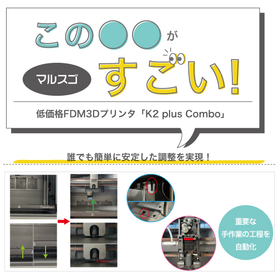
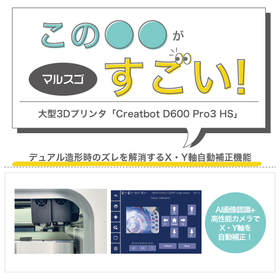
Marsugo: Achieve stable adjustments easily for anyone!

I will explain the convenient automatic adjustment feature of the "FDM method 3D printer Creality K2 Plus Combo."

Among 3D printers, the FDM method is relatively inexpensive, easy to introduce, and popular. Its ease of use allows it to be utilized by a wide range of users. However, there are various types of FDM 3D printers, and choosing one from among them can be difficult. Wouldn't it be great to have a convenient model that consolidates various features? The "Creality K2 Plus Combo" is here to solve that problem. Despite being a desktop-sized printer in the low price range, it is an excellent 3D printer equipped with a diverse array of functions! In this document, we provide a detailed explanation of the convenient automatic adjustment feature of the "K2 Plus Combo," so please take a moment to read it. *You can download the document using the button below.

  • 3D Printer
  • Method 3D Printer

Added to bookmarks

Bookmarks list

Bookmark has been removed

Bookmarks list

You can't add any more bookmarks

By registering as a member, you can increase the number of bookmarks you can save and organize them with labels.

Free membership registration

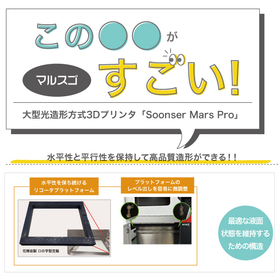
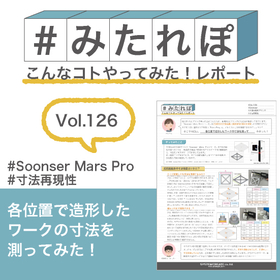
I measured the dimensions of the work created at each position!

【Mitarepo】How is the dimensional reproducibility of a large printer using light curing technology!? We measured the workpieces created at various positions in a wide area | System Create

Mitarepo is a series that introduces what can be done using various products with the concept of "I tried doing this!" The high-quality and high-speed 3D printer using light curing technology, "Soonser Mars Pro 850." This time, to investigate whether stable dimensional reproduction can be achieved regardless of where in the 850mm square build area the printing is done, we placed multiple workpieces and conducted the printing. We thoroughly checked the reproducibility based on placement positions and differences due to shapes! "Can it print uniformly all the way to the edges of the wide build area?" "What is the difference between the data dimensions and the actual dimensions?" We will introduce these points of interest along with images of the actual printed test pieces and measurement results. *You can download the materials from the button below.

  • 3D Printer
  • Resin processing machine
  • Method 3D Printer

Added to bookmarks

Bookmarks list

Bookmark has been removed

Bookmarks list

You can't add any more bookmarks

By registering as a member, you can increase the number of bookmarks you can save and organize them with labels.

Free membership registration

OPEN 3D Printer - Tour of Chinese-made 3D Printers -

We are holding a tour of the light curing method (SLA) 3D printer! Why not take a look and experience the differences compared to the 3D printers you use every day, and compare them again?

◆Exhibition Equipment ・RSPro600 / UnionTech (Chinese 3DP/SLA) ・ATOMm-8000 / CMET (Domestic 3DP/SLA) ・ATOMm-4000 / CMET (Domestic 3DP/SLA) ・Cleaning Equipment / CMET ・UV Equipment (for post-processing) / CMET ◆Usable Software ・Dedicated for CMET Equipment "C-Sirius" ・Dedicated for UnionTech Equipment "PolyDevs Pro" ◆Experience ・Equipment Data Processing Experience ・Model Cleaning Experience (from model removal to post-processing completion) ・Equipment Operating Experience ・Discussion Session with Technicians ・Discussion Session with Maintenance Service Technicians Date: August 29, 2022 (Monday) to September 30, 2022 (Friday) Location: CMET Corporation Material Development Center Application: Advance reservation required There are limited time slots for visits, so please apply early. Please check the "Basic Information" section below for application methods.

  • Contract manufacturing
  • Method 3D Printer

Added to bookmarks

Bookmarks list

Bookmark has been removed

Bookmarks list

You can't add any more bookmarks

By registering as a member, you can increase the number of bookmarks you can save and organize them with labels.

Free membership registration

Pellet Melting Layered 3D Printer "GEM444"

Equipped with an extrusion head that enables a maximum discharge rate of 3 kg/h! It can be used for a wide range of applications, from material development to large-scale modeling.

"GEM444" is a next-generation 3D printer that can create three-dimensional shapes using pellets of the grade desired by the user. Equipped with an extrusion head capable of a maximum output of 3 kg/h, it is a lab machine that can be used for a wide range of applications from material development to large-scale modeling. We also offer a super engineering plastic version that can handle temperatures up to 400°C. 【Features】 ■ Capable of three-dimensional modeling with pellets of the desired grade ■ Equipped with an extrusion head capable of a maximum output of 3 kg/h ■ Super engineering plastic version that can handle temperatures up to 400°C is also available ■ Complete design, parts processing, assembly, and after-sales service *For more details, please refer to the PDF materials or feel free to contact us.

  • 3D Printer
  • Method 3D Printer

Added to bookmarks

Bookmarks list

Bookmark has been removed

Bookmarks list

You can't add any more bookmarks

By registering as a member, you can increase the number of bookmarks you can save and organize them with labels.

Free membership registration

3D printer showroom

One of the largest in Kanto! If you are planning to introduce a 3D printer, please be sure to visit us!

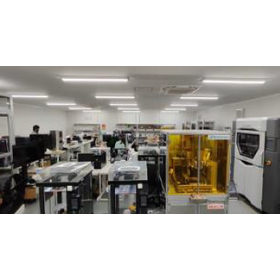
In November 2021, we opened a showroom for 3D printers at the Hotti Polymer factory in Kuki, Saitama. Focusing on the MEX method, it is possible to view various types of 3D printers, including photopolymerization and LAM (liquid additive manufacturing) methods, as well as models from different manufacturers within the same method all at once. Additionally, you can also see our in-house printer "Silicom," which can create 100% silicone rubber, a rarity even on a global scale. We invite you to visit us. 【Exhibited 3D Printers】 ■ MEX (resin extrusion additive manufacturing) 3D printer ■ Photopolymerization LCD method (transmissive liquid crystal method) 3D printer ■ Photopolymerization SLA method (laser method) 3D printer ■ LAM (liquid additive manufacturing) 3D printer ■ Poly Jet (inkjet) method 3D printer * New models will be added as they become available. * For more details, please refer to the PDF document or feel free to contact us.

  • image_17.png
  • image_18.png
  • image_19.png
  • image_20.png
  • image_21.png
  • image_22.png
  • image_23.png
  • others
  • 3D Printer
  • Method 3D Printer

Added to bookmarks

Bookmarks list

Bookmark has been removed

Bookmarks list

You can't add any more bookmarks

By registering as a member, you can increase the number of bookmarks you can save and organize them with labels.

Free membership registration

Utilization of SLS Method 3D Printers in Manufacturing Sites

We provide support for the introduction of 3D printers! You can see the actual [Fuse 1+ 30W] machine at our showroom.

Our company, which specializes in the design and manufacturing of production equipment, introduced Formlabs' 3D printers in 2022. In 2024, we became a sales partner for Formlabs. As a user of the 3D printer [Fuse 1+ 30W], we understand: - How to incorporate 3D printed parts into production equipment - The reduction in lead times and costs due to the introduction of 3D printers - The importance of designing with 3D printing in mind We will share this knowledge and provide suggestions from a user perspective on how to utilize 3D printers in your company. "If you're interested in 3D printers but are worried about the strength and precision of the parts..." "We've implemented one, but we're not utilizing it beyond making jigs..." If you have such concerns, please feel free to contact us. https://form.3fit.net/ *F.I.T. Co., Ltd. is an authorized distributor of Formlabs products.

Added to bookmarks

Bookmarks list

Bookmark has been removed

Bookmarks list

You can't add any more bookmarks

By registering as a member, you can increase the number of bookmarks you can save and organize them with labels.

Free membership registration

Here are five key points for selecting 3D prints and 3D products!

Key Points for Selecting a 3D Printer Vendor 【Handbook Available】

Our company specializes in 3D printing processing, including 3D scanning, 3D modeling, and 3D print output. We will introduce the utilization of 3D printers from this perspective in a handbook! For those who have wanted to try a 3D printer or create prototypes but are unsure about what to use or how to use it, we have summarized the key points into five sections. [Examples of content included] - Selection of printer models based on purpose and application - Post-processing, secondary processing, and printing methods - Total solutions from design to implementation, etc. We also have large machines capable of producing objects up to 1 meter in size and multi-material 3D printers that can simultaneously inject two types of resin materials with different physical properties! *For more details, please refer to the catalog or feel free to contact us.

  • 3D Printer
  • Prototype Services
  • Processing Contract
  • Method 3D Printer

Added to bookmarks

Bookmarks list

Bookmark has been removed

Bookmarks list

You can't add any more bookmarks

By registering as a member, you can increase the number of bookmarks you can save and organize them with labels.

Free membership registration

A 3D printer capable of smoothly and rapidly creating microfluidic channels, equipped with precision.

Achieving high-precision, high-speed, and highly flexible microchannel devices—accelerating innovation in the medical and research fields with an innovative light-based 3D printer.

Our 3D printer brings evolution to the next-generation manufacturing of microfluidic devices. By adopting the innovative "PµSL" technology, it enables the easy production of ultra-fine microfluidic devices ideal for applications such as cell culture, drug development, and drug delivery. Complex structures can also be easily realized, contributing to the introduction of active ingredients into cells with three-dimensional designs. It is also utilized in the development of medical devices, bringing us one step closer to achieving more innovative medical solutions. Explore the new possibilities of microfluidic devices using our 3D printer!

  • 221028_cap3-1 (1).jpg
  • Other industrial robots
  • Method 3D Printer

Added to bookmarks

Bookmarks list

Bookmark has been removed

Bookmarks list

You can't add any more bookmarks

By registering as a member, you can increase the number of bookmarks you can save and organize them with labels.

Free membership registration