We have compiled a list of manufacturers, distributors, product information, reference prices, and rankings for Nanoparticles.
ipros is IPROS GMS IPROS One of the largest technical database sites in Japan that collects information on.

Nanoparticles Product List and Ranking from 5 Manufacturers, Suppliers and Companies | IPROS GMS

Last Updated: Aggregation Period:Jun 24, 2026~Jul 21, 2026
This ranking is based on the number of page views on our site.

Nanoparticles Manufacturer, Suppliers and Company Rankings

Last Updated: Aggregation Period:Jun 24, 2026~Jul 21, 2026
This ranking is based on the number of page views on our site.

  1. アイテック Osaka//Chemical
  2. アートビーム Tokyo//Manufacturing and processing contract
  3. ナノ・ミール Shizuoka//Chemical
  4. マーケットリサーチセンター Tokyo//Service Industry
  5. 5 Tohoku Techno Arch Co., Ltd. Miyagi//Educational and Research Institutions

Nanoparticles Product ranking

Last Updated: Aggregation Period:Jun 24, 2026~Jul 21, 2026
This ranking is based on the number of page views on our site.

  1. Samples will be given to 10 people: Zirconia Nanoparticles 'Zirconeo' アイテック
  2. "Polystyrene Nanoparticles" ★Free reference materials! ナノ・ミール
  3. [Business Introduction] Development of Various Nanoparticles アートビーム
  4. [Research Material] Global Market for Barium Titanate Nanoparticles マーケットリサーチセンター
  5. 5 Small Room of Nanomaterials: Fabrication of Porous Palladium ナノ・ミール

Nanoparticles Product List

1~8 item / All 8 items

Displayed results

"Polystyrene Nanoparticles" ★Free reference materials!

For the production of structural colors and 3D porous molds! "Easily arranged," "difficult to aggregate," "free of impurities" - 'Polystyrene nanoparticle' dispersion.

Our developed "Polystyrene Nanoparticles" achieve a uniform particle size without classification. They can easily create a regular array structure. Furthermore, they are characterized by a strong negative charge on the surface, making them difficult to aggregate in water. Since they are synthesized soap-free, there are no impurities such as surfactants. They are ideal not only for structural colors but also for nanosphere lithography and molds for three-dimensional porous bodies. Expected applications for three-dimensional porous bodies include electrodes for secondary batteries and capacitors, photocatalysts, dye-sensitized solar cells, photonic crystals, and sensors. For inquiries regarding nanoparticles, please feel free to consult us. 【Features】 ■ Spherical shape with a sharp particle size distribution ■ Lineup from 50 to 300 nm ■ Easy to arrange (negative charge: sulfonic acid group for employment) ■ Free of impurities (surfactant-free manufacturing) *For more details, please refer to the catalog or feel free to contact us.

  • Other polymer materials
  • Nanoparticles

Added to bookmarks

Bookmarks list

Bookmark has been removed

Bookmarks list

You can't add any more bookmarks

By registering as a member, you can increase the number of bookmarks you can save and organize them with labels.

Free membership registration

Small Room of Nanomaterials: Fabrication of Porous Palladium

Here is an example of creating porous palladium using nanoparticles!

This is an example of creating porous palladium using nanoparticles to detect hydrogen. In the future, hydrogen will be extremely important as an energy source for decarbonization. However, due to its high combustion heat and wide explosion limits, detection measures to prevent leaks are essential. We created a porous palladium structure using polystyrene nanoparticles of various sizes as a mold and investigated its properties. The sensitivity to hydrogen greatly depends on the periodicity of the pores, with larger pore diameters being more effective. *For more detailed information, please refer to the related links. Feel free to contact us for further inquiries.*

  • others
  • Nanoparticles

Added to bookmarks

Bookmarks list

Bookmark has been removed

Bookmarks list

You can't add any more bookmarks

By registering as a member, you can increase the number of bookmarks you can save and organize them with labels.

Free membership registration

[Business Introduction] Development of Various Nanoparticles

Supercritical hydrothermal synthesis using only water as a solvent! Introduction to the nanoparticle research and development project.

We would like to introduce our business of "development of various types of nanoparticles." Based on a supercritical hydrothermal synthesis method that does not require organic solvents, we are engaged in the design development and prototyping of nanoparticles. Since our prototype equipment operates continuously, we can positively respond to customer requests regarding the concrete expansion of nanoparticle mass production. We research, develop, and manufacture various new nanoparticles that can be used in a wide range of fields, including electrical and electronic component materials, magnetic materials, medical materials, phosphor materials, electrode materials, catalysts, and high-refractive materials, supporting companies in creating new functional products with new properties tailored to their needs. 【Features of Continuous Supercritical Hydrothermal Synthesis Method】 ■ All substances found on Earth can be continuously synthesized as nanosized particles. ■ The synthesis occurs at high temperatures, resulting in particles with good crystallinity. ■ By inducing uniform nucleation, particles with a narrow particle size distribution can be obtained. ■ The reaction time is very short, on the order of seconds, allowing for mass production through continuous synthesis. ■ Nanoparticles with multi-component compositions can be synthesized. *For more details, please refer to the related links or feel free to contact us.

  • Other physicochemical equipment
  • Nanoparticles

Added to bookmarks

Bookmarks list

Bookmark has been removed

Bookmarks list

You can't add any more bookmarks

By registering as a member, you can increase the number of bookmarks you can save and organize them with labels.

Free membership registration

Hokkaido Univ. Technology : Bio-Catalytic Approach to Mesoscopic Particle Synthesis : HK24-007

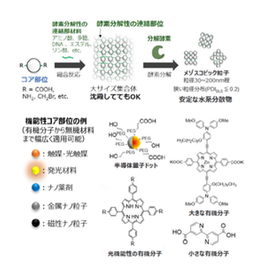
Innovative method using hydrolytic action of enzymes

Mesoscopic particles, ranging from several tens to several hundred nm in size, have attracted attention in a wide range of fields as interesting materials where quantum size effects and bulk effects interact or synergize. Regarding manufacturing methods, top-down approaches such as physical grinding and bottom-up approaches such as chemical synthesis have been proposed. However, these methods face challenges related to yield, dispersibility, and cost, necessitating new solutions.  In this study, the inventor has developed a novel manufacturing method to address these issues: the "Biocatalytic Nanoparticle Shaping method" (BNS method), which utilizes enzymes. The BNS method can be applied to fabricate various mesoscopic particles by combining enzyme-degradable materials with organic/inorganic materials. For example, semiconducting quantum dots (QDs), porphyrin molecules, bipyridine molecules, and nanographene were used as core units, resulting in nearly monodispersed mesoscopic particles with uniform sizes, obtained as stable aqueous dispersions.

  • others
  • Nanoparticles

Added to bookmarks

Bookmarks list

Bookmark has been removed

Bookmarks list

You can't add any more bookmarks

By registering as a member, you can increase the number of bookmarks you can save and organize them with labels.

Free membership registration

Samples will be given to 10 people: Zirconia Nanoparticles 'Zirconeo'

Ideal for high refractive index materials and molding materials! Zirconia nanoparticles developed using supercritical technology. Samples available for 10 people only!

The zirconia nanoparticles "Zirconeo Series" are nanosized zirconia particles developed using Aitec's supercritical hydrothermal synthesis method. They excel in compatibility and transparency when mixed with resins, making them suitable for high refractive index materials and molding materials. We also provide zirconia nanoparticle dispersions in powder form or as dispersions in water or organic solvents. The transparent dispersion containing zirconia particles under 10nm shows excellent compatibility with UV-curable resins. 【Features】 ■ Particle size is below 10nm ■ Main crystal structure is tetragonal ■ Specific surface area is over 200 square meters/g ■ Samples can be provided in either powder or dispersion form ~ Free sample giveaway ongoing! ~ * Customers wishing to receive zirconia samples should download the catalog, fill out the questionnaire, and return it via fax. * This offer is on a first-come, first-served basis and will end once we reach 10 participants. * For more details, please download the catalog or contact us directly.

  • Other polymer materials
  • Other optical parts
  • Nanoparticles

Added to bookmarks

Bookmarks list

Bookmark has been removed

Bookmarks list

You can't add any more bookmarks

By registering as a member, you can increase the number of bookmarks you can save and organize them with labels.

Free membership registration

Nano Meal Corporation Business Introduction

Do you have any troubles with "nano"?

The advent of nanoscale materials has made it possible for materials science to connect directly with biology, optics, and other fields. Photonic crystals and structural colors found in birds and insects are good examples of this. Until now, we have dealt with various materials such as semiconductors, carbon materials, metals, oxides, and polymers. In addition to these, we hope to leverage our experience in synthesizing uniformly sized "polystyrene nanoparticles" to help solve your challenges and contribute to product development. For more details, please contact us via email.

  • Other polymer materials
  • Other physicochemical equipment
  • Nanoparticles

Added to bookmarks

Bookmarks list

Bookmark has been removed

Bookmarks list

You can't add any more bookmarks

By registering as a member, you can increase the number of bookmarks you can save and organize them with labels.

Free membership registration

Small Room of Nanomaterials: Clear Structural Color Due to Black Carbon Addition (1)

Here is an example of using secondary particles mixed with black particles to create a more distinct structural color.

This is an example of using secondary particles mixed with black particles (carbon black) to achieve a more distinct structural color while controlling the aggregation of silica colloid particles. It seems that without adding NaCl, a dull, whitish color was obtained. However, by adding a small amount of carbon black, the white light due to scattering decreased, making the structural color more clearly visible. Furthermore, when magnetic iron powder was added, the secondary particles moved and gathered in response to the magnetic field. *For more detailed information, please refer to the related links. Feel free to contact us for further inquiries.*

  • others
  • Nanoparticles

Added to bookmarks

Bookmarks list

Bookmark has been removed

Bookmarks list

You can't add any more bookmarks

By registering as a member, you can increase the number of bookmarks you can save and organize them with labels.

Free membership registration

[Research Material] Global Market for Barium Titanate Nanoparticles

World Market for Barium Titanate Nanoparticles: Injection-Hydrolysis, Peptide-Assisted Precipitation, Hydrothermal/Solvothermal Synthesis, Pyrolysis, Electronics, PTC S...

This research report (Global Barium Titanate Nanoparticles Market) investigates and analyzes the current status and outlook for the global market of barium titanate nanoparticles over the next five years. It includes information on the overview of the global barium titanate nanoparticles market, trends of major companies (sales, selling prices, market share), market size by segment, market size by major regions, and distribution channel analysis. The market segments by type include injection-hydrolysis, peptide-assisted precipitation, hydrothermal/solvothermal synthesis, and pyrolysis, while the segments by application cover electronics, PTC thermistors, ceramics, optical devices, composite reinforcement, and others. The regional segments are categorized into North America, the United States, Europe, Asia-Pacific, Japan, China, India, South Korea, Southeast Asia, South America, the Middle East, and Africa to calculate the market size of barium titanate nanoparticles. It also includes the market share of major companies in barium titanate nanoparticles, product and business overviews, and sales performance.

  • Other services
  • Nanoparticles

Added to bookmarks

Bookmarks list

Bookmark has been removed

Bookmarks list

You can't add any more bookmarks

By registering as a member, you can increase the number of bookmarks you can save and organize them with labels.

Free membership registration