Why does slurry settle? An explanation of the causes of instability after dispersion and key points for dispersion design and process improvement to prevent settling.
 澁谷工業
澁谷工業
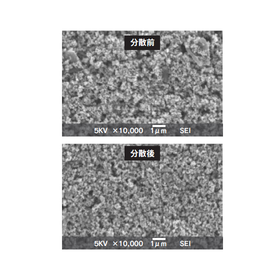
Even slurries that appear uniform after dispersion often face challenges of instability in quality due to sedimentation and separation over time, which is commonly observed in many settings. This phenomenon is not merely a result of insufficient stirring; it is influenced by the aggregation state of the particles, a lack of dispersion energy, and complex inter-particle interactions in the liquid. Particularly in the case of nanoparticles or high solid content slurries, even slight dispersion issues can significantly affect sedimentation behavior, leading to variations in product performance. Additionally, batch processing is susceptible to changes in state over time, making it difficult to ensure reproducibility. To suppress sedimentation, it is crucial to not only mix but also to break down particles to the primary particle level and achieve uniform dispersion. Furthermore, maintaining consistent shear conditions, as in inline continuous processing, can help stabilize the dispersion state and ensure uniform quality. Designing the dispersion state throughout the entire process is key to producing stable slurries that do not sediment.
Inquiry about this news
Contact Us OnlineMore Details & Registration
Details & Registration
Related Links
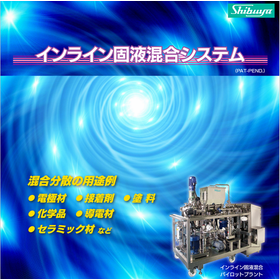
Sedimentation occurs not only in a dispersed state but is also influenced by the entire process, including shear conditions and flow design. Our company offers process engineering that takes into account energy density and reproducibility of dispersion conditions during scale-up, centered around inline continuous processing. We will provide detailed design points to suppress sedimentation and achieve stable quality.
Related product

Related catalog(1)

Distributors