What is decentralized process design? Key points for stabilizing quality.
 澁谷工業 メカトロ統轄本部
In dispersion engineering, stable quality cannot be achieved solely based on the performance of the equipment. What is important is the overall design of the process, taking into account material properties and process conditions. This is referred to as dispersion process design.
Dispersion quality is determined not only by the strength of shear but also by multiple factors such as flow state, residence time, and method of input. If these conditions are not properly designed, localized agglomeration or variation can occur, making it difficult to maintain stable quality.
For example, poor wetting during powder input or the occurrence of stagnant areas due to flow bias can lead to clumping or dispersion issues. Additionally, even if the shear energy is sufficient, if it does not act uniformly on all particles, differences in dispersion state will arise.
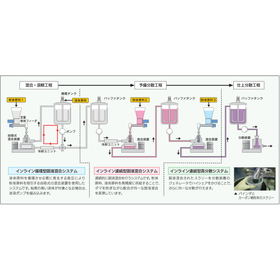
Therefore, in dispersion processes, it is crucial to design "flow," "shear," and "processing time" as an integrated system. This allows for all particles to receive the same dispersion history, achieving uniform and highly reproducible dispersion quality.
In particular, inline continuous processing has the advantage of maintaining consistent conditions within the flow, making it easier to ensure reproducibility in process design. Dispersion process design is a key concept for stabilizing quality and successfully scaling up.
Inquiry about this news
Contact Us OnlineMore Details & Registration
Details & Registration
Related Links
In dispersed process design, it is important to align the processing history for each particle. I will explain in detail why continuous processing is effective for improving reproducibility.
Related product


Distributors