Tohoku Univ. Technology:Rare metal collecting method using a single organic solvent that does not require waste liquid treatment of acid solution: T18-108

With low environmental load that enables organic olvent recycling
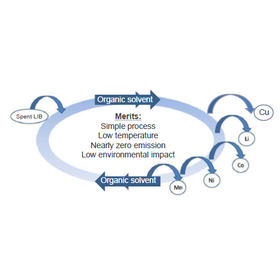
For Japan, where the natural resources are poor, the technology to collect and reuse rare metal is extremely important. In particular, with the increasing demand for electric vehicle, the collection of rare metal from the cathode material of lithium-ion battery has become a major industrial issue. Currently, the collection is done by extracting each metal species with various solvents. However, this method requires the waste liquid treatment of various acid solutions generated during the collecting process. This invention is about a rare metal collecting method using a single organic solvent. The most important feature of this rare metal collecting method is that the waste liquid treatment issue does not occur since it does not generate any acid solutions, so it realizes a rare metal collecting process with low environmental load. The right figure shows an example of the collecting device of this invention. The acetylacetone vapor reacts with waste containing rare metal to become an organometallic gas. The organometallic gas enters into the separator then it is collected by metal species using the difference in boiling point. The recovered organic metal is recycled in the form of metal or metal compound through reactions such as hydrogen reduction, hydrolysis and carbonation. In the mentioned reaction, acetylacetone is necessarily obtained after the reaction, allowing the solvent to recycle. Currently, 80% of the metal can be collected between the separator and the collector.
Inquire About This Product
basic information
For details, please contact us or refer to the PDF.
Price range
Delivery Time
Applications/Examples of results
For details, please contact us or refer to the PDF.
catalog(1)
Download All Catalogs
Company information
The revenue generated from technology transfer is reinvested as new research funding for universities and researchers, and is utilized to create further research outcomes. To ensure the smooth operation of this cycle, known as the "Intellectual Creation Cycle," we will vigorously promote technology transfer. The types of seeds we handle include patents, know-how, databases, and programs. We have established a collaborative framework by signing basic technology transfer agreements with the following universities (as of June 1, 2025): Tohoku University, Hirosaki University, Iwate University, Akita University, Fukushima University, Yamagata University, Tohoku Gakuin University, Iwate Medical University, Fukushima Medical University, Aizu University, Miyagi University, Hokkaido University, Muroran Institute of Technology, and Showa Medical University.


![[Case Study of Distillation Equipment] Ammonia Treatment Equipment](https://image.mono.ipros.com/public/product/image/ca4/2001522141/IPROS12425850718758314325.png?w=280&h=280)


![[Heat Shield Product Comparison] Rooftop Natural Energy Applied Heat Shield Sheet 'Cool Roof'](https://image.mono.ipros.com/public/product/image/6b6/2000628115/IPROS79846363654755276596.png?w=280&h=280)