Tohoku Univ. Technology : Multi-directional rock fracturing method: T22-176

Improved resource extraction rate! Contribution to CCS!
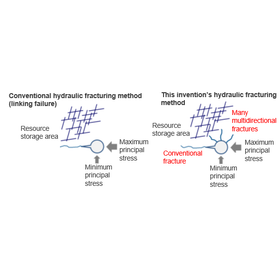
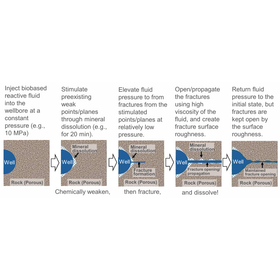
Hydraulic fracturing method is widely used in underground resource development to create fractures in the rock by injecting high pressure fluid into a borehole. The direction of fractures created by hydraulic fracturing method is limited to the direction of the maximum principal stress of the formation, so it may not create fractures in the desired resource storage area direction. In this case, several boreholes need to be drilled, but drilling requires high cost. The underground resource storage area is nonuniformly distributed, and the possibility of connecting to the resource storage area by hydraulic fracturing method is not necessarily high. One of the conventional hydraulic fracturing method is to use a low viscosity fluid to create reticulated microfractures. However, its permeability is significantly small. This invention is about a hydraulic fracturing method that creates several fractures in the rock, and it is able to create fractures in directions other than the direction of the maximum principal stress of the rock. This invention can considerably improve the probability of creating fractures which reach the resource storage area. In addition, in carbon dioxide capture and storage (CCS), it is expected to increase the amount of carbon dioxide stored.
Inquire About This Product
basic information
For details, please contact us or refer to the PDF.
Price range
Delivery Time
Applications/Examples of results
For details, please contact us or refer to the PDF.
catalog(1)
Download All Catalogs
Company information
The revenue generated from technology transfer is reinvested as new research funding for universities and researchers, and is utilized to create further research outcomes. To ensure the smooth operation of this cycle, known as the "Intellectual Creation Cycle," we will vigorously promote technology transfer. The types of seeds we handle include patents, know-how, databases, and programs. We have established a collaborative framework by signing basic technology transfer agreements with the following universities (as of June 1, 2025): Tohoku University, Hirosaki University, Iwate University, Akita University, Fukushima University, Yamagata University, Tohoku Gakuin University, Iwate Medical University, Fukushima Medical University, Aizu University, Miyagi University, Hokkaido University, Muroran Institute of Technology, and Showa Medical University.


![Amenities Meter: Creating a Comfortable Working Space with IoT [Work Style Reform]](https://image.mono.ipros.com/public/product/image/6fb/2001027009/IPROS12754886358639934309.png?w=280&h=280)