Tohoku University Technology: Non destructive inspection by magnetic hammer testing with TMR sensor: T22-348

High accurate detection of defect and thinning in structure containing magnetic material. No magnetization required, room temperature operation, low cost, compact size.
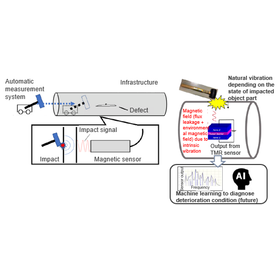
For non destructive inspection of defect such as inner surface of piping, etc., conventional percussion method has the disadvantage of being week to noise and having low spatial resolution (difficult to determine exact location). The magnetic leakage flux testing method being also a conventional method, overcomes the previous disadvantage, but it is not suitable for underground piping due to its difficulty to detect small defect, cost & time required to magnetize inspection object, and the large unit size that incorporates a permanent magnet. The percussion testing method proposed in this invention uses a TMR sensor to measure and analyze the natural frequency of a structure made of magnetic material from micro vibration to diagnose deterioration. The advantage of this method is "high spatial resolution and noise immunity because the magnetic field is measured at a short distance (2-3 cm) instead of acquiring sound wave at a long distance“, "suitable for underground piping because it targets demagnetized magnetic material" and "low sensor and calculation cost". In addition, facility that is constantly undergoing micro vibration may be able to perform the magnetic hammer testing without applying an external force.
Inquire About This Product
basic information
For details, please contact us or refer to the PDF.
Price range
Delivery Time
Applications/Examples of results
For details, please contact us or refer to the PDF.
catalog(1)
Download All Catalogs
Company information
The revenue generated from technology transfer is reinvested as new research funding for universities and researchers, and is utilized to create further research outcomes. To ensure the smooth operation of this cycle, known as the "Intellectual Creation Cycle," we will vigorously promote technology transfer. The types of seeds we handle include patents, know-how, databases, and programs. We have established a collaborative framework by signing basic technology transfer agreements with the following universities (as of June 1, 2025): Tohoku University, Hirosaki University, Iwate University, Akita University, Fukushima University, Yamagata University, Tohoku Gakuin University, Iwate Medical University, Fukushima Medical University, Aizu University, Miyagi University, Hokkaido University, Muroran Institute of Technology, and Showa Medical University.


![[Test] Turbine Oil Oxidation Stability: TOST](https://image.mono.ipros.com/public/product/image/718/2001237514/IPROS72284098545482934938.jpeg?w=280&h=280)