Tohoku Univ. Technology : Analysis of Nano-Microscale Transport Phenomena : S13-012

Large-Scale numerical simulations for development of fuel cells, secondary batteries, semiconductor film formation, etc.
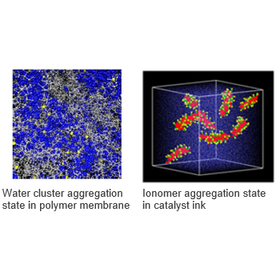
【Fuel cell】 In order to construct a fuel cell system with high efficiency, high durability and low cost, it is necessary to clarify the transport phenomena of proton, oxygen, and water in the cell. By analyzing nano and micro scale flow phenomena and clarifying the correlation between the structural characteristics and the transport mechanism of each component, PEFC performance is expected to be improved. 【Secondary battery】 Due to increasing energy demand and environmental problems, secondary batteries that can be charged and discharged without emitting CO2 or nitrogen oxides are attracting attention. We have a track record of analyzing nano and micro scale flow phenomena such as ion flow in the electrolyte inside liquid and all-solid-state lithium-ion batteries. 【Semiconductor】 For advanced semiconductor devices, controls on the atomic layer level with a thickness error of ±0.5 Å on the wafer is required for the deposition process. In the past, it was necessary to optimize a large amount of experimental data in order to form a precise thin film. At Tokumasu Laboratory, we will elucidate the mechanism through numerical simulation and search for the optimum deposition mechanism.
Inquire About This Product
basic information
For details, please contact us or refer to the PDF.
Price range
Delivery Time
Applications/Examples of results
For details, please contact us or refer to the PDF.
catalog(1)
Download All Catalogs
Company information

The revenue generated from technology transfer is reinvested into universities and researchers as new research funding, which is used to create further research outcomes. To ensure the smooth operation of this cycle, known as the "Intellectual Creation Cycle," we will actively promote technology transfer. The types of seeds we handle include patents, know-how, databases, and programs. We have established a collaborative framework by concluding basic technology transfer agreements with the following universities (as of April 1, 2026): - Tohoku University - Hirosaki University - Iwate University - Akita University - Fukushima University - Yamagata University - Tohoku Gakuin University - Iwate Medical University - Fukushima Medical University - Aizu University - Miyagi University - Hokkaido University - Muroran Institute of Technology - Showa Medical University - Asahikawa Medical University



![[Market Report] Fuel Cell UAV Market](https://image.mono.ipros.com/public/product/image/5ee/2001182225/IPROS18197658211147352083.jpeg?w=280&h=280)
![[Research Material] The Global Market for Electric Vehicle Fuel Cells](https://image.mono.ipros.com/public/product/image/980/2001470700/IPROS04167468378953030475.jpeg?w=280&h=280)