Tohoku University Technology: Variable stiffness connecting body: T20-029
Able to change its own shape and maintain high rigidity with small force
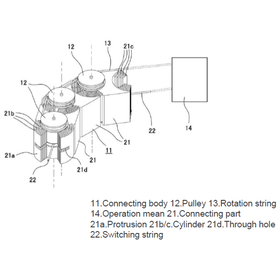
The mechanism that switches between a flexible state, which can be easily deformed when applying external force, and a high stiff state, which can transmit force to the outside when contact is made, has been studied in the past. A gripper that grasps an object using this mechanism has also been proposed. There are a wide variety of grippers, some consisting of a plurality of connecting parts arranged in a row connected to each other with a rotation flexibility, and others consisting of beads arranged in a row through a wire. However, increasing its length results to the loss of friction force, so it is not possible to achieve a high stiff state and to change the shape by itself. This invention overcomes these issues, and provides a variable stiffness connecting body that can change its own shape and maintain a high stiff state with a relatively small force. This invention has pulleys on multiple connecting parts that are connected in a row. Each pulley has a string for rotation and is configured to allow switching between fixed and rotational states of the connecting parts. This invention can reduce the force required to keep the connecting body in a fixed and high stiff state, thus allowing to keep grasping the object with a relatively small force.
Inquire About This Product
basic information
For details, please contact us or refer to the PDF.
Price range
Delivery Time
Applications/Examples of results
For details, please contact us or refer to the PDF.
catalog(1)
Download All Catalogs
Company information
The revenue generated from technology transfer is reinvested as new research funding for universities and researchers, and is utilized to create further research outcomes. To ensure the smooth operation of this cycle, known as the "Intellectual Creation Cycle," we will vigorously promote technology transfer. The types of seeds we handle include patents, know-how, databases, and programs. We have established a collaborative framework by signing basic technology transfer agreements with the following universities (as of June 1, 2025): Tohoku University, Hirosaki University, Iwate University, Akita University, Fukushima University, Yamagata University, Tohoku Gakuin University, Iwate Medical University, Fukushima Medical University, Aizu University, Miyagi University, Hokkaido University, Muroran Institute of Technology, and Showa Medical University.


![Amenities Meter: Creating a Comfortable Working Space with IoT [Work Style Reform]](https://image.mono.ipros.com/public/product/image/6fb/2001027009/IPROS12754886358639934309.png?w=280&h=280)