Tohoku Univ. Technology : Permanent use type Thallium bromide radiation detector : T07-141

Both PET and conventional radiation detectors can prevent polarization and can be used for a long time
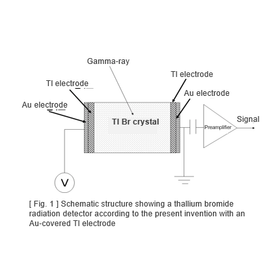
The present invention relates to a thallium halide radiation detector such as thallium bromide (TlBr) used in a positron tomography imaging diagnostic apparatus (PET), a single-photon radiation computed tomography apparatus (SPECT), and the like, and to PET or SPECT equipped therewith. On the background of PET, a radiation detector using a CdTe crystal is used for a high-performance type detector, but it has a problem that it is a covalent crystal, has a high melting point, and is expensive to fabricate. For example, the price of only a crystal per device is expensive at several hundred million yen. Therefore, thallium halide such as TlBr, which is inexpensive, has attracted attention as an alternative material to CdTe. According to the present invention, since conduction ions in thallium halide crystals such as TlBr do not cause polarization phenomena in the detector, an inexpensive thallium halide radiation detector with a long lifetime can be obtained. In addition, the present invention is applicable to general radiation detectors, not limited to PET.
Inquire About This Product
basic information
For details, please contact us or refer to the PDF.
Price range
Delivery Time
Applications/Examples of results
For details, please contact us or refer to the PDF.
catalog(1)
Download All Catalogs
Company information

The revenue generated from technology transfer is reinvested as new research funding for universities and researchers, and is utilized to create further research outcomes. To ensure the smooth operation of this cycle, known as the "Intellectual Creation Cycle," we will vigorously promote technology transfer. The types of seeds we handle include patents, know-how, databases, and programs. We have established a collaborative framework by signing basic technology transfer agreements with the following universities (as of June 1, 2025): Tohoku University, Hirosaki University, Iwate University, Akita University, Fukushima University, Yamagata University, Tohoku Gakuin University, Iwate Medical University, Fukushima Medical University, Aizu University, Miyagi University, Hokkaido University, Muroran Institute of Technology, and Showa Medical University.
![[Applicable Example] NaI(Tl) Radiation Detector for Process Water](https://image.mono.ipros.com/public/product/image/2076701/IPROS15902933724122950975.png?w=280&h=280)