Tohoku Univ. Technology : Recycling of Lithium-ion Battery Cathode Materials through Hydrothermal Reaction : T18-116

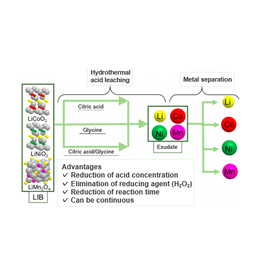
Expected to reduce environmental load, avoid corrosion of equipment, and shorten reaction time
As a method for recovering valuable metals from spent LIB cathode materials, a wet scouring method is mainly used in which various metals are separated using a back extraction method using an organic solvent after leaching metal components using an acid. However, sulfuric acid and nitric acid, which are used as acids, cause a large environmental load because toxic gases are generated, and hydrogen peroxide, which is used as a reducing agent, has problems such as explosiveness and carcinogenicity. In a system without adding hydrogen peroxide, the recovery rate of metal ions decreases, so that improvement of the process is required. In order to solve the above problems, the inventors focused on a hydrothermal reaction and examined reaction conditions such as the type of acid. As a result, they succeeded in almost completely leaching metals without using strong acids and reducing agents by using organic acids such as citric acid and the amino acid glycine. The effects of continuous operation, shortening of reaction time, and avoiding corrosion of equipment can be expected by the present invention.
Inquire About This Product
basic information
For details, please contact us or refer to the PDF.
Price range
Delivery Time
Applications/Examples of results
For details, please contact us or refer to the PDF.
catalog(1)
Download All Catalogs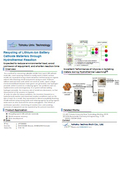
Company information
The revenue generated from technology transfer is reinvested into universities and researchers as new research funding, which is used to create further research outcomes. To ensure the smooth operation of this cycle, known as the "Intellectual Creation Cycle," we will actively promote technology transfer. The types of seeds we handle include patents, know-how, databases, and programs. We have established a collaborative framework by concluding basic technology transfer agreements with the following universities (as of April 1, 2026): - Tohoku University - Hirosaki University - Iwate University - Akita University - Fukushima University - Yamagata University - Tohoku Gakuin University - Iwate Medical University - Fukushima Medical University - Aizu University - Miyagi University - Hokkaido University - Muroran Institute of Technology - Showa Medical University - Asahikawa Medical University


![[English Market Research Report] Global Market for Sulfur Recovery Technology](https://image.mono.ipros.com/public/product/image/1fb/2001102251/IPROS2772509309456043162.png?w=280&h=280)