High efficiency heat exchange under solid-phase formation systems such as latent heat storage materials and hot spring water
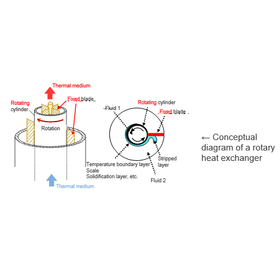
The rotary heat exchanger has a structure in which a fixed blade is in sliding contact with a rotary cylinder. Therefore, the temperature boundary layer (boundary film) of the heat transfer surface on the rotary cylinder is removed, and the fluid inside and outside the rotary cylinder can continuously exchange heat with high efficiency. In addition, even in the system where the solidification layer such as the scale is likely to occur (Hot spring water, polluted water, etc.), the solidification layer is always removed, and stable operation can be realized. In the conventional rotary heat exchanger, since only one side in the axial direction of the rotary cylinder is supported, there is a problem that the gap between the rotary cylinder and the fixed blade is likely to occur due to the run-out of the rotary cylinder, and the boundary film and solid phase are likely to remain. In addition, a rotary heat exchanger with both sides support has been devised, but the difficulty is that the rotating mechanism is immersed in the fluid, so it is unsuitable for the system with solid phase formation. In response to the above problems, the inventors have developed a mechanism (* (2)) in which the rotating mechanism on both sides touches only the clean fluid, and have created an invention that contributes to the practical application of the rotary heat exchanger such as a combination (* (1)) with a latent heat storage material.
Inquire About This Product
basic information
For details, please contact us or refer to the PDF.
Price range
Delivery Time
Applications/Examples of results
For details, please contact us or refer to the PDF.
catalog(1)
Download All Catalogs
Company information

The revenue generated from technology transfer is reinvested into universities and researchers as new research funding, which is used to create further research outcomes. To ensure the smooth operation of this cycle, known as the "Intellectual Creation Cycle," we will actively promote technology transfer. The types of seeds we handle include patents, know-how, databases, and programs. We have established a collaborative framework by concluding basic technology transfer agreements with the following universities (as of April 1, 2026): - Tohoku University - Hirosaki University - Iwate University - Akita University - Fukushima University - Yamagata University - Tohoku Gakuin University - Iwate Medical University - Fukushima Medical University - Aizu University - Miyagi University - Hokkaido University - Muroran Institute of Technology - Showa Medical University - Asahikawa Medical University