Tohoku Univ. Technology : Early Detection of Infectious Disease Outbreas : T21-311

Construction of Electrochemical Sensor and System for Detecting Biomarkers in Sewage Associated with Infectious Diseases
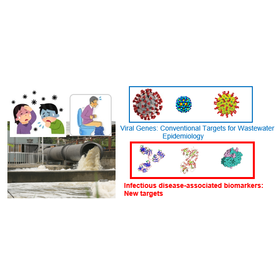
In recent years, for viral infectious diseases that cause significant damage to society, wastewater-based epidemiological methods that use epidemiological information contained in municipal wastewater to detect the occurrence of infectious disease patients and infectious epidemics at an early stage have attracted attention. Currently, wastewater-based epidemiological studies on infectious diseases are mainly performed by detecting viral genes using PCR. However, some problems remain, such as the time required to detect and quantify viral genes from collected wastewater samples, the necessity of sample concentration due to the low virus concentration, and the high cost and labor for analysis. In this study, we aimed to construct a sensor that can detect infectious disease-related biomarkers in wastewater quickly and simply. Biomarkers are emitted from patients with infectious diseases at higher concentrations than the virus itself. In this study, we used antiviral human immunoglobulin (Ig) A as a test substance. We attempted to construct a measurement system in which IgA in a sample is captured by antigen-antibody reaction with proteins immobilized on the electrode surface, and changes in the electrode surface state associated with the reaction are detected by electrochemical measurement.
Inquire About This Product
basic information
For details, please contact us or refer to the PDF.
Price range
Delivery Time
Applications/Examples of results
For details, please contact us or refer to the PDF.
catalog(1)
Download All Catalogs
Company information

The revenue generated from technology transfer is reinvested as new research funding for universities and researchers, and is utilized to create further research outcomes. To ensure the smooth operation of this cycle, known as the "Intellectual Creation Cycle," we will vigorously promote technology transfer. The types of seeds we handle include patents, know-how, databases, and programs. We have established a collaborative framework by signing basic technology transfer agreements with the following universities (as of June 1, 2025): Tohoku University, Hirosaki University, Iwate University, Akita University, Fukushima University, Yamagata University, Tohoku Gakuin University, Iwate Medical University, Fukushima Medical University, Aizu University, Miyagi University, Hokkaido University, Muroran Institute of Technology, and Showa Medical University.
![[Market Report] Global Market for Electrochemical Sensors](https://image.mono.ipros.com/public/product/image/7e2/2000980822/IPROS96769400347525550679.jpeg?w=280&h=280)
![[Market Report] World Market for Chemical Sensors](https://image.mono.ipros.com/public/product/image/319/2000947307/IPROS19718272670027818106.jpeg?w=280&h=280)
![[Research Material] World Market for Biochemical Sensors](https://image.mono.ipros.com/public/product/image/a0b/2001463498/IPROS19988205413312273449.jpeg?w=280&h=280)