Tohoku Univ. Technology : Distributed micro roughness (DMR) for reducing friction drag: T22-118
Improving fuel consumption in transportation (Automobiles, aircraft, bullet trains, linear trains, drones, etc...)
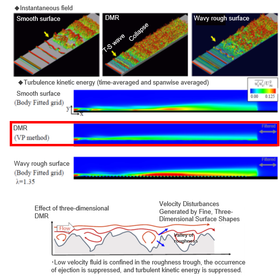
In order to improve the fuel efficiency of aircraft and automobiles, it is effective to reduce the air drag, especially the friction drag, on the surface of airframes and bodies. Riblet is known as a conventional technique for reducing friction drag, but when the direction of stream line deviates from the riblet direction by more than a predetermined angle, the friction drag increases. On the other hand, there are few research examples of sandy rough surfaces (i.e. distributed micro roughness (DMR)) for reducing friction drag. In addition, there are many simulations focusing on turbulent flow (with high friction drag) over a rough surface, but there are few simulations focusing on the transition from laminar flow to turbulent flow. The present invention focused on the transition from laminar flow to turbulent flow, and it was clarified that the DMR can delay the transition by suppressing turbulence energy growth and reduce friction drag. Therefore, it is expected that the DMR of the present invention can be applied to the surface of transportation, thereby reducing friction drag and improving fuel consumption. The device may propose a new standard for product surface finishes.
Inquire About This Product
basic information
For details, please contact us or refer to the PDF.
Price range
Delivery Time
Applications/Examples of results
For details, please contact us or refer to the PDF.
catalog(1)
Download All Catalogs
Company information
The revenue generated from technology transfer is reinvested as new research funding for universities and researchers, and is utilized to create further research outcomes. To ensure the smooth operation of this cycle, known as the "Intellectual Creation Cycle," we will vigorously promote technology transfer. The types of seeds we handle include patents, know-how, databases, and programs. We have established a collaborative framework by signing basic technology transfer agreements with the following universities (as of June 1, 2025): Tohoku University, Hirosaki University, Iwate University, Akita University, Fukushima University, Yamagata University, Tohoku Gakuin University, Iwate Medical University, Fukushima Medical University, Aizu University, Miyagi University, Hokkaido University, Muroran Institute of Technology, and Showa Medical University.
![[Production Example] FRP Pultruded Products Structures *Corrosion elimination and reduction of construction man-hours!](https://image.mono.ipros.com/public/product/image/886/2001440114/IPROS68363117497163082901.png?w=280&h=280)


![Glass sliding door component [Aluminum 5mm surface-mounted upper and lower rail] <Aluminum>](https://image.mono.ipros.com/public/product/image/434/2001317368/IPROS1317760082828935831.png?w=280&h=280)


![Amenities Meter: Creating a Comfortable Working Space with IoT [Work Style Reform]](https://image.mono.ipros.com/public/product/image/6fb/2001027009/IPROS12754886358639934309.png?w=280&h=280)