Tohoku University Technology: PNon-volatile memory materials that occur phase change between their crystal phases: T17-124_T19-041_T20-3114

Realization of phase-change memory with high speed, thermal stability and low energy operation
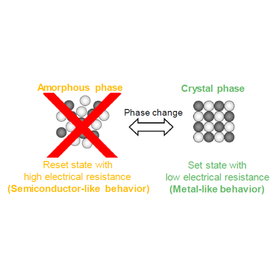
In recent years, the data traffic on internet around the world has been increasing rapidly and there is a strong need to innovate the non-volatile memory for data storage. In particular, phase-change memory (PRAM) has been attracting attention since the practical use in storage class memory has already begun. In general, PRAM records ON/OFF at 2 states: crystal phase with low electrical resistance and amorphous phase with high electrical resistance. However, the operation requires the use of amorphous phase so the heat resistance is poor and generates high power consumption during melting to the amorphous phase. Actually, there is a high expectation for creating a non-volatile memory element which solve these issues. The most important feature of this invention is that the non-volatile memory material is in crystal phase for both ON/OFF status. Since this material does not require melting to the amorphous phase, it is thermally stable and has low power consumption. Therefore, a significant operating energy reduction can be realized. Moreover, it has excellent high-speed property because a large resistance variation can be obtained through phase change between the crystal phases. Tohoku University proposes 3 types of non-volatile memory material : 1 MnTe, 2 Nitride-based material, 3 Rare-earth material.
Inquire About This Product
basic information
For details, please contact us or refer to the PDF.
Price range
Delivery Time
Applications/Examples of results
For details, please contact us or refer to the PDF.
catalog(1)
Download All Catalogs
Company information
The revenue generated from technology transfer is reinvested as new research funding for universities and researchers, and is utilized to create further research outcomes. To ensure the smooth operation of this cycle, known as the "Intellectual Creation Cycle," we will vigorously promote technology transfer. The types of seeds we handle include patents, know-how, databases, and programs. We have established a collaborative framework by signing basic technology transfer agreements with the following universities (as of June 1, 2025): Tohoku University, Hirosaki University, Iwate University, Akita University, Fukushima University, Yamagata University, Tohoku Gakuin University, Iwate Medical University, Fukushima Medical University, Aizu University, Miyagi University, Hokkaido University, Muroran Institute of Technology, and Showa Medical University.


![Amenities Meter: Creating a Comfortable Working Space with IoT [Work Style Reform]](https://image.mono.ipros.com/public/product/image/6fb/2001027009/IPROS12754886358639934309.png?w=280&h=280)