Tohoku Univ. Technology : Investigation method of breast disease : T11-183

Cyclophilin A levels can be used to determine the likelihood of developing breast disease
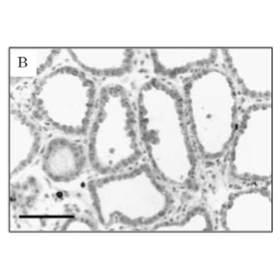
Mastitis in dairy cattle is considered to be one of the most intractable diseases in livestock, and it is known that it leads to a decrease in milk production and an increase in treatment costs, resulting in a large economic loss. In order to reduce the economic loss, early detection of mastitis is essential. However, the PL test, which is an existing mastitis detection method, does not lead to early detection because mastitis already showing degeneration is used as a sample. Therefore, a Chemical Luminescence measurement method is regarded as promising. However, a special apparatus is required to measure the Chemical Luminescence ability, and from the viewpoint of economy and difficulty, it is not suitable as a routine method for each dairy farmer. The present invention makes it possible to provide a method and a biomarker that contribute to the early detection of mastitis in a simple and rapid manner. The present invention is characterized by comprising a step of detecting cyclophilin A in milk collected from the udder of a subject and a step of determining the occurrence or possibility of occurrence of a mammary gland disease based on the amount of cyclophilin A. When the amount of cyclophilin A in milk is larger than that collected from a healthy udder, it is determined that a mammary gland disease has occurred or is likely to occur in the udder of the subject.
Inquire About This Product
basic information
For details, please contact us or refer to the PDF.
Price range
Delivery Time
Applications/Examples of results
For details, please contact us or refer to the PDF.
catalog(1)
Download All Catalogs
Company information

The revenue generated from technology transfer is reinvested as new research funding for universities and researchers, and is utilized to create further research outcomes. To ensure the smooth operation of this cycle, known as the "Intellectual Creation Cycle," we will vigorously promote technology transfer. The types of seeds we handle include patents, know-how, databases, and programs. We have established a collaborative framework by signing basic technology transfer agreements with the following universities (as of June 1, 2025): Tohoku University, Hirosaki University, Iwate University, Akita University, Fukushima University, Yamagata University, Tohoku Gakuin University, Iwate Medical University, Fukushima Medical University, Aizu University, Miyagi University, Hokkaido University, Muroran Institute of Technology, and Showa Medical University.




![[Research Material] Global Market for Molecular Influenza Testing](https://image.mono.ipros.com/public/product/image/9fa/2001476465/IPROS68446414210294471342.jpeg?w=280&h=280)